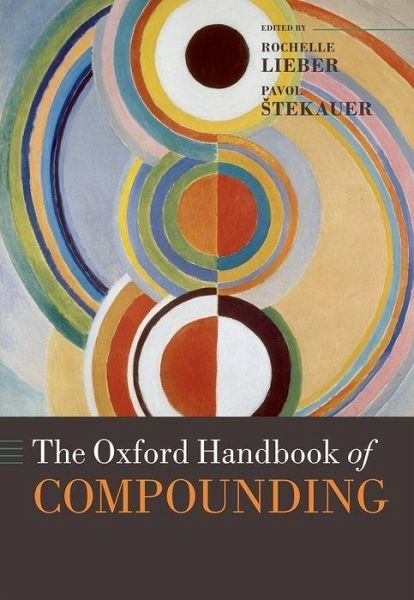
This book presents a comprehensive review of theoretical work on the linguistics and psycholinguistics of compound words and combines it with a series of surveys of compounding in a variety of languages from a wide range of language families. Compounding is an effective way to create and express new meanings. Compound words are segmentable into their constituents so that new items can often be understood on first presentation. However, as keystone, keynote, and keyboard, and breadboard, sandwich-board, and mortarboard show, the relation between components is often far from straightforward. The…mehr
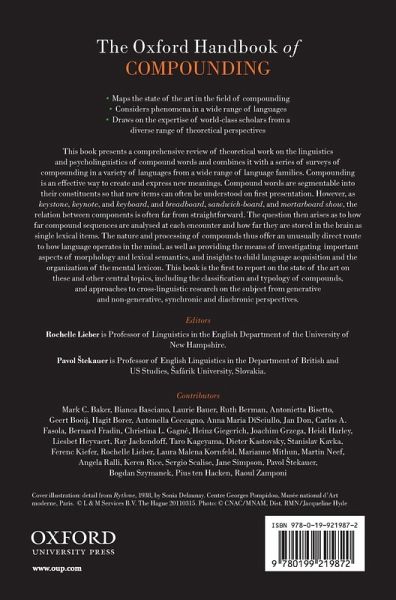
This book presents a comprehensive review of theoretical work on the linguistics and psycholinguistics of compound words and combines it with a series of surveys of compounding in a variety of languages from a wide range of language families. Compounding is an effective way to create and express new meanings. Compound words are segmentable into their constituents so that new items can often be understood on first presentation. However, as keystone, keynote, and keyboard, and breadboard, sandwich-board, and mortarboard show, the relation between components is often far from straightforward. The question then arises as to how far compound sequences are analysed at each encounter and how far they are stored in the brain as single lexical items. The nature and processing of compounds thus offer an unusually direct route to how language operates in the mind, as well as providing the means of investigating important aspects of morphology, and lexical semantics, and insights to child language acquisition and the organization of the mental lexicon. This book is the first to report on the state of the art on these and other central topics, including the classification and typology of compounds, and approaches to cross-linguistic research on the subject from generative and non-generative, synchronic and diachronic perspectives.
Rochelle Lieber is Professor of Linguistics in the English Department of the University of New Hampshire. She is the author of On the Organization of the Lexicon (1981), An Integrated Theory of Autosegmental Processes (1987), Deconstructing Morphology (1992), and Morphology and Lexical Semantics (2004). She is co-Editor in Chief of Blackwell's Language and Linguistics Compass. Pavol Stekauer is Professor of English linguistics in the Department of British and US Studies, Safárik University, Kosice, Slovakia. He is the author of A Theory of Conversion in English (Frankfurt am Main: Peter Lang, 1996), An Onomasiological Theory of English Word-Formation (1998), and English Word-Formation: A History of Research (2000), and Meaning Predictability in Word-Formation (2005) Professor Lieber and Professor Stekauer are joint editors of A Handbook of Word-Formation (2005).
Inhaltsangabe
* Part I: * 1: Rochelle Lieber and Pavol Stekauer: Introduction: Status and Definition of Compounding * 2: Stanislav Kavka: Compounding and Idiomatology * 3: Antonietta Bisetto and Sergio Scalise: The Classification of Compounds * 4: Pius ten Hacken: Early Generative Approaches * 5: Rochelle Lieber: A Lexical Semantic Approach to Compounding * 6: Ray Jackendoff: Compounding in the Parallel Architecture and Conceptual Semantics * 7: Heidi Harley: Compounding in Distributed Morphology * 8: Anna Maria Di Scuillo: Why are Compounds a Part of Human Language? A View from Asymmetry Theory * 9: Heinz Giegerich: Compounding and Lexicalism * 10: Geert Booij: Compounding and Construction Morphology * 11: Joachim Grzega: Compounding from an Onomasiological Perspective * 12: Liesbet Heyvaert: Compounding in Cognitive Linguistics * 13: Christina L. Gagné: Psycholinguistic Perspectives * 14: Pavol Stekauer: Meaning Predictability of Novel Context-free Compounds * 15: Ruth Berman: Children's Acquisition of Compound Constructions * 16: Dieter Kastovsky: Diachronic Perspectives * Part II * 17: Laurie Bauer: Typology of Compounds * 18: Rochelle Lieber: IE, Germanic: English * 19: Jan Don: IE, Germanic: Dutch * 20: Martin Neef: IE, Germanic: German * 21: Laurie Bauer: . IE, Germanic: Danish * 22: Bernard Fradin: IE, Romance: French * 23: Laura Malena Kornfeld: IE, Romance: Spanish * 24: Angela Ralli: IE, Hellenic: Modern Greek * 25: Bogdan Szymanek: IE, Slavonic: Polish * 26: Antonella Ceccagno and Bianca Basciano: Sino-Tibetan: Mandarin Chinese * 27: Hagit Borer: Afro-Asiatic, Semitic: Hebrew * 28: Taro Kageyama: Isolate: Japanese * 29: Ferenc Kiefer: Uralic, Finno-Ugric: Hungarian * 30: Keren Rice: Athapaskan: Slave * 31: Marianne Mithun: Iroquoian: Mohawk * 32: Raoul Zamponi: Arawakan: Maipure-Yavitero * 33: Mark C. Baker and Carlos A. Fasola: Araucanian: Mapudungun * 34: Jane Simpson: Pama-Nyungan: Warlpiri * References * Index
* Part I: * 1: Rochelle Lieber and Pavol Stekauer: Introduction: Status and Definition of Compounding * 2: Stanislav Kavka: Compounding and Idiomatology * 3: Antonietta Bisetto and Sergio Scalise: The Classification of Compounds * 4: Pius ten Hacken: Early Generative Approaches * 5: Rochelle Lieber: A Lexical Semantic Approach to Compounding * 6: Ray Jackendoff: Compounding in the Parallel Architecture and Conceptual Semantics * 7: Heidi Harley: Compounding in Distributed Morphology * 8: Anna Maria Di Scuillo: Why are Compounds a Part of Human Language? A View from Asymmetry Theory * 9: Heinz Giegerich: Compounding and Lexicalism * 10: Geert Booij: Compounding and Construction Morphology * 11: Joachim Grzega: Compounding from an Onomasiological Perspective * 12: Liesbet Heyvaert: Compounding in Cognitive Linguistics * 13: Christina L. Gagné: Psycholinguistic Perspectives * 14: Pavol Stekauer: Meaning Predictability of Novel Context-free Compounds * 15: Ruth Berman: Children's Acquisition of Compound Constructions * 16: Dieter Kastovsky: Diachronic Perspectives * Part II * 17: Laurie Bauer: Typology of Compounds * 18: Rochelle Lieber: IE, Germanic: English * 19: Jan Don: IE, Germanic: Dutch * 20: Martin Neef: IE, Germanic: German * 21: Laurie Bauer: . IE, Germanic: Danish * 22: Bernard Fradin: IE, Romance: French * 23: Laura Malena Kornfeld: IE, Romance: Spanish * 24: Angela Ralli: IE, Hellenic: Modern Greek * 25: Bogdan Szymanek: IE, Slavonic: Polish * 26: Antonella Ceccagno and Bianca Basciano: Sino-Tibetan: Mandarin Chinese * 27: Hagit Borer: Afro-Asiatic, Semitic: Hebrew * 28: Taro Kageyama: Isolate: Japanese * 29: Ferenc Kiefer: Uralic, Finno-Ugric: Hungarian * 30: Keren Rice: Athapaskan: Slave * 31: Marianne Mithun: Iroquoian: Mohawk * 32: Raoul Zamponi: Arawakan: Maipure-Yavitero * 33: Mark C. Baker and Carlos A. Fasola: Araucanian: Mapudungun * 34: Jane Simpson: Pama-Nyungan: Warlpiri * References * Index
Es gelten unsere Allgemeinen Geschäftsbedingungen: www.buecher.de/agb
Impressum
www.buecher.de ist ein Internetauftritt der buecher.de internetstores GmbH
Geschäftsführung: Monica Sawhney | Roland Kölbl | Günter Hilger
Sitz der Gesellschaft: Batheyer Straße 115 - 117, 58099 Hagen
Postanschrift: Bürgermeister-Wegele-Str. 12, 86167 Augsburg
Amtsgericht Hagen HRB 13257
Steuernummer: 321/5800/1497
USt-IdNr: DE450055826