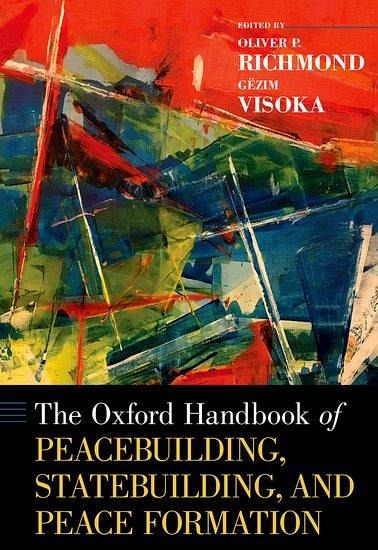
In addition to being a major area of research within International Relations, peacebuilding and statebuilding is a major policy area within the UN and other international and regional organizations. It is also a concern of international financial institutions, including the World Bank, and a significant factor in the foreign and security policies of many established and emerging democracies. Peacebuilding and statebuilding are among the main approaches for preventing, managing, and mitigating global insecurities; dealing with the humanitarian consequences of civil wars; and expanding democracy…mehr
In addition to being a major area of research within International Relations, peacebuilding and statebuilding is a major policy area within the UN and other international and regional organizations. It is also a concern of international financial institutions, including the World Bank, and a significant factor in the foreign and security policies of many established and emerging democracies. Peacebuilding and statebuilding are among the main approaches for preventing, managing, and mitigating global insecurities; dealing with the humanitarian consequences of civil wars; and expanding democracy and neoliberal economic regimes. Peace formation is a relatively new concept, addressing how local actors work in parallel to international and national projects, and helps shape the legitimacy of peace processes and state reform. The Oxford Handbook of Peacebuilding, Statebuilding, and Peace Formation serves as an essential guide to this vast intellectual and policy landscape. It offers a systematic overview of conceptual foundations, political implications, and tensions at the global, regional, and local levels, as well as key policies, practices, examples, and discourses underlining all segments of peacebuilding and statebuilding praxis. Approaching peacebuilding from disciplinary perspectives across the social sciences, the Handbook is organized around four major thematic sections. Section one explores how peacebuilding, statebuilding, and peace formation is conceived by different disciplines and IR approaches, thus offering an overview of the conceptual bedrock of major theories and approaches. Section two situates these approaches among other major global issues, including globalization, civil society, terrorism, and technology to illustrate their global, regional, and local resonance. Section three looks at key themes in the field, including peace agreements, democratization, security reform, human rights, environment, and culture. Finally, section four looks at key features of everyday and civil society peace formation processes, both in theory and in practice.
Oliver P. Richmond is a Research Professor in International Relations, Peace and Conflict Studies in the Department of Politics at the University of Manchester, UK. He is International Research Professor at Dublin City University, Ireland; Distinguished Visiting Professor at the University of Tubingen, Germany; and a Visiting Professor at the University of Coimbra, Portugal. His publications include Grand Design: The Evolution of the International Peace Architecture, Peace Formation and Political Order in Conflict Affected Societies, and Failed Statebuilding. He is editor of the Palgrave book series Rethinking Peace and Conflict Studies and co-editor of the journal Peacebuilding. Gëzim Visoka is Associate Professor of Peace and Conflict Studies in the School of Law and Government at Dublin City University. His research focuses on post-conflict peacebuilding and statebuilding, transitional justice, global governance, foreign policy, and diplomatic recognition. He is the co-author of Normalization in World Politics (with Nicolas Lemay-Hébert), and lead co-editor of the Routledge Handbook of State Recognition (with John Doyle and Edward Newman). He is editor of Routledge Studies in Statehood and deputy editor of the journal Peacebuilding.
Inhaltsangabe
1. Introduction: International, State, and Local Dynamics of Peace in the Twenty-First Century OLIVER P. RICHMOND AND GËZIM VISOKA PART I: DISCIPLINARY PERSPECTIVES 2. Liberal Internationalism BEATE JAHN 3. The Ethics of Liberal Peacebuilding KRISTOFFER LIDÉN 4. The International Law of Peace CECILIA MARCELA BAILLIET 5. The Social Construction of Peace JOANNE WALLIS 6. Critical Theory and the Politics of Peace VIVIENNE JABRI and OLIVER P. RICHMOND 7. Pacifism in International Relations RICHARD JACKSON 8. The International Political Sociology of Peacebuilding CATHERINE GOETZE AND BERIT BLIESEMANN DE GUEVARA 9. Spaces of Peace ANNIKA BJÖRKDAHL AND STEFANIE KAPPLER 10. Peace Methods and Methodologies PAMINA FIRCHOW 11. Ethnographic Peace Research GEAROID MILLAR 12. Visuality of Peace and Conflict EMMA HUTCHISON AND ROLAND BLEIKER 13. Peace in Non-Western Theory NECATI POLAT 14. Gender, Security, and Peacebuilding SARAH SMITH 15. Peace Psychology DANIEL J. CHRISTIE PART II: PEACEBUILDING AND STATEBUILDING IN GLOBAL POLITICS 16. International interventions AIDAN HEHIR 17. Peacekeeping MICHAEL PUGH 18. Protection of Civilians WALT KILROY 19. The United Nations and the Responsibility to Rebuild ALEX J. BELLAMY 20. The European Union and Peacebuilding NATHALIE TOCCI 21. Emerging Powers and Peacebuilding KAI MICHAEL KENKEL 22. Globalisation of Peace JACKIE SMITH 23. Global Civil Society, Peacebuilding, and Statebuilding MARY KALDOR AND DENISA KOSTOVICOVA 24. Networks of Peace NAJI BSISU AND AMANDA MURDIE 25. Peace, Intervention, and State Fragility NICOLAS LEMAY-HÉBERT 26. Terrorism and Peacebuilding IOANNIS TELLIDIS 27. Peace After Revolutions SANDRA POGODDA 28. Peace and Security in the Age of Hybrid Wars MARIA RAQUEL FREIRE AND LICINIA SIMÃO 29. Technologies of Peace ALLARD DUURSMA AND JOHN KARLSRUD PART III: DISAGGREGATING PEACEBUILDING AND STATEBUILDING 30. Statebuilding DAVID CHANDLER 31. Democratisation and Peacebuilding CHRISTOPH ZÜRCHER 32. Power-sharing in Divided Societies JOHN DOYLE 33. Statebuilding, Security Sector Reform, and the Rule of Law PAUL JACKSON 34. Transitional Justice and Peacebuilding CATHERINE TURNER 35. Reconciliation and Peacebuilding GRÁINNE KELLY 36. Religion and Peacebuilding JOHN D. BREWER 37. Foreign Aid and Peacebuilding RACHEL M. GISSELQUIST 38. Local Ownership, Legitimacy, and Peacebuilding TIMOTHY DONAIS 39. Environmental Peacebuilding FLORIAN KRAMPE AND ASHOK SWAIN PART IV: POST-LIBERAL PEACE AND PEACE FORMATION 40. Peace Formation and the Reshaping of International Peacebuilding OLIVER P. RICHMOND 41. Local Resistance and Hybrid Peace SUNGYONG LEE 42. Hybrid Political Orders and Customary Peace VOLKER BOEGE 43. Local Infrastructures for Peace ANDRIES ODENDAAL 44. Emancipatory Peace GËZIM VISOKA
Es gelten unsere Allgemeinen Geschäftsbedingungen: www.buecher.de/agb
Impressum
www.buecher.de ist ein Internetauftritt der buecher.de internetstores GmbH
Geschäftsführung: Monica Sawhney | Roland Kölbl | Günter Hilger
Sitz der Gesellschaft: Batheyer Straße 115 - 117, 58099 Hagen
Postanschrift: Bürgermeister-Wegele-Str. 12, 86167 Augsburg
Amtsgericht Hagen HRB 13257
Steuernummer: 321/5800/1497
USt-IdNr: DE450055826