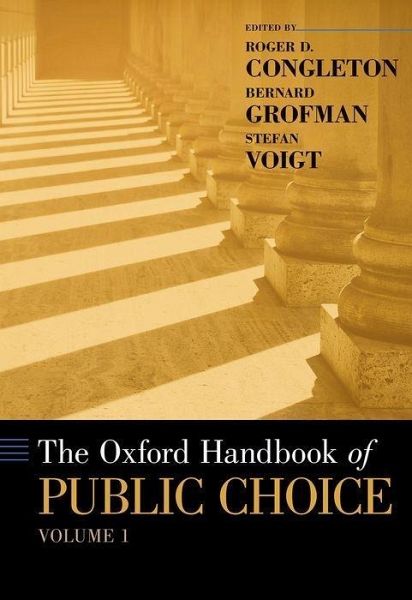
The Oxford Handbook of Public Choice provides a comprehensive overview of the research in economics, political science, law, and sociology that has generated considerable insight into the politics of democratic and authoritarian systems as well as the influence of different institutional frameworks on incentives and outcomes. The result is an improved understanding of public policy, public finance, industrial organization, and macroeconomics as the combination of political and economic analysis shed light on how various interests compete both within a given rules of the games and, at times, to…mehr
The Oxford Handbook of Public Choice provides a comprehensive overview of the research in economics, political science, law, and sociology that has generated considerable insight into the politics of democratic and authoritarian systems as well as the influence of different institutional frameworks on incentives and outcomes. The result is an improved understanding of public policy, public finance, industrial organization, and macroeconomics as the combination of political and economic analysis shed light on how various interests compete both within a given rules of the games and, at times, to change the rules. These volumes include analytical surveys, syntheses, and general overviews of the many subfields of public choice focusing on interesting, important, and at times contentious issues. Throughout the focus is on enhancing understanding how political and economic systems act and interact, and how they might be improved. Both volumes combine methodological analysis with substantive overviews of key topics. This first volume covers voting and elections; interest group competition and rent seeking, including corruption and various normative approaches to evaluating policies and politics. Throughout both volumes important analytical concepts and tools are discussed, including their application to substantive topics. Readers will gain increased understanding of rational choice and its implications for collective action; various explanations of voting, including economic and expressive; the role of taxation and finance in government dynamics; how trust and persuasion influence political outcomes; and how revolution, coups, and authoritarianism can be explained by the same set of analytical tools as enhance understanding of the various forms of democracy.
Roger D. Congleton is the BB&T Professor of Economics at West Virginia University. He is coeditor of the journal, Constitutional Political Economy , and has publishing well over a hundred fifty articles on public choice related topics in journals and academic books. Professor Congleton also served as president of the Public Choice Society from March 2018 through March 2020. Bernard Grofman is the Jack W. Peltason Chair of Democracy Studies and Professor of Political Science, University of California, Irvine Stefan Voigt is professor of Law & Economics at the University of Hamburg in Germany. He is best known for his research in constitutional political economy. Together with Roger Congleton, he is editor of the journal, Constitutional Political Economy
Inhaltsangabe
* PART I: Introductory Essays * 1. Rational Choice and Politics: An Introduction to the Research Program and Methodology of Public Choice * Roger D. Congleton * 2. Choosing among Governments * Alan Hamlin * 3. Public Choice: Early Contributions * Dennis C. Mueller * PART II: VOTING AND ELECTIONS * A. Modelling Collective Choice in Voting * 4. From Paired Comparisons and Cycles to Arrow's Theorem * Donald G. Saari * 5. Institution-induced Stability * Kenneth A. Shepsle * 6. Voting Power * Stefan Napel * 7. Aggregation of Information by Binary Voting Rules * Shmuel Nitzan and Jacob Paroush * B. Spatial Voting Models * 8. Political Choices in One Dimension: Theory * Bernard Grofman * 9. Political Choices in One Dimension: Applications * Bernard Grofman * 10. Spatial Voting Models of Party Competition in Two Dimensions * James F. Adams * 11. Spatial Social Choice * Norman Schofield * C. Other Aspects of Voter and Party Choice * 12. Economic Voting * Michael S. Lewis-Beck and Mary Stegmaier * 13. Valence Politics * Haldun Evrenk * 14. The Study of Strategic Voting * André Blais and Arianna Degan * 15. Turnout: Why do voters vote? * Serguei Kaniovski * 16. Expressive Voting * Alan Hamlin and Colin Jennings * 17. Altruism and Political Participation * Richard Jankowski * 18. Social Embeddedness and Rational Turnout * Carole Jean Uhlaner * 19. Information cues and rational ignorance * Shaun Bowler and Stephen P. Nicholson * 20. Manipulation * Charles R. Plott * D. Democracy in Practice * 21. Campaign Finance * Thomas Stratmann * 22. Primaries, conventions, and other methods for nominating candidates: How do they matter? * Gilles Serra * 23. Logrolling and Coalitions * Anthony J. McGann * PART III: INTEREST GROUP POLITICS AND RENT SEEKING * A. Interest Group Politics * 24. Collective Action * Jac C. Heckelman * 25. Rent seeking: The social cost of contestable benefits * Arye L. Hillman and Ngo Van Long * 26. The Structure of Contests and the Extent of Dissipation * Karl Wärneryd * 27. The Political Economy of Rent Creation and Rent Extraction * Roger D. Congleton * 28. Empirical evidence on rent seeking costs * Ignacio Del Rosal * B. Political Agency Problems and Trust in Government * 29. 'The Bureaucracy' as an Interest Group * Patrick Dunleavy * 30. Interest Groups and Regulatory Capture * William F. Shughart II and Diana W. Thomas * 31. Corruption * Toke Aidt * 32. The Political Economy of Trust * Christian Bjørnskov * C. Persuasion * 33. Contested Political Persuasion * Stergios Skaperdas and Samarth Vaidya * 34. Stochastic Process Models of Preference Change * Michel Regenwetter and Yung-Fong Hsu * 35. Leadership as Persuasion * Benjamin E. Hermalin * PART IV: NORMATIVE POLITICAL THEORY: EVALUATING POLICIES AND POLITIES * 36. Fairness Concepts * Christian Klamler * 37. Social Contract vs. Invisible Hand: Agreeing to Solve Social Dilemmas * Viktor J. Vanberg * 38. Utilitarianism as a Criterion for State Action * Nicolaus Tideman and Florenz Plassmann * 39. Public Choice and Happiness * Bruno Frey and Alois Stutzer * 40. Kantianism and Political Institutions * Geoffrey Brennan and Hartmut Kliemt * 41. Public choice and libertarianism * Peter J. Boettke and Ennio E. Piano * 42. Public choice and social democracy * Peter Kurrild-Klitgaard * 43. Supreme Values, Totalitarianism and Terrorism * Peter Bernholz * 44. Fair Division in Dispute Resolution * Steven J. Brams * 45. Fair Division in Allocating Cabinet Ministries * Steven J. Brams
* PART I: Introductory Essays * 1. Rational Choice and Politics: An Introduction to the Research Program and Methodology of Public Choice * Roger D. Congleton * 2. Choosing among Governments * Alan Hamlin * 3. Public Choice: Early Contributions * Dennis C. Mueller * PART II: VOTING AND ELECTIONS * A. Modelling Collective Choice in Voting * 4. From Paired Comparisons and Cycles to Arrow's Theorem * Donald G. Saari * 5. Institution-induced Stability * Kenneth A. Shepsle * 6. Voting Power * Stefan Napel * 7. Aggregation of Information by Binary Voting Rules * Shmuel Nitzan and Jacob Paroush * B. Spatial Voting Models * 8. Political Choices in One Dimension: Theory * Bernard Grofman * 9. Political Choices in One Dimension: Applications * Bernard Grofman * 10. Spatial Voting Models of Party Competition in Two Dimensions * James F. Adams * 11. Spatial Social Choice * Norman Schofield * C. Other Aspects of Voter and Party Choice * 12. Economic Voting * Michael S. Lewis-Beck and Mary Stegmaier * 13. Valence Politics * Haldun Evrenk * 14. The Study of Strategic Voting * André Blais and Arianna Degan * 15. Turnout: Why do voters vote? * Serguei Kaniovski * 16. Expressive Voting * Alan Hamlin and Colin Jennings * 17. Altruism and Political Participation * Richard Jankowski * 18. Social Embeddedness and Rational Turnout * Carole Jean Uhlaner * 19. Information cues and rational ignorance * Shaun Bowler and Stephen P. Nicholson * 20. Manipulation * Charles R. Plott * D. Democracy in Practice * 21. Campaign Finance * Thomas Stratmann * 22. Primaries, conventions, and other methods for nominating candidates: How do they matter? * Gilles Serra * 23. Logrolling and Coalitions * Anthony J. McGann * PART III: INTEREST GROUP POLITICS AND RENT SEEKING * A. Interest Group Politics * 24. Collective Action * Jac C. Heckelman * 25. Rent seeking: The social cost of contestable benefits * Arye L. Hillman and Ngo Van Long * 26. The Structure of Contests and the Extent of Dissipation * Karl Wärneryd * 27. The Political Economy of Rent Creation and Rent Extraction * Roger D. Congleton * 28. Empirical evidence on rent seeking costs * Ignacio Del Rosal * B. Political Agency Problems and Trust in Government * 29. 'The Bureaucracy' as an Interest Group * Patrick Dunleavy * 30. Interest Groups and Regulatory Capture * William F. Shughart II and Diana W. Thomas * 31. Corruption * Toke Aidt * 32. The Political Economy of Trust * Christian Bjørnskov * C. Persuasion * 33. Contested Political Persuasion * Stergios Skaperdas and Samarth Vaidya * 34. Stochastic Process Models of Preference Change * Michel Regenwetter and Yung-Fong Hsu * 35. Leadership as Persuasion * Benjamin E. Hermalin * PART IV: NORMATIVE POLITICAL THEORY: EVALUATING POLICIES AND POLITIES * 36. Fairness Concepts * Christian Klamler * 37. Social Contract vs. Invisible Hand: Agreeing to Solve Social Dilemmas * Viktor J. Vanberg * 38. Utilitarianism as a Criterion for State Action * Nicolaus Tideman and Florenz Plassmann * 39. Public Choice and Happiness * Bruno Frey and Alois Stutzer * 40. Kantianism and Political Institutions * Geoffrey Brennan and Hartmut Kliemt * 41. Public choice and libertarianism * Peter J. Boettke and Ennio E. Piano * 42. Public choice and social democracy * Peter Kurrild-Klitgaard * 43. Supreme Values, Totalitarianism and Terrorism * Peter Bernholz * 44. Fair Division in Dispute Resolution * Steven J. Brams * 45. Fair Division in Allocating Cabinet Ministries * Steven J. Brams
Es gelten unsere Allgemeinen Geschäftsbedingungen: www.buecher.de/agb
Impressum
www.buecher.de ist ein Internetauftritt der buecher.de internetstores GmbH
Geschäftsführung: Monica Sawhney | Roland Kölbl | Günter Hilger
Sitz der Gesellschaft: Batheyer Straße 115 - 117, 58099 Hagen
Postanschrift: Bürgermeister-Wegele-Str. 12, 86167 Augsburg
Amtsgericht Hagen HRB 13257
Steuernummer: 321/5800/1497
USt-IdNr: DE450055826