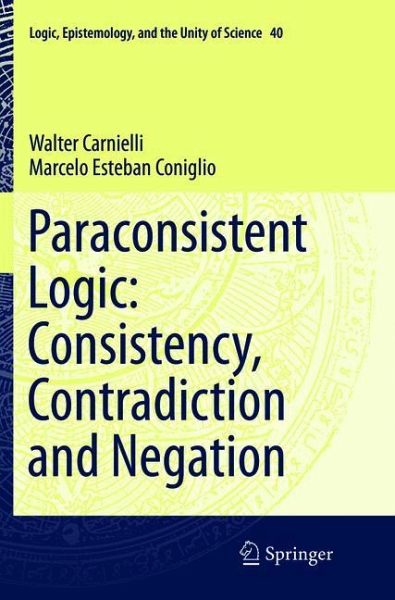
This book is the first in the field of paraconsistency to offer a comprehensive overview of the subject, including connections to other logics and applications in information processing, linguistics, reasoning and argumentation, and philosophy of science. It is recommended reading for anyone interested in the question of reasoning and argumentation in the presence of contradictions, in semantics, in the paradoxes of set theory and in the puzzling properties of negation in logic programming. Paraconsistent logic comprises a major logical theory and offers the broadest possible perspective on…mehr
This book is the first in the field of paraconsistency to offer a comprehensive overview of the subject, including connections to other logics and applications in information processing, linguistics, reasoning and argumentation, and philosophy of science. It is recommended reading for anyone interested in the question of reasoning and argumentation in the presence of contradictions, in semantics, in the paradoxes of set theory and in the puzzling properties of negation in logic programming. Paraconsistent logic comprises a major logical theory and offers the broadest possible perspective on the debate of negation in logic and philosophy. It is a powerful tool for reasoning under contradictoriness as it investigates logic systems in which contradictory information does not lead to arbitrary conclusions. Reasoning under contradictions constitutes one of most important and creative achievements in contemporary logic, with deep roots in philosophical questions involving negation and consistency
This book offers an invaluable introduction to a topic of central importance in logic and philosophy. It discusses (i) the history of paraconsistent logic; (ii) language, negation, contradiction, consistency and inconsistency; (iii) logics of formal inconsistency (LFIs) and the main paraconsistent propositional systems; (iv) many-valued companions, possible-translations semantics and non-deterministic semantics; (v) paraconsistent modal logics; (vi) first-order paraconsistent logics; (vii) applications to information processing, databases and quantum computation; and (viii) applications to deontic paradoxes, connections to Eastern thought and to dialogical reasoning.
Walter Carnielli is Full Professor of Logic, Department of Philosophy, State University of Campinas, Brazil. Ex-Director of the Centre for Logic, Epistemology and the History of Science (1998-2004) and full member of the Security and Quantum Information Group-- Institute of Telecommunications, Lisbon, Portugal. Grantee of the Alexander von Humboldt Foundation, Germany, held temporary positions and research appointments in the USA (University of California, Berkeley), as well as in several institutions in Chile, Colombia, Venezuela, Italy, Germany (Münster and Bonn), France, Spain, Portugal and Luxembourg. Carnielli is known for his contribution to the proof theory and semantics for contemporary heterodox (non-classical) logics. Of special significance are his contributions to many-valued logics, paraconsistent logics and combinations of logics. With his students and collaborators Carnielli introduced the possible-translations semantics, which led to a revival in the semantic interpretation of paraconsistent logics, and the concept of logics of formal inconsistency which systematize a great number of extant paraconsistent logics, opening the way to applications of paraconsistency to computer science and to philosophical investigations around the topic. Carnielli has also worked on finite and infinite combinatorics, and shaped, with collaborators, the modulated logics, a wide class of logics dedicated to formalize quantified uncertain reasoning. He is the author or co-author of more than academic 70 publications (papers, books and monographs). Claudio Pizzi is Full Professor of Philosophy of Science at the Faculty of Letters of the University of Siena (Italy) and contract professor at the University of Milano Bicocca. His main interests are in the field of general modal logic, conditional logic, tense logic and philosophy of causality. In 1973 he translated and edited the Italian version G.E.Hughes and M.J.Cresswell's "An Introduction to ModalLogic". In the past ten years he has been at the head of a research team which organized the international conferences of the series MBR (Model-Based Reasoning). He is author or coauthor of more that 70 publications , some of which published in Topoi, Notre Dame Journal of Formal Logic, Logique et Analyse, Journal of Philosophical Logic, Studia Logica. His main theoretical contributions concern a theory of rational inference based on the consequence relation (consequential implication) and a theory of causal relations based on iterated conditionals.
Inhaltsangabe
Chapter 1. Introduction: Contradictions and (in)consistency.- Chapter 2. A basic logic of formal inconsistency: mbC.- Chapter 3. Some extensions of mbC.- Chapter 4. Matrices and algebraizability.- Chapter 5. LFIs based on other logics.- Chapter 6. Alternative semantics for LFIs.- Chapter 7. First-order LFIs.- Chapter 8. Paraconsistent set theory.- Chapter 9. Paraconsistent modal logic.- Chapter 10. Paraconsistency and philosophy of science: perspectives.
Chapter 1. Introduction: Contradictions and (in)consistency.- Chapter 2. A basic logic of formal inconsistency: mbC.- Chapter 3. Some extensions of mbC.- Chapter 4. Matrices and algebraizability.- Chapter 5. LFIs based on other logics.- Chapter 6. Alternative semantics for LFIs.- Chapter 7. First-order LFIs.- Chapter 8. Paraconsistent set theory.- Chapter 9. Paraconsistent modal logic.- Chapter 10. Paraconsistency and philosophy of science: perspectives.
Rezensionen
"This is a formal book focusing on logics of formal inconsistency (LFI). ... the authors focus on various issues in philosophy of science and do a great job to exhibit the breadth and depth of LFIs. ... the book is very thought-provoking, which is a great advantage of researchers. ... This book is a first step to identify, understand and explore these questions." (Can Baskent, zbMATH 1355.03001, 2017)
Es gelten unsere Allgemeinen Geschäftsbedingungen: www.buecher.de/agb
Impressum
www.buecher.de ist ein Internetauftritt der buecher.de internetstores GmbH
Geschäftsführung: Monica Sawhney | Roland Kölbl | Günter Hilger
Sitz der Gesellschaft: Batheyer Straße 115 - 117, 58099 Hagen
Postanschrift: Bürgermeister-Wegele-Str. 12, 86167 Augsburg
Amtsgericht Hagen HRB 13257
Steuernummer: 321/5800/1497
USt-IdNr: DE450055826