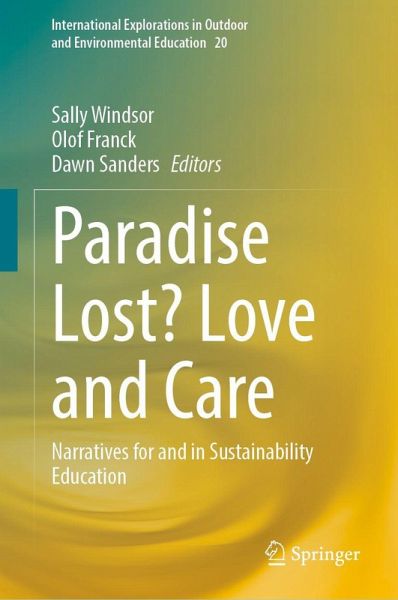
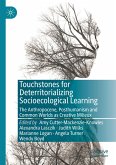
This edited volume examines how traditional and contemporary narratives influence sustainability education through philosophical and ethical perspectives. Emphasizing a multidisciplinary approach, it explores how storytelling and narrative approaches can enrich educational frameworks and foster deeper environmental awareness. Centered on the themes of knowledge, love, and care, the book offers practical insights for integrating these values into teaching practices. Advocating a holistic shift in education, it aims to cultivate environmentally responsible citizens by nurturing not only…mehr
This edited volume examines how traditional and contemporary narratives influence sustainability education through philosophical and ethical perspectives. Emphasizing a multidisciplinary approach, it explores how storytelling and narrative approaches can enrich educational frameworks and foster deeper environmental awareness. Centered on the themes of knowledge, love, and care, the book offers practical insights for integrating these values into teaching practices. Advocating a holistic shift in education, it aims to cultivate environmentally responsible citizens by nurturing not only understanding but also emotional and ethical engagement with the planet.
Chapters 7 and 10 are available open access under a Creative Commons Attribution 4.0 International License via link.springer.com.
Produktdetails
Produktdetails
International Explorations in Outdoor and Environmental Education 20
Sally Windsor is an associate professor at the University of Gothenburg, Sweden, and a researcher in the field of sustainability education, educational praxis, and teacher education. Her teaching work explores how education can contribute to social, cultural, and environmental sustainability. Her research interests include school and university level sustainability education, mentoring, pre-service teacher practicum, and teacher sustainability learning. Across teaching and research, Sally is committed to developing ethically grounded and pedagogically meaningful approaches to teaching and learning for sustainability. Olof Franck is a professor in the Department of Social Studies, Education and Philosophy of Religion at the University of Gothenburg, Sweden. He is presently engaged in research on conceptions of ethical competence in religious education, and teaching on controversial issues in ethics and religious education and writes on issues of ethics, social sustainability, religious education and philosophy more broadly. Dawn Sanders is a professor at the Department of Pedagogical, Curricular and Professional Studies at the University of Gothenburg, Sweden. Her teaching takes interdisciplinary approaches to the complexities of life on Earth. Her research is often focused on questions arising from educational praxis. She has studied both fine art and ecology and brings both disciplines to her academic identity. Dawn has been a gardener since the age of three and is still growing plants.
Inhaltsangabe
Chapter 1. Narratives for a World in Crisis: Reimagining the Role of Narrative in Sustainability Education.- Part I. Philosophical Narratives.- Chapter 2. Sustainable education in the flow of life.- Chapter 3. On Love, Sustainability Education and the Importance of Impossible Ideals.- Chapter 4. The Aristotelian notion of phronesis as a platform for exploring the epistemic context of education for sustainable development.- Chapter 5. Community in sustainability education: Ambiguity, autoimmunity and exclusionary inclusion.- Chapter 6. Is there life on Mars? Educating the dwellers of the universe towards amor mundi.- Part II. Narratives Exploring Education.- Chapter 7. Critical pluralistic teaching: An educational approach to transformative change.- Chapter 8. Narrative and identity in the formation of environmental citizenship.- Chapter 9. Rebelling for the Decommodification of Bovine Motherhood Ecofeminist Tendencies in Danish Animal Rights Activism.- Chapter 10. Making Sparks: Exploring the Power of Oral Storytelling to Create Connection in Sustainability Education.- Chapter 11. Tracing care for life: An Experimental Wayfaring Practice.- Part III. Pragmatic and Pedagogical Narratives.- Chapter 12. Becoming care-full collectives in schools and scholarship through sympoethical withnessing.- Chapter 13. Paradise Lost and Regained: When Sustainable Development Goals are not enough.- Chapter 14. Students, Smoke, Sparks, and Mushrooms: Tensions within Sustainability Teaching.- Chapter 15. Weaving an otherwise of sustainability education in Canada through restorying with plants.- Chapter 16. Developing knowledge and capacities for care in social sustainability education – an analysis of student submissions in higher education.- Chapter 17. Reimagining Sustainability Education: Narrative, Love, Care, and Ethical Responsibility.
Chapter 1. Narratives for a World in Crisis: Reimagining the Role of Narrative in Sustainability Education.- Part I. Philosophical Narratives.- Chapter 2. Sustainable education in the flow of life.- Chapter 3. On Love, Sustainability Education and the Importance of Impossible Ideals.- Chapter 4. The Aristotelian notion of phronesis as a platform for exploring the epistemic context of education for sustainable development.- Chapter 5. Community in sustainability education: Ambiguity, autoimmunity and exclusionary inclusion.- Chapter 6. Is there life on Mars? Educating the dwellers of the universe towards amor mundi.- Part II. Narratives Exploring Education.- Chapter 7. Critical pluralistic teaching: An educational approach to transformative change.- Chapter 8. Narrative and identity in the formation of environmental citizenship.- Chapter 9. Rebelling for the Decommodification of Bovine Motherhood Ecofeminist Tendencies in Danish Animal Rights Activism.- Chapter 10. Making Sparks: Exploring the Power of Oral Storytelling to Create Connection in Sustainability Education.- Chapter 11. Tracing care for life: An Experimental Wayfaring Practice.- Part III. Pragmatic and Pedagogical Narratives.- Chapter 12. Becoming care-full collectives in schools and scholarship through sympoethical withnessing.- Chapter 13. Paradise Lost and Regained: When Sustainable Development Goals are not enough.- Chapter 14. Students, Smoke, Sparks, and Mushrooms: Tensions within Sustainability Teaching.- Chapter 15. Weaving an otherwise of sustainability education in Canada through restorying with plants.- Chapter 16. Developing knowledge and capacities for care in social sustainability education – an analysis of student submissions in higher education.- Chapter 17. Reimagining Sustainability Education: Narrative, Love, Care, and Ethical Responsibility.
Es gelten unsere Allgemeinen Geschäftsbedingungen: www.buecher.de/agb
Impressum
www.buecher.de ist ein Internetauftritt der buecher.de internetstores GmbH
Geschäftsführung: Monica Sawhney | Roland Kölbl | Günter Hilger
Sitz der Gesellschaft: Batheyer Straße 115 - 117, 58099 Hagen
Postanschrift: Bürgermeister-Wegele-Str. 12, 86167 Augsburg
Amtsgericht Hagen HRB 13257
Steuernummer: 321/5800/1497
USt-IdNr: DE450055826