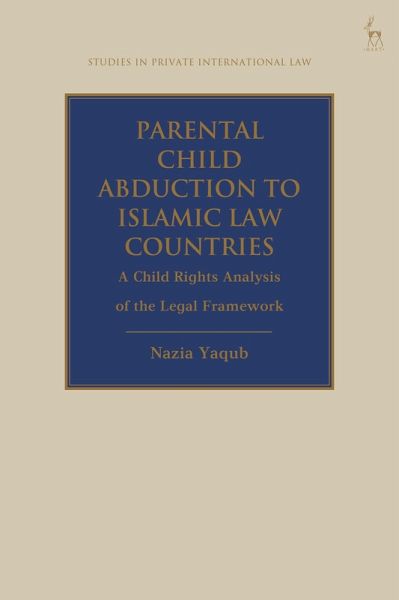
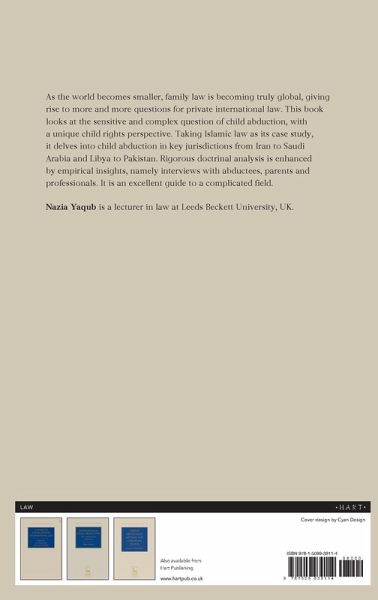
As the world becomes smaller, family law is becoming truly global, giving rise to more and more questions for private international law. This book looks at the sensitive and complex question of child abduction, with a unique child rights perspective. Taking Islamic law as its case study, it delves into child abduction in key jurisdictions from Iran to Saudi Arabia and Libya to Pakistan. Rigorous doctrinal analysis is enhanced by empirical insights, namely interviews with abductees, parents and professionals. It is an excellent guide to a complicated field.
As the world becomes smaller, family law is becoming truly global, giving rise to more and more questions for private international law. This book looks at the sensitive and complex question of child abduction, with a unique child rights perspective. Taking Islamic law as its case study, it delves into child abduction in key jurisdictions from Iran to Saudi Arabia and Libya to Pakistan. Rigorous doctrinal analysis is enhanced by empirical insights, namely interviews with abductees, parents and professionals. It is an excellent guide to a complicated field.
Nazia Yaqub is Lecturer in Law at Leeds Beckett University, UK.
Inhaltsangabe
1. Introduction I. Islamic Law Countries as a Focus II. The Abducted Child as a Focus III. A Children's Rights-Based Approach IV. Methodological Approach Dataset Diversity of Islamic Law Countries The Limitations of this Methodology V. The Parameters and Overview of this Text 2. The Importance of Children's Rights to the Regulation of Parental Child Abduction I. A Children's Rights-Based Approach Requires the Hague Convention to be Interpreted as a Children's Rights Instrument II. Embedding Children's Rights to Correctly Apply the Hague Convention III. Morocco: A Case Study IV. Conclusion 3. In the Best Interests of the Abducted Child I. Introducing Samir, Yasmin, Jamal and Daniel II. The Principle of the Best Interests of the Child and the Law on Cross-Border Parental Abduction III. How the Domestic Islamic Law Framework Responds to Cases of Parental Child Abduction from the UK IV. How the Hague Regime Fares as an Alternative to Upholding the Article 3 CRC Right of Children Abducted to Islamic Law Countries V. Best Interests of the Child as a Rule of the Procedure VI. Conclusion 4. The Child's Voice in Abduction Proceedings I. An Abducted Child's Right to be Heard: Article 12 CRC II. A Child's Right to Autonomy in Decision-Making: Islamic Court Proceedings III. A Child's Right to Participate: Hague Proceedings IV. Conclusion 5. The Abducted Child's Right to Non-Discrimination I. The Legal Framework on Non-Discrimination II. Gender Discrimination, Islamic Law and the Abducted Child: A Conceptual and Contextual Analysis III. The Challenge of Gender Discrimination in Cases of Parental Abduction IV. Solutions to Gender Discrimination in Parental Child Abduction Law V. How Will the Hague Convention Respond to the Cases of Miriam, Ryan and Aliyah? VI. Conclusion 6. Conclusion I. Does the Legislation Responding to Parental Abduction Uphold Children's Rights? II. Does the Legislation Grant the Judiciary Discretion to Interpret Parental Abduction Law in a Manner Consistent With Children's Rights? III. What Developments in the Law are Needed to Centralise the Rights of the Child in a Parental Abduction Context? IV. Future Implications of the Research: Child Abduction Law as a Living Instrument
1. Introduction I. Islamic Law Countries as a Focus II. The Abducted Child as a Focus III. A Children's Rights-Based Approach IV. Methodological Approach Dataset Diversity of Islamic Law Countries The Limitations of this Methodology V. The Parameters and Overview of this Text 2. The Importance of Children's Rights to the Regulation of Parental Child Abduction I. A Children's Rights-Based Approach Requires the Hague Convention to be Interpreted as a Children's Rights Instrument II. Embedding Children's Rights to Correctly Apply the Hague Convention III. Morocco: A Case Study IV. Conclusion 3. In the Best Interests of the Abducted Child I. Introducing Samir, Yasmin, Jamal and Daniel II. The Principle of the Best Interests of the Child and the Law on Cross-Border Parental Abduction III. How the Domestic Islamic Law Framework Responds to Cases of Parental Child Abduction from the UK IV. How the Hague Regime Fares as an Alternative to Upholding the Article 3 CRC Right of Children Abducted to Islamic Law Countries V. Best Interests of the Child as a Rule of the Procedure VI. Conclusion 4. The Child's Voice in Abduction Proceedings I. An Abducted Child's Right to be Heard: Article 12 CRC II. A Child's Right to Autonomy in Decision-Making: Islamic Court Proceedings III. A Child's Right to Participate: Hague Proceedings IV. Conclusion 5. The Abducted Child's Right to Non-Discrimination I. The Legal Framework on Non-Discrimination II. Gender Discrimination, Islamic Law and the Abducted Child: A Conceptual and Contextual Analysis III. The Challenge of Gender Discrimination in Cases of Parental Abduction IV. Solutions to Gender Discrimination in Parental Child Abduction Law V. How Will the Hague Convention Respond to the Cases of Miriam, Ryan and Aliyah? VI. Conclusion 6. Conclusion I. Does the Legislation Responding to Parental Abduction Uphold Children's Rights? II. Does the Legislation Grant the Judiciary Discretion to Interpret Parental Abduction Law in a Manner Consistent With Children's Rights? III. What Developments in the Law are Needed to Centralise the Rights of the Child in a Parental Abduction Context? IV. Future Implications of the Research: Child Abduction Law as a Living Instrument
Es gelten unsere Allgemeinen Geschäftsbedingungen: www.buecher.de/agb
Impressum
www.buecher.de ist ein Internetauftritt der buecher.de internetstores GmbH
Geschäftsführung: Monica Sawhney | Roland Kölbl | Günter Hilger
Sitz der Gesellschaft: Batheyer Straße 115 - 117, 58099 Hagen
Postanschrift: Bürgermeister-Wegele-Str. 12, 86167 Augsburg
Amtsgericht Hagen HRB 13257
Steuernummer: 321/5800/1497
USt-IdNr: DE450055826