
Andere Kunden interessierten sich auch für
 An Ethics of Clinical Uncertainty41,99 €
 Adoption in India137,99 €
Worthy of Living") A Life (Un)Worthy of Living115,99 €
A Life (Un)Worthy of Living115,99 € Exploring the Ethics of Clinical Xenotransplantation137,99 €
 Adoption Policy and Practice131,99 €
 After Adoption59,99 €
 Inter-Country Adoption57,99 €

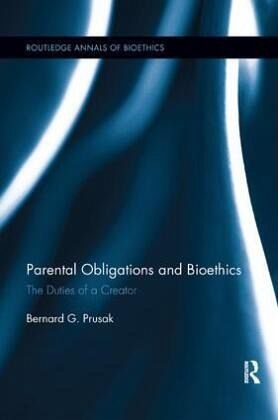
This book examines the question of what parental obligations procreators incur by bringing children into being. Prusak argues that parents, as procreators, have obligations regarding future children that constrain the liberty of would-be parents to do as they wish. Moreover, these obligations go beyond simply respecting a child's rights. He addresses in turn the ethics of adoption, child support, gamete donation, surrogacy, prenatal genetic enhancement, and public responsibility for children.
"This book is a valuable addition to what is already a rich philosophical literature on the question of what we owe to those we create. Throughout Prusak's style is direct, honest, engaging, and forthright."-David Archard in Notre Dame Philosophical Reviews
"[Prusak's] book is educational, easy to read, and gets to the heart of many very important issues in reproductive ethics."-Jake Earl's in Kennedy Institute of Ethics Journal
"Prusak's project is fundamentally philosophical in nature and will thereby enjoy wide-ranging applicability to a host of ethical issues concerning the parent-child relationship. Furthermore, in debating the particular bioethical issues Prusak discusses, scholars often presume certain parental obligations without the benefit of a cohesive theoretical framework that grounds various putative obligations. This volume thus offers a valuable contribution to bioethical debate on these and other issues that will invalidate certain argumentative strategies while affirming others."-Jason Eberl in Expositions: Interdisciplinary Studies in the Humanities
"[Prusak's] book is educational, easy to read, and gets to the heart of many very important issues in reproductive ethics."-Jake Earl's in Kennedy Institute of Ethics Journal
"Prusak's project is fundamentally philosophical in nature and will thereby enjoy wide-ranging applicability to a host of ethical issues concerning the parent-child relationship. Furthermore, in debating the particular bioethical issues Prusak discusses, scholars often presume certain parental obligations without the benefit of a cohesive theoretical framework that grounds various putative obligations. This volume thus offers a valuable contribution to bioethical debate on these and other issues that will invalidate certain argumentative strategies while affirming others."-Jason Eberl in Expositions: Interdisciplinary Studies in the Humanities