
Andere Kunden interessierten sich auch für
 The Democratic Potential of Charter Schools32,95 €
 Education in Hope40,50 €
 Education in Hope137,35 €
 Educational Management Turned on Its Head40,50 €
 School Food Politics147,80 €
 School Food Politics39,15 €
 Betwixt & Between32,95 €
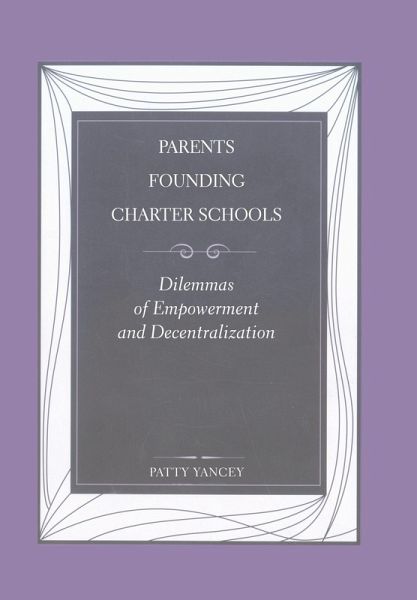
Parents Founding Charter Schools investigates the founding, development, and early operations of two start-up, parent-run charter schools in neighboring urban areas in California. Both schools were among the first 105 charters approved in the state and provide an "up close and personal" view of the early years of charter organizing. The ethnographic case study method allows us to witness the impact of external and internal barriers to decentralization on the lives and relationships of charter parents, teachers, and administrators. Also rendered visible are the connections between internal chaos after the schools are operational and decisions or compromises made by sponsors and charter founders during the early developmental stages of the organizations.
"So little is known about what goes on inside these robust little organizations called charter schools. Patty Yancey shines a bright light into two schools, revealing intriguing relations among the parents involved and between parents and educators, as well as the dilemmas inherent in the struggle to create truly democratic and demanding forms of school decision-making." (Bruce Fuller, Co-Director of Policy Analysis for California Education, PACE)
"Through her detailed and compelling analysis, Patty Yancey's work shows how easy it is for charter schools to re-create the power struggles that many of us had come to believe were exclusively problems associated with public schools. Through her case studies she demonstrates how conflicts over the mission and direction of a charter school can undermine the noble and sincere efforts of committed individuals. Put more simply, good intentions are not enough. Anyone seriously considering starting a charter school of their own ought to read this book very carefully." (Pedro Noguera, Associate Professor at University of California at Berkeley's Graduate School of Education)
"Through her detailed and compelling analysis, Patty Yancey's work shows how easy it is for charter schools to re-create the power struggles that many of us had come to believe were exclusively problems associated with public schools. Through her case studies she demonstrates how conflicts over the mission and direction of a charter school can undermine the noble and sincere efforts of committed individuals. Put more simply, good intentions are not enough. Anyone seriously considering starting a charter school of their own ought to read this book very carefully." (Pedro Noguera, Associate Professor at University of California at Berkeley's Graduate School of Education)