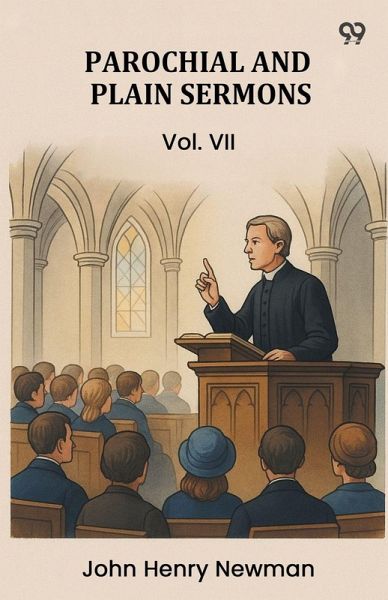
Parochial and plain sermons Vol. VII is a collection of religious sermons exploring Christian doctrine and moral teachings designed to guide spiritual lives. The volume focuses on themes such as the passage of time, the certainty of death, the weight of earthly desires, and the contrast between true religion and worldly pursuits. It opens with the sermon which reflects on Solomon s advice to work diligently toward the salvation of the soul, emphasizing life s brevity and the inevitability of death that ends all human endeavors. Newman stresses the importance of living with purpose and urgency,…mehr
Parochial and plain sermons Vol. VII is a collection of religious sermons exploring Christian doctrine and moral teachings designed to guide spiritual lives. The volume focuses on themes such as the passage of time, the certainty of death, the weight of earthly desires, and the contrast between true religion and worldly pursuits. It opens with the sermon which reflects on Solomon s advice to work diligently toward the salvation of the soul, emphasizing life s brevity and the inevitability of death that ends all human endeavors. Newman stresses the importance of living with purpose and urgency, highlighting how distractions can cause people to undervalue the present moment. The sermons call attention to the accountability that follows death and the need to align actions with divine expectations. Ultimately, the work urges prioritizing spiritual well-being above temporary gains, encouraging readers to cultivate a life focused on eternal values rather than fleeting pleasures. The volume offers a thoughtful examination of faith and the human condition through reflective sermons.
John Henry Newman was an influential theologian, philosopher, historian, and writer whose work shaped both Anglican and Catholic thought in the 19th century. Born on February 21, 1801, in London to Jemina Fourdrinier and John Newman, he showed early intellectual promise and later studied at Trinity College, Oxford. He initially served as an Anglican priest, where his academic and spiritual contributions made him a central figure in the Oxford Movement, which aimed to return the Church of England to its Catholic roots. Over time, his theological inquiries and personal convictions led him to convert to Catholicism in 1845, a decision that marked a turning point in his life and drew considerable attention. Newman became a Catholic priest and was eventually elevated to cardinal by Pope Leo XIII in 1879. His most notable works include Apologia Pro Vita Sua and The Idea of a University, through which he articulated his vision of faith, reason, and education. A gifted writer and poet, he continued his scholarly and pastoral work until his death on August 11, 1890, in Edgbaston, Birmingham. He left behind a legacy of spiritual depth and intellectual rigor that continues to resonate in religious and academic circles.
Es gelten unsere Allgemeinen Geschäftsbedingungen: www.buecher.de/agb
Impressum
www.buecher.de ist ein Internetauftritt der buecher.de internetstores GmbH
Geschäftsführung: Monica Sawhney | Roland Kölbl | Günter Hilger
Sitz der Gesellschaft: Batheyer Straße 115 - 117, 58099 Hagen
Postanschrift: Bürgermeister-Wegele-Str. 12, 86167 Augsburg
Amtsgericht Hagen HRB 13257
Steuernummer: 321/5800/1497
USt-IdNr: DE450055826