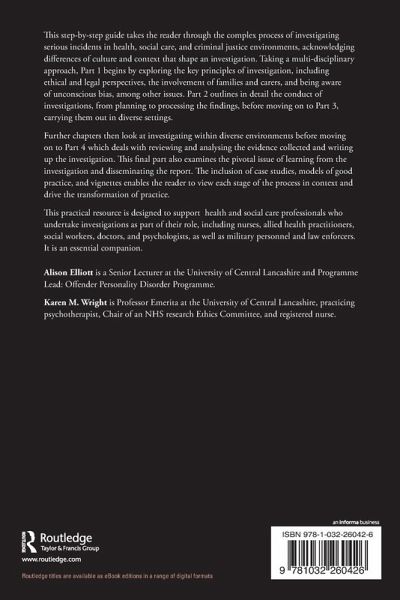
This practical resource is designed to support all health and social care professionals who undertake investigations as part of their role, including nurses, allied health practitioners, social workers, doctors and psychologists. It is an essential companion for novice investigators and a useful reference for more experienced staff.
This practical resource is designed to support all health and social care professionals who undertake investigations as part of their role, including nurses, allied health practitioners, social workers, doctors and psychologists. It is an essential companion for novice investigators and a useful reference for more experienced staff.
Alison Elliott is a Senior Lecturer at the University of Central Lancashire and Programme Lead: Offender Personality Disorder Programme. Karen M. Wright is Professor Emerita at the University of Central Lancashire, practicing psychotherapist, Chair of an NHS research Ethics Committee, and registered nurse.
Inhaltsangabe
Acknowledgements Table of figures Editors & Contributors Foreword Introduction PART 1. Principles of investigation 1: Understanding and Avoiding Unconscious Bias 2: To Debrief or not to Debrief 3: The Theoretical and legal principles of formal investigations 4: Family engagement - why it matters PART 2: Conducting the investigation. 5: Planning Investigations 6. Individual investigative Interviews 7: Managing Interpersonal dynamics, and issues with group interviews 8: Processing, reviewing and analysing material PART 3 : Investigating in diverse environments. 9: Managing Diversity and Vulnerability 10: Serious incident investigations involving children and young people 11: Investigations in the custodial setting - practical advice 12: Investigating within the military context 13: Fitness to Practice Investigations 14: Managing Organisational Dynamics PART 4: Post- investigation reporting, learning & development 15: Approaches to managing information post investigation 16: How to present a report & the executive summary 17: 'Cautionary tales: investigations - the effects on staff involved' 18: The coroner's inquest and attendance to an inquest hearing 19: Closing the loop: Creating learning from the incident Glossary of Terms.
Acknowledgements Table of figures Editors & Contributors Foreword Introduction PART 1. Principles of investigation 1: Understanding and Avoiding Unconscious Bias 2: To Debrief or not to Debrief 3: The Theoretical and legal principles of formal investigations 4: Family engagement - why it matters PART 2: Conducting the investigation. 5: Planning Investigations 6. Individual investigative Interviews 7: Managing Interpersonal dynamics, and issues with group interviews 8: Processing, reviewing and analysing material PART 3 : Investigating in diverse environments. 9: Managing Diversity and Vulnerability 10: Serious incident investigations involving children and young people 11: Investigations in the custodial setting - practical advice 12: Investigating within the military context 13: Fitness to Practice Investigations 14: Managing Organisational Dynamics PART 4: Post- investigation reporting, learning & development 15: Approaches to managing information post investigation 16: How to present a report & the executive summary 17: 'Cautionary tales: investigations - the effects on staff involved' 18: The coroner's inquest and attendance to an inquest hearing 19: Closing the loop: Creating learning from the incident Glossary of Terms.
Es gelten unsere Allgemeinen Geschäftsbedingungen: www.buecher.de/agb
Impressum
www.buecher.de ist ein Internetauftritt der buecher.de internetstores GmbH
Geschäftsführung: Monica Sawhney | Roland Kölbl | Günter Hilger
Sitz der Gesellschaft: Batheyer Straße 115 - 117, 58099 Hagen
Postanschrift: Bürgermeister-Wegele-Str. 12, 86167 Augsburg
Amtsgericht Hagen HRB 13257
Steuernummer: 321/5800/1497
USt-IdNr: DE450055826