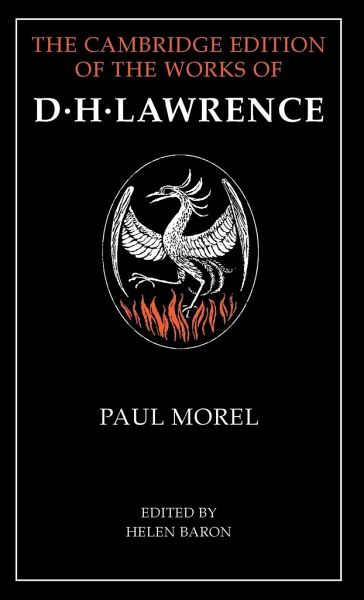
This is the first ever edition of the early version of Sons and Lovers, D. H. Lawrence's highly popular autobiographical novel. Amongst all the surviving early drafts of Lawrence's works this is the most different from the final version; as he rewrote, Lawrence discarded many episodes, some of them stories from his childhood not recorded anywhere else. It is less polished than Sons and Lovers, but it is full of powerful, spontaneous, dramatic writing: there is more humour and charm, more raw violence and nervous energy. This volume also contains remarkable documents written by Lawrence's…mehr
This is the first ever edition of the early version of Sons and Lovers, D. H. Lawrence's highly popular autobiographical novel. Amongst all the surviving early drafts of Lawrence's works this is the most different from the final version; as he rewrote, Lawrence discarded many episodes, some of them stories from his childhood not recorded anywhere else. It is less polished than Sons and Lovers, but it is full of powerful, spontaneous, dramatic writing: there is more humour and charm, more raw violence and nervous energy. This volume also contains remarkable documents written by Lawrence's girlfriend Jessie Chambers, the model for Miriam in Paul Morel and in Sons and Lovers, in which she gives Lawrence some hostile criticisms and writes out for him her own versions of some of his episodes. In addition there is a fragment of a novel about his mother's childhood, facsimiles of manuscript pages, maps, and scholarly notes and apparatus.
David Herbert Richards "D. H." Lawrence (11 September 1885 - 2 March 1930) was an English novelist, poet, playwright, essayist, literary critic and painter. His collected works represent, among other things, an extended reflection upon the dehumanising effects of modernity and industrialisation. Some of the issues Lawrence explores are emotional health, vitality, spontaneity and instinct. Lawrence's opinions earned him many enemies and he endured official persecution, censorship, and misrepresentation of his creative work throughout the second half of his life, much of which he spent in a voluntary exile which he called his "savage pilgrimage." At the time of his death, his public reputation was that of a pornographer who had wasted his considerable talents. E. M. Forster, in an obituary notice, challenged this widely held view, describing him as, "The greatest imaginative novelist of our generation." Lawrence is perhaps best known for his novels Sons and Lovers, The Rainbow, Women in Love and Lady Chatterley's Lover. Within these Lawrence explores the possibilities for life within an industrial setting. In particular Lawrence is concerned with the nature of relationships that can be had within such a setting. Though often classed as a realist, Lawrence in fact uses his characters to give form to his personal philosophy. His depiction of sexual activity, though seen as shocking when he first published in the early 20th century, has its roots in this highly personal way of thinking and being. It is worth noting that Lawrence was very interested in the sense of touch and that his focus on physical intimacy has its roots in a desire to restore an emphasis on the body, and re-balance it with what he perceived to be Western civilisation's over-emphasis on the mind.
Inhaltsangabe
General editor's preface Acknowledgements Chronology Cue-titles Introduction Paul Morel Appendix 1. 'Matilda' Appendix 2. Chapter plan Appendix 3. Two versions of the start of MS3 Appendix 4. MS3 chapter 9 annotated by Jessie Chambers Appendix 5. Jessie Chambers' manuscripts Explanatory notes Maps Textual apparatus Line-end hyphenation Note on pounds, shillings and pence.