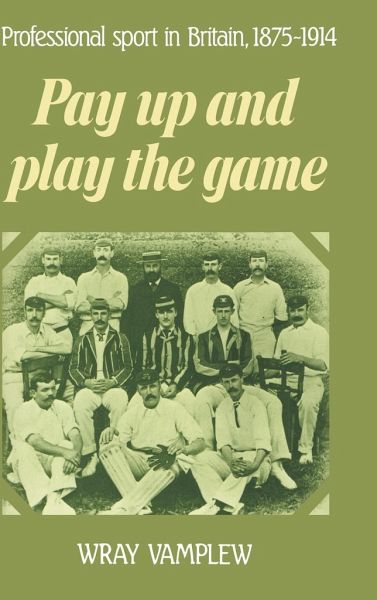

Based on a vast range of club and association records, Pay Up and Play the Game, first published in 1988, presents a systematic economic analysis of the emergence of mass spectator sport during the years prior to World War I. It explores the tensions behind an increasingly commercialised activity that was nonetheless suffused with 'gentlemanly' values at many levels, and highlights the retreat of the latter as working-class consumption and participation became predominant, symbolised most dramatically by the celebrated victory of proletarian Blackburn Olympic over the Old Etonians in the FA…mehr
Based on a vast range of club and association records, Pay Up and Play the Game, first published in 1988, presents a systematic economic analysis of the emergence of mass spectator sport during the years prior to World War I. It explores the tensions behind an increasingly commercialised activity that was nonetheless suffused with 'gentlemanly' values at many levels, and highlights the retreat of the latter as working-class consumption and participation became predominant, symbolised most dramatically by the celebrated victory of proletarian Blackburn Olympic over the Old Etonians in the FA Cup final of 1883. Wray Vamplew examines the linkages between sport, gambling, crime and spectator violence, and concludes that many supposedly 'recent' developments (notably football hooliganism) in fact have their origins in this, the 'Golden Age' of sport in Britain.
Part I. An Overview: 1. Is money the root of all evil? A historical appreciation of commercialisation in sports 2. Comments on the state of play: economic historians and sports history Part II. The Development of Professional Gate-Money Sport: 3. Popular recreation before the industrial revolution 4. Sporting activities and economic change, 1750-1830 5. The precursors of commercialised sport, 1830-75 6. The rise of professional gate-money sport, 1875-1914 7. From sports spectator to sports consumer Part III. Sport in the Market Place: The Economics of Professional Sport: 8. Profits or premierships? 9. All for one and one for all 10. Paying the piper: shareholders and directors 11. Winning at any cost? Part IV. Playing for Pay: Professional Sport as an Occupation: 12. The struggle for recognition 13. Earnings and opportunities 14. Close of play 15. Not playing the game: unionism and strikes 16. Labour aristocrats or wage slaves? Part V. Unsporting Behaviour: 17. Ungentlemany conduct 18. The madding crowd Part VI. A Second Overview: 19. An industrial revolution in sport Appendices: 1. Shareholders and shareholdings in Scottish and English sport 2. Regulations defining amateurism and professionalism in British sports.
Es gelten unsere Allgemeinen Geschäftsbedingungen: www.buecher.de/agb
Impressum
www.buecher.de ist ein Internetauftritt der buecher.de internetstores GmbH
Geschäftsführung: Monica Sawhney | Roland Kölbl | Günter Hilger
Sitz der Gesellschaft: Batheyer Straße 115 - 117, 58099 Hagen
Postanschrift: Bürgermeister-Wegele-Str. 12, 86167 Augsburg
Amtsgericht Hagen HRB 13257
Steuernummer: 321/5800/1497
USt-IdNr: DE450055826