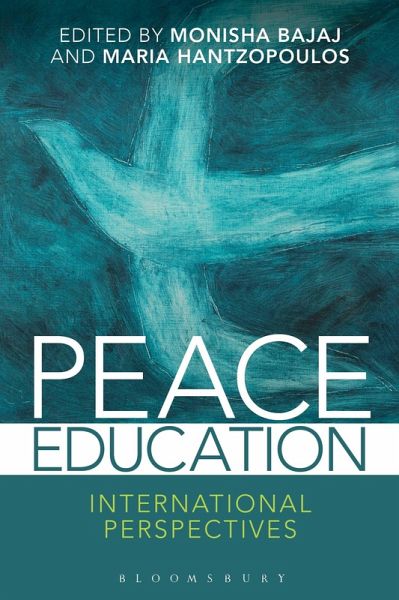
'Honorable Mention' 2017 PROSE Award - Education Practice Bringing together the voices of scholars and practitioners on challenges and possibilities of implementing peace education in diverse global sites, this book addresses key questions for students seeking to deepen their understanding of the field. The book not only highlights ground-breaking and rich qualitative studies from around the globe, but also analyses the limits and possibilities of peace education in diverse contexts of conflict and post-conflict societies. Contributing authors address how educators and learners can make…mehr
'Honorable Mention' 2017 PROSE Award - Education Practice Bringing together the voices of scholars and practitioners on challenges and possibilities of implementing peace education in diverse global sites, this book addresses key questions for students seeking to deepen their understanding of the field. The book not only highlights ground-breaking and rich qualitative studies from around the globe, but also analyses the limits and possibilities of peace education in diverse contexts of conflict and post-conflict societies. Contributing authors address how educators and learners can make meaning of international peace education efforts, how various forms of peace and violence interact in and around schools, and how the field of peace education has evolved and grown over the past four decades.
Monisha Bajaj is Associate Professor of International and Multicultural Education at the University of San Francisco, USA, where she directs the Human Rights Education MA. She is the editor of the Encyclopedia of Peace Education (2008) and author of Schooling for Social Change (2012), winner of the Jackie Kirk Outstanding Book Award of the Comparative and International Education Society (CIES). Maria Hantzopoulos is Associate Professor of Education at Vassar College, USA, where she is the coordinator of the Adolescent Education Certification Program. She is co-editor, with Alia Tyner-Mullings, of Critical Small Schools (2012).
Inhaltsangabe
Introduction: Theory Research and Praxis of Peace Education Monisha Bajaj (University of San Francisco USA) and Maria Hantzopoulos (Vassar College USA) Part I: Educating for Peace in Conflict and Post-Traumatic Contexts 1. Emotion Trauma and Critical Pedagogy: Implications for Critical Peace Education Michalinos Zembylas (Open University of Cyprus Cyprus) 2. Building Peace: The Opportunities and Limitations of Educational Interventions in Countries with Identity-Based Conflicts Karen Murphy (Facing History and Ourselves USA) Sean Pettis (Corrymeela Community Northern Ireland) and Dylan Wray (Shikaya South Africa) 3. Experimenting with Integrated Peace Education: Critical Perspectives in the Israeli Context Zvi Bekerman (Hebrew University of Jerusalem Israel) Part II: National Landscapes for Peacebuilding and Education 4. Peace Education and Peacebuilding Across the Conflict Continuum: Insights from Lebanon Zeena Zakharia (University of Massachusetts USA) 5. Peace Education in Crisis Settings: Insights and Lessons Learned from Kenya Mary Mendenhall and Nivedita Chopra (Columbia University USA) 6. In the Gaze of Gandhi: Peace Education in Contemporary India Monisha Bajaj (University of San Francisco USA) Part III: Navigating Structures of Violence 7. Uncertainty fluidity and occupying spaces in-between: Peace education practices in Mindanao the Philippines Lindsey Horner (University of Sussex UK) 8. Lingering Colonialities as Blockades to Peace Education: School Violence in Trinidad Hakim Williams (Gettysburg College USA) 9. Teachers as Agents of Peace: The Role of Educators in Interrupting Youth Involvement in Urban Violence in Guayaquil Ecuador Maria Jose Bermeo (Columbia University USA) Part IV: Peace by Piece: Approaches and Models for Peace Education 10. Beyond American Exceptionalism: Centering Critical Peace Education in US School Reform Maria Hantzopoulos (Vassar College USA) 11. Nurturing and Growing the 'Ceeds' of Peace: A Peacebuilding Model for Educators Maya Soetoro-Ng (University of Hawai'i USA) and Kerrie Urosevich (University of Hawai'i USA) 12. Promoting Peace through Children's Media: The Case of Sesame Workshop Mathangi Subramanian (Mahatma Gandhi Institute of Education for Peace and Sustainable Development India) June Lee (Sesame Workshop USA) Lilith Dollard (Sesame Workshop USA) and Zainab Kabba (Oxford University UK) Conclusion: Critical Directions for Peace Education Maria Hantzopoulos (Vassar College USA) and Monisha Bajaj (University of San Francisco USA)
Introduction: Theory Research and Praxis of Peace Education Monisha Bajaj (University of San Francisco USA) and Maria Hantzopoulos (Vassar College USA) Part I: Educating for Peace in Conflict and Post-Traumatic Contexts 1. Emotion Trauma and Critical Pedagogy: Implications for Critical Peace Education Michalinos Zembylas (Open University of Cyprus Cyprus) 2. Building Peace: The Opportunities and Limitations of Educational Interventions in Countries with Identity-Based Conflicts Karen Murphy (Facing History and Ourselves USA) Sean Pettis (Corrymeela Community Northern Ireland) and Dylan Wray (Shikaya South Africa) 3. Experimenting with Integrated Peace Education: Critical Perspectives in the Israeli Context Zvi Bekerman (Hebrew University of Jerusalem Israel) Part II: National Landscapes for Peacebuilding and Education 4. Peace Education and Peacebuilding Across the Conflict Continuum: Insights from Lebanon Zeena Zakharia (University of Massachusetts USA) 5. Peace Education in Crisis Settings: Insights and Lessons Learned from Kenya Mary Mendenhall and Nivedita Chopra (Columbia University USA) 6. In the Gaze of Gandhi: Peace Education in Contemporary India Monisha Bajaj (University of San Francisco USA) Part III: Navigating Structures of Violence 7. Uncertainty fluidity and occupying spaces in-between: Peace education practices in Mindanao the Philippines Lindsey Horner (University of Sussex UK) 8. Lingering Colonialities as Blockades to Peace Education: School Violence in Trinidad Hakim Williams (Gettysburg College USA) 9. Teachers as Agents of Peace: The Role of Educators in Interrupting Youth Involvement in Urban Violence in Guayaquil Ecuador Maria Jose Bermeo (Columbia University USA) Part IV: Peace by Piece: Approaches and Models for Peace Education 10. Beyond American Exceptionalism: Centering Critical Peace Education in US School Reform Maria Hantzopoulos (Vassar College USA) 11. Nurturing and Growing the 'Ceeds' of Peace: A Peacebuilding Model for Educators Maya Soetoro-Ng (University of Hawai'i USA) and Kerrie Urosevich (University of Hawai'i USA) 12. Promoting Peace through Children's Media: The Case of Sesame Workshop Mathangi Subramanian (Mahatma Gandhi Institute of Education for Peace and Sustainable Development India) June Lee (Sesame Workshop USA) Lilith Dollard (Sesame Workshop USA) and Zainab Kabba (Oxford University UK) Conclusion: Critical Directions for Peace Education Maria Hantzopoulos (Vassar College USA) and Monisha Bajaj (University of San Francisco USA)
Es gelten unsere Allgemeinen Geschäftsbedingungen: www.buecher.de/agb
Impressum
www.buecher.de ist ein Internetauftritt der buecher.de internetstores GmbH
Geschäftsführung: Monica Sawhney | Roland Kölbl | Günter Hilger
Sitz der Gesellschaft: Batheyer Straße 115 - 117, 58099 Hagen
Postanschrift: Bürgermeister-Wegele-Str. 12, 86167 Augsburg
Amtsgericht Hagen HRB 13257
Steuernummer: 321/5800/1497
USt-IdNr: DE450055826