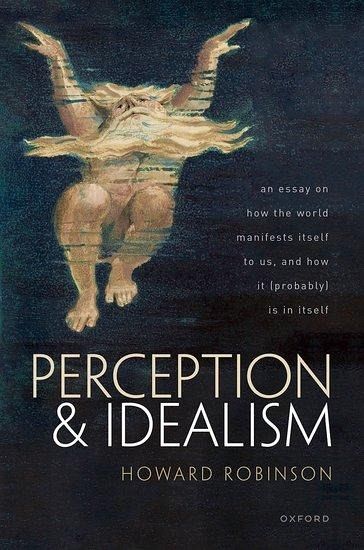
Perception and Idealism examines how perception makes objects manifest to us, and what the world must be like for objects to be manifest in that way. Howard Robinson argues for a version of sense-datum theory about perception and theistic phenomenalism about metaphysical reality.
Perception and Idealism examines how perception makes objects manifest to us, and what the world must be like for objects to be manifest in that way. Howard Robinson argues for a version of sense-datum theory about perception and theistic phenomenalism about metaphysical reality.
Howard Robinson is Professor Emeritus in Philosophy at Central European University, Vienna. He is also Research Fellow at Blackfriars Hall, Oxford, and Senior Fellow, Rutgers Center for Philosophy of Religion. He was educated at Manchester Grammar School and Corpus Christi College, Oxford. He previously held positions at the University of Nottingham, Oriel College, Oxford, University of Liverpool, and Eötvös Loránd University, Budapest.
Inhaltsangabe
* Introduction * Part I: How the World Manifests Itself to Us * 1: The Causal Argument for Sense-Data, 'Philosophers' Hallucinations', and the Disjunctive Response * 2: Naïve Realism and the Argument from Illusion * 3: Intentionality and Perception (I): The Fundamental irrelevance of Intentionality to Phenomenal Consciousness * 4: Intentionality and Perception (II): Attempts to Articulate the 'Content' and 'Object' Distinction * 5: Singular Reference and its Relation to Intentionality * 6: Objectivity: How is It Possible? * 7: Semantic Direct Realism, Critical Realism, and the Sense-Datum Theory * 8: Building the Manifest World * Part II: What the World Is, in Itself * 9: The Problematic Nature of the Modern Conception of Matter * 10: Two Suggestive Berkeleyan Arguments * 11: Bishop Berkeley and John Foster on Problems with Physical Realism about Space * 12: Mentalist Alternatives to Berkeleyan Theism, and their Failure * General Conclusion
* Introduction * Part I: How the World Manifests Itself to Us * 1: The Causal Argument for Sense-Data, 'Philosophers' Hallucinations', and the Disjunctive Response * 2: Naïve Realism and the Argument from Illusion * 3: Intentionality and Perception (I): The Fundamental irrelevance of Intentionality to Phenomenal Consciousness * 4: Intentionality and Perception (II): Attempts to Articulate the 'Content' and 'Object' Distinction * 5: Singular Reference and its Relation to Intentionality * 6: Objectivity: How is It Possible? * 7: Semantic Direct Realism, Critical Realism, and the Sense-Datum Theory * 8: Building the Manifest World * Part II: What the World Is, in Itself * 9: The Problematic Nature of the Modern Conception of Matter * 10: Two Suggestive Berkeleyan Arguments * 11: Bishop Berkeley and John Foster on Problems with Physical Realism about Space * 12: Mentalist Alternatives to Berkeleyan Theism, and their Failure * General Conclusion
Es gelten unsere Allgemeinen Geschäftsbedingungen: www.buecher.de/agb
Impressum
www.buecher.de ist ein Internetauftritt der buecher.de internetstores GmbH
Geschäftsführung: Monica Sawhney | Roland Kölbl | Günter Hilger
Sitz der Gesellschaft: Batheyer Straße 115 - 117, 58099 Hagen
Postanschrift: Bürgermeister-Wegele-Str. 12, 86167 Augsburg
Amtsgericht Hagen HRB 13257
Steuernummer: 321/5800/1497
USt-IdNr: DE450055826