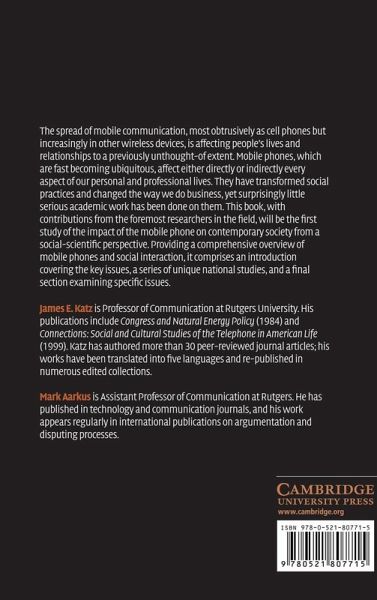
The spread of mobile communication, most obtrusively as cell phones but increasingly in other wireless devices, is affecting people's lives and relationships to a previously unthought-of extent. Mobile phones, which are fast becoming ubiquitous, affect either directly or indirectly every aspect of our personal and professional lives. They have transformed social practices and changed the way we do business, yet surprisingly little serious academic work has been done on them. This 2002 book, with contributions from the foremost researchers in the field, studies the impact of the mobile phone on…mehr
The spread of mobile communication, most obtrusively as cell phones but increasingly in other wireless devices, is affecting people's lives and relationships to a previously unthought-of extent. Mobile phones, which are fast becoming ubiquitous, affect either directly or indirectly every aspect of our personal and professional lives. They have transformed social practices and changed the way we do business, yet surprisingly little serious academic work has been done on them. This 2002 book, with contributions from the foremost researchers in the field, studies the impact of the mobile phone on contemporary society from a social scientific perspective. Providing a comprehensive overview of mobile phones and social interaction, it comprises an introduction covering the key issues, a series of unique national studies and a final section examining specific issues.
Rutgers University, USA Dr James Katz is the author of several books in the field of technology and society. With Philip Aspden and Ronald E. Rice, he is the co-author of a book about the social impact of the Internet on life in America, to be published by MIT Press. His 1999 book, Connections: Social and Cultural Studies of the Telephone in American Life, was included in the 37th Outstanding Academic Titles award, given by the American Library Association''s journal Choice. Another of his books, Congress and Natural Energy Policy, was nominated for the American Political Science Association Gladys Kammerer prize for best political science publication in 1984. In 2000, he won the Rutgers Department of Communication Researcher of the year award. Katz has authored more than 30 peer-reviewed journal articles; his works have been translated into five languages and re-published in numerous edited collections. He earned his Ph.D. in 1974 from Rutgers; in 1997, he joined its department of communication as professor. In between those years he won postdoctoral fellowships at Harvard and MIT, served on the faculties of the University of Texas, Austin and Clarkson University, and headed the social science research unit at Bell Communication Research (Bellcore). He was also granted national and foreign patents on his inventions in telecommunication technology. The national electronic media frequently interview Katz; and he has appeared on numerous network news programs. He has been quoted on the front-pages of leading newspapers including The New York Times, Wall Street Journal, Boston Globe and USA Today. He serves on the boards of several leading social science journals and charitable and educational foundations. His teaching and research interests include research methods, the social aspects of communication technology, the contest between privacy and publicity on the Internet, and of course mobile communication and computing.
Inhaltsangabe
1. Introduction J. E. Katz and M. Aakhus Part I. Mobile Communication - National and Comparative Perspectives: 2. Finland: a mobile phone culture J. P. Puro 3. Israel: chutzpah and chatter in the Holy Land A. Cohen and A. Schejter 4. Italy: stereotypes, true and false L. Fortunati 5. Korea: personal meanings S. D. Kim 6. United States: popular, pragmatic and problematic K. Robbins and M. Turner 7. France: preserving the image J. Heurtin and C. Licoppe 8. The Netherlands and the US compared E. Mante-Meijer 9. Bulgaria: mobile phones as post-Communist cultural icons V. D. Varbanov Part II. Private Talk - Interpersonal Relations and Micro-Behaviour: 10. Hyper-coordination via mobile phone in Norway R. Ling and B. Yttri 11. Mobile culture of children and teenagers in Finland E. Kasesniemi and P. Rautiainen 12. Pretense of intimacy in France C. DeGourney 13. Mobile phone consumption and concepts of personhood D. Nafus and K. Tracy Part III. Public Performance - Social Groups and Structures: 14. The chattage of absent presence K. Gergen 15. From mass society to perpetual contact J. Rule 16. Mobiles and the Norwegian teen: identity, gender and class B. Skog 17. The telephone comes to the Filipino village G. Strom 18. Beginnings in the telephone E. Schegloff Part IV. Conclusion: making meaning of mobiles J. E. Katz and M. Aakhus.
1. Introduction J. E. Katz and M. Aakhus Part I. Mobile Communication - National and Comparative Perspectives: 2. Finland: a mobile phone culture J. P. Puro 3. Israel: chutzpah and chatter in the Holy Land A. Cohen and A. Schejter 4. Italy: stereotypes, true and false L. Fortunati 5. Korea: personal meanings S. D. Kim 6. United States: popular, pragmatic and problematic K. Robbins and M. Turner 7. France: preserving the image J. Heurtin and C. Licoppe 8. The Netherlands and the US compared E. Mante-Meijer 9. Bulgaria: mobile phones as post-Communist cultural icons V. D. Varbanov Part II. Private Talk - Interpersonal Relations and Micro-Behaviour: 10. Hyper-coordination via mobile phone in Norway R. Ling and B. Yttri 11. Mobile culture of children and teenagers in Finland E. Kasesniemi and P. Rautiainen 12. Pretense of intimacy in France C. DeGourney 13. Mobile phone consumption and concepts of personhood D. Nafus and K. Tracy Part III. Public Performance - Social Groups and Structures: 14. The chattage of absent presence K. Gergen 15. From mass society to perpetual contact J. Rule 16. Mobiles and the Norwegian teen: identity, gender and class B. Skog 17. The telephone comes to the Filipino village G. Strom 18. Beginnings in the telephone E. Schegloff Part IV. Conclusion: making meaning of mobiles J. E. Katz and M. Aakhus.
Es gelten unsere Allgemeinen Geschäftsbedingungen: www.buecher.de/agb
Impressum
www.buecher.de ist ein Internetauftritt der buecher.de internetstores GmbH
Geschäftsführung: Monica Sawhney | Roland Kölbl | Günter Hilger
Sitz der Gesellschaft: Batheyer Straße 115 - 117, 58099 Hagen
Postanschrift: Bürgermeister-Wegele-Str. 12, 86167 Augsburg
Amtsgericht Hagen HRB 13257
Steuernummer: 321/5800/1497
USt-IdNr: DE450055826