
Peter Joseph Kuhn
Personnel Economics
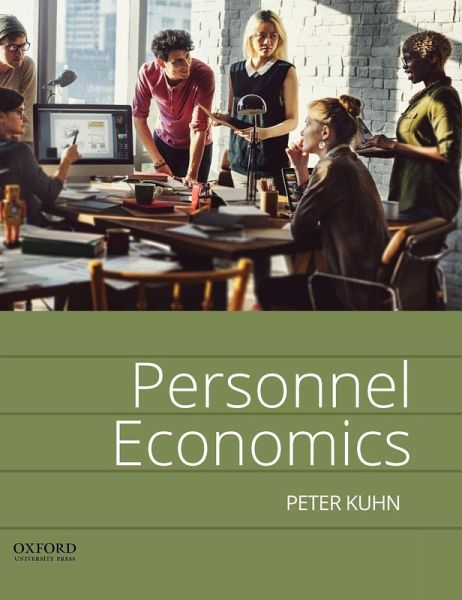
Peter Joseph Kuhn
Personnel Economics
- Gebundenes Buch
- Merkliste
- Auf die Merkliste
- Bewerten Bewerten
- Teilen
- Produkt teilen
- Produkterinnerung
- Produkterinnerung
The centerpiece of most adults' daily lives is the workplace, where all participants-as workers or managers-can benefit from thinking strategically about employee motivation, compensation, and selection. Personnel Economics uses simple but formal economic models to study what happens inside the workplace. Fueled by the latest findings from behavioral economic research, the text provides an intuitive introduction to the two workhorses of empirical research on personnel issues: designing experiments and using regression to study naturally occurring data.
Andere Kunden interessierten sich auch für
 Pietro GaribaldiPersonnel Economics in Imperfect Labour Markets68,99 €
") Tony WatsonThe Personnel Managers (Routledge Revivals)26,99 €
Tony WatsonThe Personnel Managers (Routledge Revivals)26,99 € Les McIlroyThe Manager's Mentor17,99 €
 Carrie HrubyMaking Personnel Personal78,99 €
 Sara FazzinEmotion-Based Approaches to Personnel Management114,99 €
 David ChanPersonnel Selection148,99 €
 Robert M. GuionAssessment, Measurement, and Prediction for Personnel Decisions54,99 €
-
-
-





The centerpiece of most adults' daily lives is the workplace, where all participants-as workers or managers-can benefit from thinking strategically about employee motivation, compensation, and selection. Personnel Economics uses simple but formal economic models to study what happens inside the workplace. Fueled by the latest findings from behavioral economic research, the text provides an intuitive introduction to the two workhorses of empirical research on personnel issues: designing experiments and using regression to study naturally occurring data.
Produktdetails
- Produktdetails
- Verlag: OXFORD UNIV PR
- Seitenzahl: 594
- Erscheinungstermin: 21. November 2017
- Englisch
- Abmessung: 241mm x 196mm x 36mm
- Gewicht: 1288g
- ISBN-13: 9780199378012
- ISBN-10: 0199378010
- Artikelnr.: 49290009
- Herstellerkennzeichnung
- Libri GmbH
- Europaallee 1
- 36244 Bad Hersfeld
- gpsr@libri.de
- Verlag: OXFORD UNIV PR
- Seitenzahl: 594
- Erscheinungstermin: 21. November 2017
- Englisch
- Abmessung: 241mm x 196mm x 36mm
- Gewicht: 1288g
- ISBN-13: 9780199378012
- ISBN-10: 0199378010
- Artikelnr.: 49290009
- Herstellerkennzeichnung
- Libri GmbH
- Europaallee 1
- 36244 Bad Hersfeld
- gpsr@libri.de
Peter Kuhn is Professor of Economics at the University of California, Santa Barbara. He is well known for his research on the economics of trade unions, wage and employment discrimination, immigration, displaced workers, and personnel economics with a particular emphasis on behavioral economics.
* PART ONE: Principal-Agent Models
* Chapter 1: Structure of the Principal-Agent Problem
* 1.1 What Is a Principal-Agent Problem?
* 1.2 Components
* 1.3 Profits
* 1.4 Utility
* 1.5 The Contract
* 1.6 The Production Function
* 1.7 Backwards Induction
* Chapter 2: Solving the Agent's Problem
* 2.1 A Mathematical Solution
* 2.2 Comparative Statics
* 2.3 The Solution with Indifference Curves
* Chapter 3: Solving the Principal's Problem
* 3.1 Warm-Up Exercise: The Principal's Problem When A=0
* 3.2 The Full Solution to the Principal-Agent Problem
* 3.3 Is It Crazy to "Sell the Job to the Worker"?
* Chapter 4: Best for Whom? Efficiency and Distribution
* 4.1 Economically Efficient Contracts
* 4.2 Dividing the Pie: What's Feasible?
* Chapter 5: Extensions: Uncertainty, Risk Aversion and Multiple Tasks
* 5.1 Which Assumptions Matter? Which Ones Don't?
* 5.2 Uncertainty and Risk Aversion: State-Contingent Contracts
* 5.3 Optimal Non-Contingent Contracts
* 5.4 Evidence on the Insurance-Incentives Tradeoff: Sharecropping in
the South
* 5.5 Multi-Task Principal-Agent Problems
* 5.6 Nonlinear Incentives and the 'Timing Gaming' Problem
* Chapter 6: Noisy Performance Measures and Optimal Monitoring
* 6.1 A Simple Model of Shirking with Monitoring and Fines
* 6.2 Solving the Agent's Problem
* 6.3 Efficiency: The Pie-Maximizing Solution
* PART TWO: Evidence on Employee Motivation
* Chapter 7: Empirical Methods in Personnel Economics
* 7.1 Inferring Causality: The Advantages of Randomized Controlled
Trials (RCTs)
* 7.2 Inferring Causality in Non-Experimental Settings: Regression
Analysis
* Chapter 8: Performance Pay at Safelite Glass: Higher Productivity,
Pay and Profits
* 8.1 Safelite's Performance Pay Plan (PPP) and Its Predicted Effects
* 8.2 How Did PPP Affect Employee Performance at Safelite?
* 8.3 Did the PPP Plan Raise Safelite's Profits?
* 8.4 Lessons from Safelite
* 8.5 Safelite 20 Years Later--An Epilogue
* Chapter 9: Some 'Non-Classical' Motivators
* 9.1 "Pay Enough or Don't Pay at All"
* 9.2 What's Meaningful Work Worth? Intrinsic Motivation and Image
Motivation
* 9.3 "Large Stakes and Big Mistakes"
* 9.4 Are High States Really a Problem? The Role of Self-Selection
* 9.5 Reference Points: Evidence from the Lab
* 9.6 Reference Points: Evidence from the Workplace
* 9.7 Present Bias and Procrastination
* Chapter 10: Reciprocity at Work: Gift exchange, Implicit Contracts,
and Trust
* 10.1 The Gift-Exchange Game (GEG)
* 10.2 Incomplete Contracts
* 10.3 Laboratory Evidence on Gift-Exchange Games
* 10.4 Intentions, Reference Points, and Positive versus Negative
Reciprocity
* 10.5 Positive and Negative Reciprocity in the Field
* 10.6 Trust Can Pay: The Hidden Cost of Control
* 10.7 Fairness among Workers
* Chapter 11: Pigeons and Pecks: Incentives and Income Effects
* 11.1 The Backward-Bending Labor Supply Curve (BBLS)
* 11.2 Explaining the BBLS: The Role of Income Effects
* 11.3 When Are Income Effects Likely to Be Important?
* 11.4 The Shape of the Utility Function and the Mathematics of Income
Effects
* PART THREE: Employee Selection and Training
* Chapter 15: Choosing Qualifications
* 15.1 Optimal Worker Mix When Workers Work Independently
* 15.2 Optimal Worker Mix When Workers Interact in the Production
Process
* Chapter 16: Risky versus Safe Workers
* 16.1 A Baseline Example: Risky Workers and the Principle of Option
Value
* 16.2 Changing Assumptions: When Are Risky Workers The Better Bet?
* Chapter 17: Recruitment: Selecting Individual Workers
* 17.1 Whether to 'Go Fishing': Formal Versus Informal Channels;
Internal Versus External Candidates
* 17.2 How Wide a Net to Cast? Searching Narrowly Versus Broadly
* 17.3 Choosing From the Pool: Testing, Discretion, and Self-Selection
* 17.4 Avoiding Bias
* Chapter 18: Setting Pay Levels
* 18.1 "Optimal Exploitation": Pay Levels and the Elasticity of Labor
Supply
* 18.2 Does It Really Matter What You Pay? Finding a Pay Level Niche
* 18.3 High Pay as a Worker Discipline Device: Efficiency Wage Models
* 18.4 Effects of Pay Levels on Worker Selection and Motivation:
Evidence
* 18.5 Deferred Compensation as an Incentive and Retention Tool
* Chapter 19: Training
* 19.1 When to Train? An Education Example
* 19.2 Training in Firms: When Is it Efficient?
* 19.3 Training in Firms: Who Should Pay?
* 19.4 Firm-Specific Training and the Holdup Problem
* 19.5 Costs and Benefits of Multiskilling
* PART FOUR: Competition in the Workplace--The Economics of Relative
Rewards
* Chapter 20: A Simple Model of Tournaments
* 20.1 The Basic Elements of a Two-Player Tournament
* 20.2 Effort and the Probability of Winning the Promotion
* 20.3 The Agents' Problem: Optimal Individual Effort, Given the
Contest Rules
* 20.4 Efficiency: Which Effort Levels Maximize the Size of the Pie?
* 20.5 Achieving Efficiency with the Optimal Tournament
* 20.6 A Theorem: The Equivalence of Tournaments and Piece Rates
* 20.7 Some Extensions: Many Players, Prizes and Stages
* 20.8 Tournaments with Risk-Averse Agents
* 20.9 Relative Pay Schemes in Action: The Market for Broilers
* Chapter 21: Some Caveats: Sabotage, Collusion, and Risk-Taking in
Tournaments
* 21.1 Helping and Sabotage in Tournaments
* 21.2 Collusion in Tournaments
* 21.3 Tournaments and Risk-Taking
* Chapter 22: Unfair and Uneven Tournaments
* 22.1 Effort and the Probability of Winning the Tournament
* 22.2 Evidence on Asymmetric Tournaments: The Tiger Woods Effect
* 22.3 Addressing Ability Differences in Tournaments: Leagues,
Handicaps, and Affirmative Action
* 22.4 Ability Differences in Multistage Contests and Promotion Ladders
* Chapter 23: Who Wants to Compete? Selection into Tournaments
* 23.1 Ability, Risk Aversion, and Tournament Entry
* 23.2 Gender, Confidence, and Competitiveness
* PART FIVE: Teams
* Chapter 24: Incentives in Teams and the Free-Rider Problem
* 24.1 Some Definitions
* 24.2 Efficiency: Which Effort Levels Maximize the Size of the Pie?
* 24.3 Sharing Rules and the Free-Rider (1/N) Problem
* 24.4 Group Piece Rates, Group Bonuses, and Free-Riding in Teams
* Chapter 25: Team Production in Practice
* 25.1 Altruistic Punishment and Team Performance
* 25.2 Can Team-Based Pay Outperform Individual Pay? Peer Pressure on
Campus
* 25.3 Team Incentives In A Garment Factory: Why So Successful?
* Chapter 26: Complementarity, Substitutability, and Ability
Differences in Teams
* 26.1 Complementarity and Substitutability: Definitions and Evidence
* 26.2 Team Effort Choices under Extreme Complementarity
* 26.3 Team Effort Choices under Moderate Complementarity
* 26.4 Team Effort Choices under Substitutability
* 26.5 Effort, Ability Differences, and Optimal Team Size
* Chapter 27: Choosing Teams: Self-Selection and Team Assignment
* 27.1 Who Wants To Join Teams? Ability Differences and Self-Selection
* 27.2 Skill Diversity, Information Sharing, and Team Performance
* Chapter 1: Structure of the Principal-Agent Problem
* 1.1 What Is a Principal-Agent Problem?
* 1.2 Components
* 1.3 Profits
* 1.4 Utility
* 1.5 The Contract
* 1.6 The Production Function
* 1.7 Backwards Induction
* Chapter 2: Solving the Agent's Problem
* 2.1 A Mathematical Solution
* 2.2 Comparative Statics
* 2.3 The Solution with Indifference Curves
* Chapter 3: Solving the Principal's Problem
* 3.1 Warm-Up Exercise: The Principal's Problem When A=0
* 3.2 The Full Solution to the Principal-Agent Problem
* 3.3 Is It Crazy to "Sell the Job to the Worker"?
* Chapter 4: Best for Whom? Efficiency and Distribution
* 4.1 Economically Efficient Contracts
* 4.2 Dividing the Pie: What's Feasible?
* Chapter 5: Extensions: Uncertainty, Risk Aversion and Multiple Tasks
* 5.1 Which Assumptions Matter? Which Ones Don't?
* 5.2 Uncertainty and Risk Aversion: State-Contingent Contracts
* 5.3 Optimal Non-Contingent Contracts
* 5.4 Evidence on the Insurance-Incentives Tradeoff: Sharecropping in
the South
* 5.5 Multi-Task Principal-Agent Problems
* 5.6 Nonlinear Incentives and the 'Timing Gaming' Problem
* Chapter 6: Noisy Performance Measures and Optimal Monitoring
* 6.1 A Simple Model of Shirking with Monitoring and Fines
* 6.2 Solving the Agent's Problem
* 6.3 Efficiency: The Pie-Maximizing Solution
* PART TWO: Evidence on Employee Motivation
* Chapter 7: Empirical Methods in Personnel Economics
* 7.1 Inferring Causality: The Advantages of Randomized Controlled
Trials (RCTs)
* 7.2 Inferring Causality in Non-Experimental Settings: Regression
Analysis
* Chapter 8: Performance Pay at Safelite Glass: Higher Productivity,
Pay and Profits
* 8.1 Safelite's Performance Pay Plan (PPP) and Its Predicted Effects
* 8.2 How Did PPP Affect Employee Performance at Safelite?
* 8.3 Did the PPP Plan Raise Safelite's Profits?
* 8.4 Lessons from Safelite
* 8.5 Safelite 20 Years Later--An Epilogue
* Chapter 9: Some 'Non-Classical' Motivators
* 9.1 "Pay Enough or Don't Pay at All"
* 9.2 What's Meaningful Work Worth? Intrinsic Motivation and Image
Motivation
* 9.3 "Large Stakes and Big Mistakes"
* 9.4 Are High States Really a Problem? The Role of Self-Selection
* 9.5 Reference Points: Evidence from the Lab
* 9.6 Reference Points: Evidence from the Workplace
* 9.7 Present Bias and Procrastination
* Chapter 10: Reciprocity at Work: Gift exchange, Implicit Contracts,
and Trust
* 10.1 The Gift-Exchange Game (GEG)
* 10.2 Incomplete Contracts
* 10.3 Laboratory Evidence on Gift-Exchange Games
* 10.4 Intentions, Reference Points, and Positive versus Negative
Reciprocity
* 10.5 Positive and Negative Reciprocity in the Field
* 10.6 Trust Can Pay: The Hidden Cost of Control
* 10.7 Fairness among Workers
* Chapter 11: Pigeons and Pecks: Incentives and Income Effects
* 11.1 The Backward-Bending Labor Supply Curve (BBLS)
* 11.2 Explaining the BBLS: The Role of Income Effects
* 11.3 When Are Income Effects Likely to Be Important?
* 11.4 The Shape of the Utility Function and the Mathematics of Income
Effects
* PART THREE: Employee Selection and Training
* Chapter 15: Choosing Qualifications
* 15.1 Optimal Worker Mix When Workers Work Independently
* 15.2 Optimal Worker Mix When Workers Interact in the Production
Process
* Chapter 16: Risky versus Safe Workers
* 16.1 A Baseline Example: Risky Workers and the Principle of Option
Value
* 16.2 Changing Assumptions: When Are Risky Workers The Better Bet?
* Chapter 17: Recruitment: Selecting Individual Workers
* 17.1 Whether to 'Go Fishing': Formal Versus Informal Channels;
Internal Versus External Candidates
* 17.2 How Wide a Net to Cast? Searching Narrowly Versus Broadly
* 17.3 Choosing From the Pool: Testing, Discretion, and Self-Selection
* 17.4 Avoiding Bias
* Chapter 18: Setting Pay Levels
* 18.1 "Optimal Exploitation": Pay Levels and the Elasticity of Labor
Supply
* 18.2 Does It Really Matter What You Pay? Finding a Pay Level Niche
* 18.3 High Pay as a Worker Discipline Device: Efficiency Wage Models
* 18.4 Effects of Pay Levels on Worker Selection and Motivation:
Evidence
* 18.5 Deferred Compensation as an Incentive and Retention Tool
* Chapter 19: Training
* 19.1 When to Train? An Education Example
* 19.2 Training in Firms: When Is it Efficient?
* 19.3 Training in Firms: Who Should Pay?
* 19.4 Firm-Specific Training and the Holdup Problem
* 19.5 Costs and Benefits of Multiskilling
* PART FOUR: Competition in the Workplace--The Economics of Relative
Rewards
* Chapter 20: A Simple Model of Tournaments
* 20.1 The Basic Elements of a Two-Player Tournament
* 20.2 Effort and the Probability of Winning the Promotion
* 20.3 The Agents' Problem: Optimal Individual Effort, Given the
Contest Rules
* 20.4 Efficiency: Which Effort Levels Maximize the Size of the Pie?
* 20.5 Achieving Efficiency with the Optimal Tournament
* 20.6 A Theorem: The Equivalence of Tournaments and Piece Rates
* 20.7 Some Extensions: Many Players, Prizes and Stages
* 20.8 Tournaments with Risk-Averse Agents
* 20.9 Relative Pay Schemes in Action: The Market for Broilers
* Chapter 21: Some Caveats: Sabotage, Collusion, and Risk-Taking in
Tournaments
* 21.1 Helping and Sabotage in Tournaments
* 21.2 Collusion in Tournaments
* 21.3 Tournaments and Risk-Taking
* Chapter 22: Unfair and Uneven Tournaments
* 22.1 Effort and the Probability of Winning the Tournament
* 22.2 Evidence on Asymmetric Tournaments: The Tiger Woods Effect
* 22.3 Addressing Ability Differences in Tournaments: Leagues,
Handicaps, and Affirmative Action
* 22.4 Ability Differences in Multistage Contests and Promotion Ladders
* Chapter 23: Who Wants to Compete? Selection into Tournaments
* 23.1 Ability, Risk Aversion, and Tournament Entry
* 23.2 Gender, Confidence, and Competitiveness
* PART FIVE: Teams
* Chapter 24: Incentives in Teams and the Free-Rider Problem
* 24.1 Some Definitions
* 24.2 Efficiency: Which Effort Levels Maximize the Size of the Pie?
* 24.3 Sharing Rules and the Free-Rider (1/N) Problem
* 24.4 Group Piece Rates, Group Bonuses, and Free-Riding in Teams
* Chapter 25: Team Production in Practice
* 25.1 Altruistic Punishment and Team Performance
* 25.2 Can Team-Based Pay Outperform Individual Pay? Peer Pressure on
Campus
* 25.3 Team Incentives In A Garment Factory: Why So Successful?
* Chapter 26: Complementarity, Substitutability, and Ability
Differences in Teams
* 26.1 Complementarity and Substitutability: Definitions and Evidence
* 26.2 Team Effort Choices under Extreme Complementarity
* 26.3 Team Effort Choices under Moderate Complementarity
* 26.4 Team Effort Choices under Substitutability
* 26.5 Effort, Ability Differences, and Optimal Team Size
* Chapter 27: Choosing Teams: Self-Selection and Team Assignment
* 27.1 Who Wants To Join Teams? Ability Differences and Self-Selection
* 27.2 Skill Diversity, Information Sharing, and Team Performance
* PART ONE: Principal-Agent Models
* Chapter 1: Structure of the Principal-Agent Problem
* 1.1 What Is a Principal-Agent Problem?
* 1.2 Components
* 1.3 Profits
* 1.4 Utility
* 1.5 The Contract
* 1.6 The Production Function
* 1.7 Backwards Induction
* Chapter 2: Solving the Agent's Problem
* 2.1 A Mathematical Solution
* 2.2 Comparative Statics
* 2.3 The Solution with Indifference Curves
* Chapter 3: Solving the Principal's Problem
* 3.1 Warm-Up Exercise: The Principal's Problem When A=0
* 3.2 The Full Solution to the Principal-Agent Problem
* 3.3 Is It Crazy to "Sell the Job to the Worker"?
* Chapter 4: Best for Whom? Efficiency and Distribution
* 4.1 Economically Efficient Contracts
* 4.2 Dividing the Pie: What's Feasible?
* Chapter 5: Extensions: Uncertainty, Risk Aversion and Multiple Tasks
* 5.1 Which Assumptions Matter? Which Ones Don't?
* 5.2 Uncertainty and Risk Aversion: State-Contingent Contracts
* 5.3 Optimal Non-Contingent Contracts
* 5.4 Evidence on the Insurance-Incentives Tradeoff: Sharecropping in
the South
* 5.5 Multi-Task Principal-Agent Problems
* 5.6 Nonlinear Incentives and the 'Timing Gaming' Problem
* Chapter 6: Noisy Performance Measures and Optimal Monitoring
* 6.1 A Simple Model of Shirking with Monitoring and Fines
* 6.2 Solving the Agent's Problem
* 6.3 Efficiency: The Pie-Maximizing Solution
* PART TWO: Evidence on Employee Motivation
* Chapter 7: Empirical Methods in Personnel Economics
* 7.1 Inferring Causality: The Advantages of Randomized Controlled
Trials (RCTs)
* 7.2 Inferring Causality in Non-Experimental Settings: Regression
Analysis
* Chapter 8: Performance Pay at Safelite Glass: Higher Productivity,
Pay and Profits
* 8.1 Safelite's Performance Pay Plan (PPP) and Its Predicted Effects
* 8.2 How Did PPP Affect Employee Performance at Safelite?
* 8.3 Did the PPP Plan Raise Safelite's Profits?
* 8.4 Lessons from Safelite
* 8.5 Safelite 20 Years Later--An Epilogue
* Chapter 9: Some 'Non-Classical' Motivators
* 9.1 "Pay Enough or Don't Pay at All"
* 9.2 What's Meaningful Work Worth? Intrinsic Motivation and Image
Motivation
* 9.3 "Large Stakes and Big Mistakes"
* 9.4 Are High States Really a Problem? The Role of Self-Selection
* 9.5 Reference Points: Evidence from the Lab
* 9.6 Reference Points: Evidence from the Workplace
* 9.7 Present Bias and Procrastination
* Chapter 10: Reciprocity at Work: Gift exchange, Implicit Contracts,
and Trust
* 10.1 The Gift-Exchange Game (GEG)
* 10.2 Incomplete Contracts
* 10.3 Laboratory Evidence on Gift-Exchange Games
* 10.4 Intentions, Reference Points, and Positive versus Negative
Reciprocity
* 10.5 Positive and Negative Reciprocity in the Field
* 10.6 Trust Can Pay: The Hidden Cost of Control
* 10.7 Fairness among Workers
* Chapter 11: Pigeons and Pecks: Incentives and Income Effects
* 11.1 The Backward-Bending Labor Supply Curve (BBLS)
* 11.2 Explaining the BBLS: The Role of Income Effects
* 11.3 When Are Income Effects Likely to Be Important?
* 11.4 The Shape of the Utility Function and the Mathematics of Income
Effects
* PART THREE: Employee Selection and Training
* Chapter 15: Choosing Qualifications
* 15.1 Optimal Worker Mix When Workers Work Independently
* 15.2 Optimal Worker Mix When Workers Interact in the Production
Process
* Chapter 16: Risky versus Safe Workers
* 16.1 A Baseline Example: Risky Workers and the Principle of Option
Value
* 16.2 Changing Assumptions: When Are Risky Workers The Better Bet?
* Chapter 17: Recruitment: Selecting Individual Workers
* 17.1 Whether to 'Go Fishing': Formal Versus Informal Channels;
Internal Versus External Candidates
* 17.2 How Wide a Net to Cast? Searching Narrowly Versus Broadly
* 17.3 Choosing From the Pool: Testing, Discretion, and Self-Selection
* 17.4 Avoiding Bias
* Chapter 18: Setting Pay Levels
* 18.1 "Optimal Exploitation": Pay Levels and the Elasticity of Labor
Supply
* 18.2 Does It Really Matter What You Pay? Finding a Pay Level Niche
* 18.3 High Pay as a Worker Discipline Device: Efficiency Wage Models
* 18.4 Effects of Pay Levels on Worker Selection and Motivation:
Evidence
* 18.5 Deferred Compensation as an Incentive and Retention Tool
* Chapter 19: Training
* 19.1 When to Train? An Education Example
* 19.2 Training in Firms: When Is it Efficient?
* 19.3 Training in Firms: Who Should Pay?
* 19.4 Firm-Specific Training and the Holdup Problem
* 19.5 Costs and Benefits of Multiskilling
* PART FOUR: Competition in the Workplace--The Economics of Relative
Rewards
* Chapter 20: A Simple Model of Tournaments
* 20.1 The Basic Elements of a Two-Player Tournament
* 20.2 Effort and the Probability of Winning the Promotion
* 20.3 The Agents' Problem: Optimal Individual Effort, Given the
Contest Rules
* 20.4 Efficiency: Which Effort Levels Maximize the Size of the Pie?
* 20.5 Achieving Efficiency with the Optimal Tournament
* 20.6 A Theorem: The Equivalence of Tournaments and Piece Rates
* 20.7 Some Extensions: Many Players, Prizes and Stages
* 20.8 Tournaments with Risk-Averse Agents
* 20.9 Relative Pay Schemes in Action: The Market for Broilers
* Chapter 21: Some Caveats: Sabotage, Collusion, and Risk-Taking in
Tournaments
* 21.1 Helping and Sabotage in Tournaments
* 21.2 Collusion in Tournaments
* 21.3 Tournaments and Risk-Taking
* Chapter 22: Unfair and Uneven Tournaments
* 22.1 Effort and the Probability of Winning the Tournament
* 22.2 Evidence on Asymmetric Tournaments: The Tiger Woods Effect
* 22.3 Addressing Ability Differences in Tournaments: Leagues,
Handicaps, and Affirmative Action
* 22.4 Ability Differences in Multistage Contests and Promotion Ladders
* Chapter 23: Who Wants to Compete? Selection into Tournaments
* 23.1 Ability, Risk Aversion, and Tournament Entry
* 23.2 Gender, Confidence, and Competitiveness
* PART FIVE: Teams
* Chapter 24: Incentives in Teams and the Free-Rider Problem
* 24.1 Some Definitions
* 24.2 Efficiency: Which Effort Levels Maximize the Size of the Pie?
* 24.3 Sharing Rules and the Free-Rider (1/N) Problem
* 24.4 Group Piece Rates, Group Bonuses, and Free-Riding in Teams
* Chapter 25: Team Production in Practice
* 25.1 Altruistic Punishment and Team Performance
* 25.2 Can Team-Based Pay Outperform Individual Pay? Peer Pressure on
Campus
* 25.3 Team Incentives In A Garment Factory: Why So Successful?
* Chapter 26: Complementarity, Substitutability, and Ability
Differences in Teams
* 26.1 Complementarity and Substitutability: Definitions and Evidence
* 26.2 Team Effort Choices under Extreme Complementarity
* 26.3 Team Effort Choices under Moderate Complementarity
* 26.4 Team Effort Choices under Substitutability
* 26.5 Effort, Ability Differences, and Optimal Team Size
* Chapter 27: Choosing Teams: Self-Selection and Team Assignment
* 27.1 Who Wants To Join Teams? Ability Differences and Self-Selection
* 27.2 Skill Diversity, Information Sharing, and Team Performance
* Chapter 1: Structure of the Principal-Agent Problem
* 1.1 What Is a Principal-Agent Problem?
* 1.2 Components
* 1.3 Profits
* 1.4 Utility
* 1.5 The Contract
* 1.6 The Production Function
* 1.7 Backwards Induction
* Chapter 2: Solving the Agent's Problem
* 2.1 A Mathematical Solution
* 2.2 Comparative Statics
* 2.3 The Solution with Indifference Curves
* Chapter 3: Solving the Principal's Problem
* 3.1 Warm-Up Exercise: The Principal's Problem When A=0
* 3.2 The Full Solution to the Principal-Agent Problem
* 3.3 Is It Crazy to "Sell the Job to the Worker"?
* Chapter 4: Best for Whom? Efficiency and Distribution
* 4.1 Economically Efficient Contracts
* 4.2 Dividing the Pie: What's Feasible?
* Chapter 5: Extensions: Uncertainty, Risk Aversion and Multiple Tasks
* 5.1 Which Assumptions Matter? Which Ones Don't?
* 5.2 Uncertainty and Risk Aversion: State-Contingent Contracts
* 5.3 Optimal Non-Contingent Contracts
* 5.4 Evidence on the Insurance-Incentives Tradeoff: Sharecropping in
the South
* 5.5 Multi-Task Principal-Agent Problems
* 5.6 Nonlinear Incentives and the 'Timing Gaming' Problem
* Chapter 6: Noisy Performance Measures and Optimal Monitoring
* 6.1 A Simple Model of Shirking with Monitoring and Fines
* 6.2 Solving the Agent's Problem
* 6.3 Efficiency: The Pie-Maximizing Solution
* PART TWO: Evidence on Employee Motivation
* Chapter 7: Empirical Methods in Personnel Economics
* 7.1 Inferring Causality: The Advantages of Randomized Controlled
Trials (RCTs)
* 7.2 Inferring Causality in Non-Experimental Settings: Regression
Analysis
* Chapter 8: Performance Pay at Safelite Glass: Higher Productivity,
Pay and Profits
* 8.1 Safelite's Performance Pay Plan (PPP) and Its Predicted Effects
* 8.2 How Did PPP Affect Employee Performance at Safelite?
* 8.3 Did the PPP Plan Raise Safelite's Profits?
* 8.4 Lessons from Safelite
* 8.5 Safelite 20 Years Later--An Epilogue
* Chapter 9: Some 'Non-Classical' Motivators
* 9.1 "Pay Enough or Don't Pay at All"
* 9.2 What's Meaningful Work Worth? Intrinsic Motivation and Image
Motivation
* 9.3 "Large Stakes and Big Mistakes"
* 9.4 Are High States Really a Problem? The Role of Self-Selection
* 9.5 Reference Points: Evidence from the Lab
* 9.6 Reference Points: Evidence from the Workplace
* 9.7 Present Bias and Procrastination
* Chapter 10: Reciprocity at Work: Gift exchange, Implicit Contracts,
and Trust
* 10.1 The Gift-Exchange Game (GEG)
* 10.2 Incomplete Contracts
* 10.3 Laboratory Evidence on Gift-Exchange Games
* 10.4 Intentions, Reference Points, and Positive versus Negative
Reciprocity
* 10.5 Positive and Negative Reciprocity in the Field
* 10.6 Trust Can Pay: The Hidden Cost of Control
* 10.7 Fairness among Workers
* Chapter 11: Pigeons and Pecks: Incentives and Income Effects
* 11.1 The Backward-Bending Labor Supply Curve (BBLS)
* 11.2 Explaining the BBLS: The Role of Income Effects
* 11.3 When Are Income Effects Likely to Be Important?
* 11.4 The Shape of the Utility Function and the Mathematics of Income
Effects
* PART THREE: Employee Selection and Training
* Chapter 15: Choosing Qualifications
* 15.1 Optimal Worker Mix When Workers Work Independently
* 15.2 Optimal Worker Mix When Workers Interact in the Production
Process
* Chapter 16: Risky versus Safe Workers
* 16.1 A Baseline Example: Risky Workers and the Principle of Option
Value
* 16.2 Changing Assumptions: When Are Risky Workers The Better Bet?
* Chapter 17: Recruitment: Selecting Individual Workers
* 17.1 Whether to 'Go Fishing': Formal Versus Informal Channels;
Internal Versus External Candidates
* 17.2 How Wide a Net to Cast? Searching Narrowly Versus Broadly
* 17.3 Choosing From the Pool: Testing, Discretion, and Self-Selection
* 17.4 Avoiding Bias
* Chapter 18: Setting Pay Levels
* 18.1 "Optimal Exploitation": Pay Levels and the Elasticity of Labor
Supply
* 18.2 Does It Really Matter What You Pay? Finding a Pay Level Niche
* 18.3 High Pay as a Worker Discipline Device: Efficiency Wage Models
* 18.4 Effects of Pay Levels on Worker Selection and Motivation:
Evidence
* 18.5 Deferred Compensation as an Incentive and Retention Tool
* Chapter 19: Training
* 19.1 When to Train? An Education Example
* 19.2 Training in Firms: When Is it Efficient?
* 19.3 Training in Firms: Who Should Pay?
* 19.4 Firm-Specific Training and the Holdup Problem
* 19.5 Costs and Benefits of Multiskilling
* PART FOUR: Competition in the Workplace--The Economics of Relative
Rewards
* Chapter 20: A Simple Model of Tournaments
* 20.1 The Basic Elements of a Two-Player Tournament
* 20.2 Effort and the Probability of Winning the Promotion
* 20.3 The Agents' Problem: Optimal Individual Effort, Given the
Contest Rules
* 20.4 Efficiency: Which Effort Levels Maximize the Size of the Pie?
* 20.5 Achieving Efficiency with the Optimal Tournament
* 20.6 A Theorem: The Equivalence of Tournaments and Piece Rates
* 20.7 Some Extensions: Many Players, Prizes and Stages
* 20.8 Tournaments with Risk-Averse Agents
* 20.9 Relative Pay Schemes in Action: The Market for Broilers
* Chapter 21: Some Caveats: Sabotage, Collusion, and Risk-Taking in
Tournaments
* 21.1 Helping and Sabotage in Tournaments
* 21.2 Collusion in Tournaments
* 21.3 Tournaments and Risk-Taking
* Chapter 22: Unfair and Uneven Tournaments
* 22.1 Effort and the Probability of Winning the Tournament
* 22.2 Evidence on Asymmetric Tournaments: The Tiger Woods Effect
* 22.3 Addressing Ability Differences in Tournaments: Leagues,
Handicaps, and Affirmative Action
* 22.4 Ability Differences in Multistage Contests and Promotion Ladders
* Chapter 23: Who Wants to Compete? Selection into Tournaments
* 23.1 Ability, Risk Aversion, and Tournament Entry
* 23.2 Gender, Confidence, and Competitiveness
* PART FIVE: Teams
* Chapter 24: Incentives in Teams and the Free-Rider Problem
* 24.1 Some Definitions
* 24.2 Efficiency: Which Effort Levels Maximize the Size of the Pie?
* 24.3 Sharing Rules and the Free-Rider (1/N) Problem
* 24.4 Group Piece Rates, Group Bonuses, and Free-Riding in Teams
* Chapter 25: Team Production in Practice
* 25.1 Altruistic Punishment and Team Performance
* 25.2 Can Team-Based Pay Outperform Individual Pay? Peer Pressure on
Campus
* 25.3 Team Incentives In A Garment Factory: Why So Successful?
* Chapter 26: Complementarity, Substitutability, and Ability
Differences in Teams
* 26.1 Complementarity and Substitutability: Definitions and Evidence
* 26.2 Team Effort Choices under Extreme Complementarity
* 26.3 Team Effort Choices under Moderate Complementarity
* 26.4 Team Effort Choices under Substitutability
* 26.5 Effort, Ability Differences, and Optimal Team Size
* Chapter 27: Choosing Teams: Self-Selection and Team Assignment
* 27.1 Who Wants To Join Teams? Ability Differences and Self-Selection
* 27.2 Skill Diversity, Information Sharing, and Team Performance