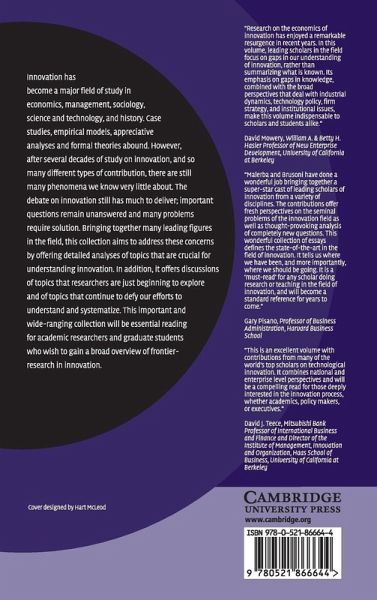
Innovation has become a major field of study in economics, management, sociology, science and technology, and history. Case studies, empirical models, appreciative analyses and formal theories abound. However, after several decades of study on innovation, and so many different types of contribution, there are still many phenomena we know very little about. The debate on innovation still has much to deliver; important questions remain unanswered and many problems require solution. Bringing together many leading figures in the field, this collection aims to address these concerns by offering…mehr
Innovation has become a major field of study in economics, management, sociology, science and technology, and history. Case studies, empirical models, appreciative analyses and formal theories abound. However, after several decades of study on innovation, and so many different types of contribution, there are still many phenomena we know very little about. The debate on innovation still has much to deliver; important questions remain unanswered and many problems require solution. Bringing together many leading figures in the field, this collection aims to address these concerns by offering detailed analyses of topics that are crucial for understanding innovation. In addition, it offers discussions of topics that researchers are just beginning to explore and of topics that continue to defy our efforts to understand and systematise. This important and wide-ranging collection will be essential reading for academic researchers and graduate students who wish to gain a broad overview of frontier-research in innovation.
Stefano Brusoni is Assistant Research Professor and Deputy Director of CESPRI at Bocconi University, Milan. Franco Malerba is Professor of Industrial Economics and Director of CESPRI at Bocconi University, Milan.
Inhaltsangabe
Introduction Franco Malerba and Stefano Brusoni; Part I. Innovation and Economic Growth:1. Understanding economic growth as the central task of economic analysis Richard R. Nelson; 2. Innovation and economic growth theory: a Schumpeterian legacy and agenda Bart Verspagen; Part II. The Micro-dynamics of the Innovation Process: 3. Schumpeter's prophecy and individual incentives as a driver of innovation Wesley M. Cohen and Henry Sauermann; 4. Creative destruction in the PC industry Timothy Bresnahan; Part III. Innovation and Industrial Dynamics: 5. Statistical regularities in the evolution of industries: a guide through some evidence and challenges for the theory Giovanni Dosi; 6. Spinoff entry in high-tech industries: motives and consequences Steven Klepper and Peter Thompson; Part IV. Innovation and Institutions: 7. Schumpeterian innovation in institutions Masahiko Aoki; 8. Innovation in Europe's academic institutions Paul A. David; Part V. Innovation, Firms' Organization and Business Strategies: 9. Bringing selection back into our evolutionary theories of innovation Daniel A. Levinthal; 10. From leadership to management: mobilizing knowledge for innovationYves L. Doz, Andrea Cuomo and Julie Wrazel; Part VI. Innovation and Entrepreneurship: 11. Schumpeterian legacies for entrepreneurship and networks: the social dimensions of entrepreneurial action Piera Morlacchi; 12. Knowledge-based entrepreneurship: the organizational side of technology commercialization Ulrich Witt and Christian Zellner; Part VII. Innovation and the Evolution of the University System: 13. Academic entrepreneurs and technology transfer: who participates and why? Janet Bercovitz and Maryann Feldman; 14. Modelling and measuring scientific production: a first estimation for a panel of OECD countries Gustavo Crespi and Aldo Geuna; Part VIII. Innovation and Public Policy: 15. Innovation systems, innovation policy and restless capitalism Stan Metcalfe; 16. Intellectual property rights and competition policy Paul A. Geroski; 17. The policy shaper's anxiety at the innovation kick: how far do innovation theories really help in the world of policy? Paraskevas Caracostas; Part IX. Chapter Commentaries Jan Fagerberg, Ashish Arora, Luigi Orsenigo, Bengt-Ake Lundvall, Sidney G. Winter, Maureen McKelvey and W. Edward Steinmueller; Index.
Introduction Franco Malerba and Stefano Brusoni; Part I. Innovation and Economic Growth:1. Understanding economic growth as the central task of economic analysis Richard R. Nelson; 2. Innovation and economic growth theory: a Schumpeterian legacy and agenda Bart Verspagen; Part II. The Micro-dynamics of the Innovation Process: 3. Schumpeter's prophecy and individual incentives as a driver of innovation Wesley M. Cohen and Henry Sauermann; 4. Creative destruction in the PC industry Timothy Bresnahan; Part III. Innovation and Industrial Dynamics: 5. Statistical regularities in the evolution of industries: a guide through some evidence and challenges for the theory Giovanni Dosi; 6. Spinoff entry in high-tech industries: motives and consequences Steven Klepper and Peter Thompson; Part IV. Innovation and Institutions: 7. Schumpeterian innovation in institutions Masahiko Aoki; 8. Innovation in Europe's academic institutions Paul A. David; Part V. Innovation, Firms' Organization and Business Strategies: 9. Bringing selection back into our evolutionary theories of innovation Daniel A. Levinthal; 10. From leadership to management: mobilizing knowledge for innovationYves L. Doz, Andrea Cuomo and Julie Wrazel; Part VI. Innovation and Entrepreneurship: 11. Schumpeterian legacies for entrepreneurship and networks: the social dimensions of entrepreneurial action Piera Morlacchi; 12. Knowledge-based entrepreneurship: the organizational side of technology commercialization Ulrich Witt and Christian Zellner; Part VII. Innovation and the Evolution of the University System: 13. Academic entrepreneurs and technology transfer: who participates and why? Janet Bercovitz and Maryann Feldman; 14. Modelling and measuring scientific production: a first estimation for a panel of OECD countries Gustavo Crespi and Aldo Geuna; Part VIII. Innovation and Public Policy: 15. Innovation systems, innovation policy and restless capitalism Stan Metcalfe; 16. Intellectual property rights and competition policy Paul A. Geroski; 17. The policy shaper's anxiety at the innovation kick: how far do innovation theories really help in the world of policy? Paraskevas Caracostas; Part IX. Chapter Commentaries Jan Fagerberg, Ashish Arora, Luigi Orsenigo, Bengt-Ake Lundvall, Sidney G. Winter, Maureen McKelvey and W. Edward Steinmueller; Index.
Rezensionen
'This is an excellent volume with contributions from many of the world's top scholars on technological innovation. It combines national and enterprise level perspectives and will be a compelling read for those deeply interested in the innovation process, whether academics, policy makers, or executives.' David J. Teece, Mitsubishi Bank Professor of International Business and Finance and Director of the Institute of Management, Innovation and Organization, Haas School of Business, University of California at Berkeley
Es gelten unsere Allgemeinen Geschäftsbedingungen: www.buecher.de/agb
Impressum
www.buecher.de ist ein Internetauftritt der buecher.de internetstores GmbH
Geschäftsführung: Monica Sawhney | Roland Kölbl | Günter Hilger
Sitz der Gesellschaft: Batheyer Straße 115 - 117, 58099 Hagen
Postanschrift: Bürgermeister-Wegele-Str. 12, 86167 Augsburg
Amtsgericht Hagen HRB 13257
Steuernummer: 321/5800/1497
USt-IdNr: DE450055826