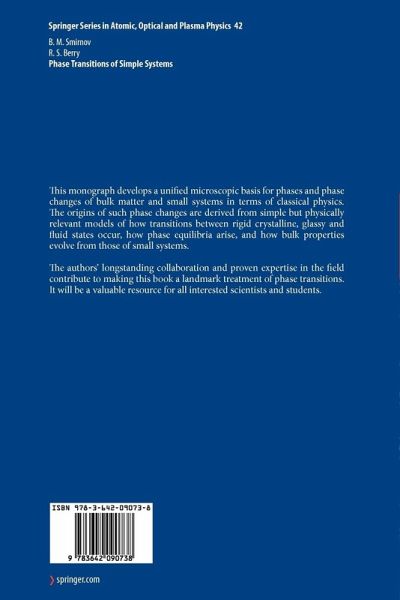
Thermodynamic concepts of aggregate states and their phase transitions - veloped during the 19th Century and are now the basis of our contem- rary understanding of these phenomena. Thermodynamics gives an universal, macroscopic description of the equilibrium properties of phase transitions - dependent of the detailed nature of the substances. However understanding the nature of phase transitions at the microscopic level requires a di?erent approach, one that takes into account the speci?cs of the interparticle int- actions. In this book, we lay the groundwork that connects the microscopic…mehr
Thermodynamic concepts of aggregate states and their phase transitions - veloped during the 19th Century and are now the basis of our contem- rary understanding of these phenomena. Thermodynamics gives an universal, macroscopic description of the equilibrium properties of phase transitions - dependent of the detailed nature of the substances. However understanding the nature of phase transitions at the microscopic level requires a di?erent approach, one that takes into account the speci?cs of the interparticle int- actions. In this book, we lay the groundwork that connects the microscopic phenomena underlying phase changes with the macroscopic picture, but in a somewhat restricted way. We deal only with systems in which electronic excitations are not important, only with atomic systems, and only with - mogeneous systems. We also restrict our analysis to systems in which only pairwise interactions need be included, and, in many parts of the treatment, to systems in which one need consider only the interactions between nearest neighbor atoms. In establishing these restrictions, we can be guided by the solid and liquid states of inert gases and the phase transitions between them, althoughthesubsequentanalysisisrelevantandapplicableforaseriesofother physical systems. To study the behavior of a system of many interacting identical par- cles, we work extensively with its potential energy surface (PES), a surface in a many-dimensional space whose independent variables are the monomer coordinates or some transformation thereof. A central property of any m- tidimensional PES is its large number of local minima.
Produktdetails
Produktdetails
Springer Series on Atomic, Optical, and Plasma Physics 42
V.P. Krainov was born in Moscow in 1938. In 1962 he obtained a Master of Science in the field of theoretical nuclear physics and went on to complete his Doctor of Phys. Mat. Science in 1982. He became a professor of physics in 1986. Between 1963 and 1971 he worked as a scientist at the Kurchatov Institute of Atomic Energy in Moscow and was a professor at the Moscow Engineering Physics Institute from 1971 to 1992. Since then he has been a professor at Moscow Institute of Physics and Technology. Throughout his career his research has focused primarily on the theory of atomic, molecular, plasma and nuclear physics. He is the author of 27 books and about 380 papers. Boris Smirnov was born in 1938 in Moscow. In 1962 he graduated from Moscow's Engineering-Physical Institute in theoretical nuclear physics and obtained his Doctor of Phys. Mat. Science in 1968. He became a professor of physics in 1970. Between 1962 and 1982 he was Head of Laboratory at Kurchatov Institute of Atomic Energy (Moscow), then from 1982 to 1986 Head of Laboratory at Institute of Thermophysics (Novosibirsk) and from 1986 Head of Laboratory and Head of Department and, currently, Principal Scientist at the Joint Institute for High Temperatures of the Russian Academy of Science. B.M. Smirnov was a member of the editorial board of several journals of various publishers. He was a professor at the Moscow Power Institute, Novosibirsk, State University and the Moscow Institute of Science and Technology, and is a laureate of the National Prize of Russia. His research focusses on theoretical physics, atomic, molecular, cluster, plasma and chemical physics. He is the author of 53 books and about 500 papers.
Inhaltsangabe
Thermodynamics of Ensembles of Classical Particles.- Excitations in Simple Atomic Ensembles.- Structures of Ensembles of Interacting Particles.- Thermodynamics of Dense Gases and Liquids.- Clusters with Short-Range Interaction.- Ensembles of Classical Particles with Repulsion.- Configurational Excitations and Aggregate States of Ensembles of Classical Particles.- Configurational Excitation and Voids in Ensembles of Bound Classical Atoms.- Configurational Cluster Excitation with Pairwise Interactions.- Phase Transitions in Macroscopic Systems of Atoms.- Melting of Clusters and Bulk Atomic Ensembles.- Dynamics of Configurational Excitations in Ensembles of Classical Particles.- Coexistence of Cluster Phases.- Glassy States of an Ensemble of Bound Atoms.- Transport of Voids in Nucleation Processes.- Conclusion and Summary.
Thermodynamics of Ensembles of Classical Particles.- Excitations in Simple Atomic Ensembles.- Structures of Ensembles of Interacting Particles.- Thermodynamics of Dense Gases and Liquids.- Clusters with Short-Range Interaction.- Ensembles of Classical Particles with Repulsion.- Configurational Excitations and Aggregate States of Ensembles of Classical Particles.- Configurational Excitation and Voids in Ensembles of Bound Classical Atoms.- Configurational Cluster Excitation with Pairwise Interactions.- Phase Transitions in Macroscopic Systems of Atoms.- Melting of Clusters and Bulk Atomic Ensembles.- Dynamics of Configurational Excitations in Ensembles of Classical Particles.- Coexistence of Cluster Phases.- Glassy States of an Ensemble of Bound Atoms.- Transport of Voids in Nucleation Processes.- Conclusion and Summary.
Es gelten unsere Allgemeinen Geschäftsbedingungen: www.buecher.de/agb
Impressum
www.buecher.de ist ein Internetauftritt der buecher.de internetstores GmbH
Geschäftsführung: Monica Sawhney | Roland Kölbl | Günter Hilger
Sitz der Gesellschaft: Batheyer Straße 115 - 117, 58099 Hagen
Postanschrift: Bürgermeister-Wegele-Str. 12, 86167 Augsburg
Amtsgericht Hagen HRB 13257
Steuernummer: 321/5800/1497
USt-IdNr: DE450055826