- Gebundenes Buch
- Merkliste
- Auf die Merkliste
- Bewerten Bewerten
- Teilen
- Produkt teilen
- Produkterinnerung
- Produkterinnerung
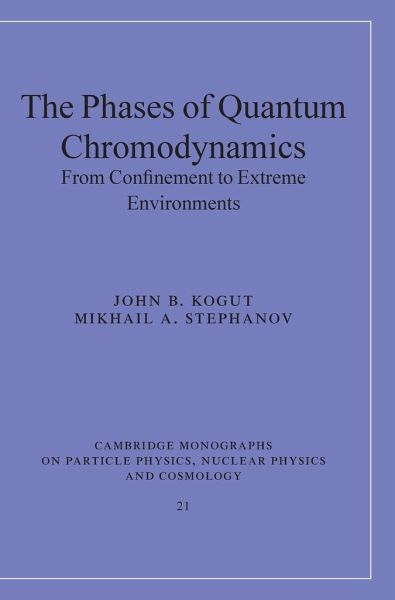
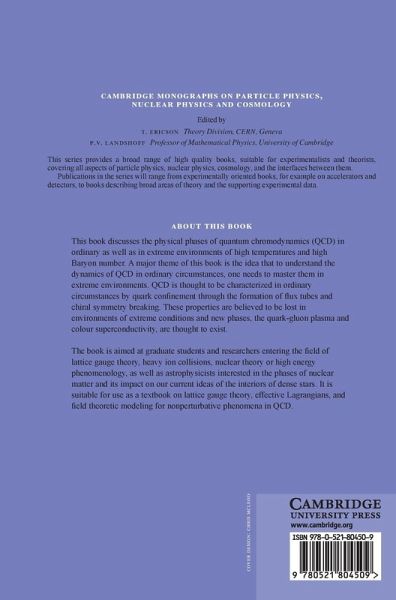
Reference for graduate students, covering the physical phases of quantum chromodynamics (QCD).
Andere Kunden interessierten sich auch für
J. R. ForshawQuantum Chromodynamics and the Pomeron101,99 €
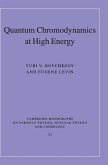
Yuri V. KovchegovQuantum Chromodynamics at High Energy141,99 €
Yuri V. KovchegovQuantum Chromodynamics at High Energy111,99 €
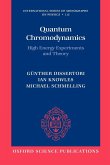
Günther DissertoriQuantum Chromodynamics High Energy Experiments and Theory (Paperback)104,99 €
Quantum Chromodynamics - Proceedings of the Fifth Workshop155,99 €
Quantum Chromodynamics - Proceedings of the IV Workshop156,99 €
R. Fiore / L.L. Jenkovszky / M.I. Kotsky / V.K. Magas / A. Papa (Hgg.)DIFFRACTION 2002: Interpretation of the New Diffractive Phenomena in Quantum Chromodynamics and in the S-Matrix Theory77,99 €-
-
-
Reference for graduate students, covering the physical phases of quantum chromodynamics (QCD).
Produktdetails
- Produktdetails
- Verlag: Cambridge University Press
- Seitenzahl: 376
- Erscheinungstermin: 24. Dezember 2003
- Englisch
- Abmessung: 250mm x 175mm x 25mm
- Gewicht: 827g
- ISBN-13: 9780521804509
- ISBN-10: 0521804507
- Artikelnr.: 21367818
- Herstellerkennzeichnung
- Libri GmbH
- Europaallee 1
- 36244 Bad Hersfeld
- gpsr@libri.de
- Verlag: Cambridge University Press
- Seitenzahl: 376
- Erscheinungstermin: 24. Dezember 2003
- Englisch
- Abmessung: 250mm x 175mm x 25mm
- Gewicht: 827g
- ISBN-13: 9780521804509
- ISBN-10: 0521804507
- Artikelnr.: 21367818
- Herstellerkennzeichnung
- Libri GmbH
- Europaallee 1
- 36244 Bad Hersfeld
- gpsr@libri.de
John Kogut obtained his PhD from Stanford University in 1971. He was nominated for the 1987 Nobel Peace Prize, for the International Scientists' Boycott of the Strategic Defense Initiative. He is currently Professor of Physics at the University of Illinois, Urbana-Champaign. He is co-author of over 200 original papers in elementary particle, high-energy and condensed matter physics, and is the author of one previous book.
Mikhail Sephanov obtained his PhD from the University of Oxford in 1994. He was a Postdoctoral Research Associate University of Illinois, Urbana-Champaign from 1994 to 1997 and then spent two years at the State University of New York at Stony Brook. He is presently Assistant Professor at the University of Illinois at Chicago and RHIC Fellow. His research interests lie in particle and nuclear physics, quantum field theory on the lattice, matter under extreme conditions, and heavy-ion collisions.
1. Introduction
2. Background to spin systems and critical phenomena
3. Gauge fields on a four-dimensional Euclidean lattice
4. Fermions and nonperturbative dynamics in QCD
5. Lattice fermions and chiral symmetry
6. Hamiltonian version of lattice-gauge theory
7. Phase transitions in lattice-gauge theory at high temperatures
8. Physics of QCD at high temperatures and chemical potentials
9. Large chemical potentials and color superconductivity
10. Effective Lagrangians and models of QCD at nonzero chemical potential
11. Lattice-gauge theory at nonzero chemical potential
12. Epilogue
References
Index.

2. Background to spin systems and critical phenomena
3. Gauge fields on a four-dimensional Euclidean lattice
4. Fermions and nonperturbative dynamics in QCD
5. Lattice fermions and chiral symmetry
6. Hamiltonian version of lattice-gauge theory
7. Phase transitions in lattice-gauge theory at high temperatures
8. Physics of QCD at high temperatures and chemical potentials
9. Large chemical potentials and color superconductivity
10. Effective Lagrangians and models of QCD at nonzero chemical potential
11. Lattice-gauge theory at nonzero chemical potential
12. Epilogue
References
Index.
1. Introduction
2. Background to spin systems and critical phenomena
3. Gauge fields on a four-dimensional Euclidean lattice
4. Fermions and nonperturbative dynamics in QCD
5. Lattice fermions and chiral symmetry
6. Hamiltonian version of lattice-gauge theory
7. Phase transitions in lattice-gauge theory at high temperatures
8. Physics of QCD at high temperatures and chemical potentials
9. Large chemical potentials and color superconductivity
10. Effective Lagrangians and models of QCD at nonzero chemical potential
11. Lattice-gauge theory at nonzero chemical potential
12. Epilogue
References
Index.
2. Background to spin systems and critical phenomena
3. Gauge fields on a four-dimensional Euclidean lattice
4. Fermions and nonperturbative dynamics in QCD
5. Lattice fermions and chiral symmetry
6. Hamiltonian version of lattice-gauge theory
7. Phase transitions in lattice-gauge theory at high temperatures
8. Physics of QCD at high temperatures and chemical potentials
9. Large chemical potentials and color superconductivity
10. Effective Lagrangians and models of QCD at nonzero chemical potential
11. Lattice-gauge theory at nonzero chemical potential
12. Epilogue
References
Index.