
Andere Kunden interessierten sich auch für
 Encyclopedia of Phenomenology339,99 €
 The Phenomenology of Individual Agency106,99 €
 Doing a Phenomenology of Political Life90,99 €
 Toward an Ontology of Social Communities109,95 €
 Addressing Contemporary Sustainability Challenges Through Eco-Imagination91,99 €
 Philosophical Ecology91,99 €
 Narrating Experiences of Alzheimer's Through the Arts36,99 €


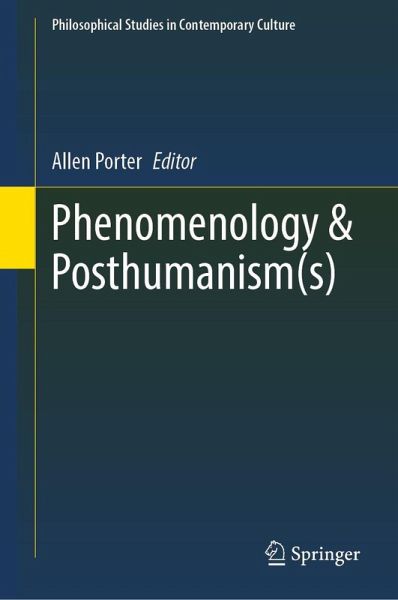
This book offers a timely intervention in the discourses around transhumanism, posthumanism, and phenomenology, aspiring to inaugurate a turning in Western thought in the direction of a more phenomenologically oriented consideration of what it means to be human and of what it might mean to be posthuman. It gathers important contributions from both established and new scholarly voices to each of the literatures on phenomenology, humanism, and posthumanism, as well as to the much scantier literature on phenomenology and posthumanism.
The book treats posthumanism(s) primarily in terms of transhumanism and critical posthumanism but also includes consideration of alternative posthumanisms either extant or conceivable, including forms of phenomenological posthumanism. By phenomenology is primarily meant the tradition of transcendental methodology forged by Edmund Husserl and further developed by such figures as Martin Heidegger, Maurice Merleau-Ponty, and Emmanuel Levinas, among others. In relation to each of the movements of phenomenology, humanism(s), and posthumanism(s), the chapters in this volume propose new understandings of long-discussed topics, offer alternatives to standard accounts, introduce and explicate neglected figures and movements, provide case studies of exemplary issues, and more.
The book is divided into four main parts: Part I: Humanism(s), Part II: Posthumanism(s), Part III: Transhumanism, and Part IV: Humans, Nonhumans, and Posthumans.
The book treats posthumanism(s) primarily in terms of transhumanism and critical posthumanism but also includes consideration of alternative posthumanisms either extant or conceivable, including forms of phenomenological posthumanism. By phenomenology is primarily meant the tradition of transcendental methodology forged by Edmund Husserl and further developed by such figures as Martin Heidegger, Maurice Merleau-Ponty, and Emmanuel Levinas, among others. In relation to each of the movements of phenomenology, humanism(s), and posthumanism(s), the chapters in this volume propose new understandings of long-discussed topics, offer alternatives to standard accounts, introduce and explicate neglected figures and movements, provide case studies of exemplary issues, and more.
The book is divided into four main parts: Part I: Humanism(s), Part II: Posthumanism(s), Part III: Transhumanism, and Part IV: Humans, Nonhumans, and Posthumans.