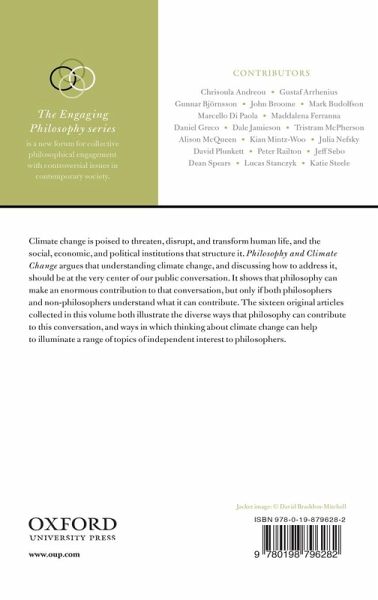
This volume illustrates the diverse ways that philosophy can contribute to conversations around climate change, and explores the ways in which thinking about climate change can help to illuminate a range of topics of independent interest to philosophers.
This volume illustrates the diverse ways that philosophy can contribute to conversations around climate change, and explores the ways in which thinking about climate change can help to illuminate a range of topics of independent interest to philosophers.
Mark Budolfson is Assistant Professor in the Center for Population-Level Bioethics and Department of Environmental and Occupational Health at Rutgers University. Tristram McPherson is Professor of Philosophy at the Ohio State University. David Plunkett is Associate Professor of Philosophy at Dartmouth College.
Inhaltsangabe
* List of Figures * List of Tables * List of Contributors * Abstracts for Chapters * Introduction * Section I. Valuing Climate Change Impacts * 1: Peter Railton: A Convenient Truth? Climate Change and Quality of Life * 2: Jeff Sebo: Animals and Climate Change * 3: Maddalena Ferranna: Discounting under Risk: Utilitarianism vs. Prioritarianism * 4: Kian Mintz-Woo: A Philosopher's Guide to Discounting * 5: Gustaf Arrhenius, Mark Budolfson, and Dean Spears: Climate Change Policy Depend Importantly On Population Ethics? Deflationary Responses to the Challenges of Population Ethics for Public Policy * Section II. Cognition, Emotions, and Climate Change * 6: Chrisoula Andreou: Way to Go, Me * 7: Alison McQueen: The Wages of Fear? Toward Fearing Well About Climate Change * 8: Dan Greco: Climate Change and Cultural Cognition * Section III. Climate Change and Individual Ethics * 9: Julia Nefsky: Climate Change and Individual Obligations: A Dilemma for the Expected Utility Approach, and the Need for an Imperfect View * 10: Tristram McPherson: The Puzzle of Inefficacy * 11: Gunnar Björnsson: On individual and shared obligations: in defense of the activist's perspective * 12: John Broome: What Harm Does Each of Us Do? * Section IV. Climate Change and Politics * 13: Lucas Stanczyk: How Quickly Should the World Reduce Its Greenhouse Gas Emissions? Welfare Economics, the Non-Identity Problem, and the Structure of Intergenerational Justice * 14: Mark Budolfson: Political Realism, Feasibility Wedges, and Opportunities for Collective Action on Climate Change * 15: Katie Steele: Pareto Improvements and Feasible Climate Solutions * 16: Dale Jamieson and Marcello Di Paola: Climate Change, Liberalism, and the Public/Private Distinction * Index
* List of Figures * List of Tables * List of Contributors * Abstracts for Chapters * Introduction * Section I. Valuing Climate Change Impacts * 1: Peter Railton: A Convenient Truth? Climate Change and Quality of Life * 2: Jeff Sebo: Animals and Climate Change * 3: Maddalena Ferranna: Discounting under Risk: Utilitarianism vs. Prioritarianism * 4: Kian Mintz-Woo: A Philosopher's Guide to Discounting * 5: Gustaf Arrhenius, Mark Budolfson, and Dean Spears: Climate Change Policy Depend Importantly On Population Ethics? Deflationary Responses to the Challenges of Population Ethics for Public Policy * Section II. Cognition, Emotions, and Climate Change * 6: Chrisoula Andreou: Way to Go, Me * 7: Alison McQueen: The Wages of Fear? Toward Fearing Well About Climate Change * 8: Dan Greco: Climate Change and Cultural Cognition * Section III. Climate Change and Individual Ethics * 9: Julia Nefsky: Climate Change and Individual Obligations: A Dilemma for the Expected Utility Approach, and the Need for an Imperfect View * 10: Tristram McPherson: The Puzzle of Inefficacy * 11: Gunnar Björnsson: On individual and shared obligations: in defense of the activist's perspective * 12: John Broome: What Harm Does Each of Us Do? * Section IV. Climate Change and Politics * 13: Lucas Stanczyk: How Quickly Should the World Reduce Its Greenhouse Gas Emissions? Welfare Economics, the Non-Identity Problem, and the Structure of Intergenerational Justice * 14: Mark Budolfson: Political Realism, Feasibility Wedges, and Opportunities for Collective Action on Climate Change * 15: Katie Steele: Pareto Improvements and Feasible Climate Solutions * 16: Dale Jamieson and Marcello Di Paola: Climate Change, Liberalism, and the Public/Private Distinction * Index
Es gelten unsere Allgemeinen Geschäftsbedingungen: www.buecher.de/agb
Impressum
www.buecher.de ist ein Internetauftritt der buecher.de internetstores GmbH
Geschäftsführung: Monica Sawhney | Roland Kölbl | Günter Hilger
Sitz der Gesellschaft: Batheyer Straße 115 - 117, 58099 Hagen
Postanschrift: Bürgermeister-Wegele-Str. 12, 86167 Augsburg
Amtsgericht Hagen HRB 13257
Steuernummer: 321/5800/1497
USt-IdNr: DE450055826