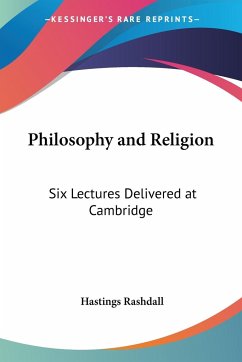
This scarce antiquarian book is a facsimile reprint of the original. Due to its age, it may contain imperfections such as marks, notations, marginalia and flawed pages. Because we believe this work is culturally important, we have made it available as part of our commitment for protecting, preserving, and promoting the world's literature in affordable, high quality, modern editions that are true to the original work.
This scarce antiquarian book is a facsimile reprint of the original. Due to its age, it may contain imperfections such as marks, notations, marginalia and flawed pages. Because we believe this work is culturally important, we have made it available as part of our commitment for protecting, preserving, and promoting the world's literature in affordable, high quality, modern editions that are true to the original work.
Hastings Rashdall was born on June 24, 1858, in London, United Kingdom, to parents Charles Rashdall and Caroline Sophia Rashdall. He became an influential English philosopher, Anglican priest, theologian, and historian. Educated at Harrow School and later at New College, Oxford, Rashdall made significant contributions to moral philosophy and religious thought. He is best known for developing ideal utilitarianism, a refined ethical theory that combines the utilitarian focus on outcomes with a deeper idealist commitment to moral value. He emphasized personal idealism, arguing that spiritual and moral realities are fundamental, and also supported theistic finitism, proposing that God is limited in some respects. In addition to his philosophical work, he was a respected historian of medieval education, with important studies on European universities. Influenced by thinkers such as Henry Sidgwick, T. H. Green, and J. B. Lightfoot, Rashdall sought to bridge rational analysis with spiritual understanding. His major work, The Theory of Good and Evil, published in 1907, remains a key text in ethical philosophy. He died in Worthing on February 9, 1924.
Es gelten unsere Allgemeinen Geschäftsbedingungen: www.buecher.de/agb
Impressum
www.buecher.de ist ein Internetauftritt der buecher.de internetstores GmbH
Geschäftsführung: Monica Sawhney | Roland Kölbl | Günter Hilger
Sitz der Gesellschaft: Batheyer Straße 115 - 117, 58099 Hagen
Postanschrift: Bürgermeister-Wegele-Str. 12, 86167 Augsburg
Amtsgericht Hagen HRB 13257
Steuernummer: 321/5800/1497
USt-IdNr: DE450055826