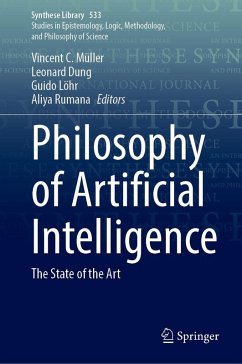
This book contains a selection of the very best papers from the Philosophy of AI (PhAI, formerly PT-AI), one of the leading regular conferences in the field of Philosophy of AI. The field finds itself in a moment of massive growth and change, and this book presents highly innovative, cutting-edge research by top scholars. The philosophy of AI is more and more intertwined with the ethics of AI and it now has both a deep impact on society, and on philosophy itself. Containing chapters on classic issues such as machine agency, regulation or bias, as well as new ones like large language models…mehr
This book contains a selection of the very best papers from the Philosophy of AI (PhAI, formerly PT-AI), one of the leading regular conferences in the field of Philosophy of AI. The field finds itself in a moment of massive growth and change, and this book presents highly innovative, cutting-edge research by top scholars. The philosophy of AI is more and more intertwined with the ethics of AI and it now has both a deep impact on society, and on philosophy itself. Containing chapters on classic issues such as machine agency, regulation or bias, as well as new ones like large language models (LLMs), machine agency, creativity and the general ability to have mental states, this volume is of great interest to those interested in philosophy of AI and its impact on society.
Vincent C. Müller is AvH Professor for Philosophy and Ethics of AI and Director of the Centre for Philosophy and AI Research (PAIR) at FAU Erlangen-Nuremberg - as well as Visiting Professor at TU Eindhoven, President of the European Society for Cognitive Systems, Chair of the Society for the Philosophy of Artificial Intelligence', and Chair of the euRobotics topics group on 'ethical, legal and socio-economic issues'. Previously, he was Professor at the Technical University of Eindhoven (2019-22) and at Anatolia College/ACT (Thessaloniki) (1998-2019), Turing Fellow at the Alan Turing Institute in London (2018-22), University Academic Fellow at the IDEA Centre at the University of Leeds (2016-22), James Martin Research Fellow at the University of Oxford (2011-15) and Stanley J. Seeger Fellow at Princeton University (2005-6). Müller studied philosophy with cognitive science, linguistics and history at the universities of Marburg, Hamburg, London and Oxford. - www.sophia.de/research/ Guido Lohr is an Assistant Professor (TT) of Logic and AI at Vrije Universiteit Amsterdam. He received his (joint) PhD in philosophy (2020) from Ruhr University Bochum and École Normale Supérieure, Paris (Institut Jean Nicod). He hold master's degrees in philosophy (Humboldt University Berlin) and cognitive science (Berlin School of Mind and Brain). As a student, he spent one year at UC Berkeley and two terms at University College London. Before joining the department in Amsterdam, he was a postdoc at Radboud University and Eindhoven University of Technology. In 2023, he visited the Concept Lab in Hong Kong for one month.
Inhaltsangabe
1 Conceptual Engineering Using Large Language Models. 2 Inference to the Best Explanation in Explainable AI (XAI). 3 Generative AI Companions and the Cognitive and Affective Incorporation of the Ersatz Other. 4 Risks Deriving from the Agential Profiles of Modern AI Systems. 5 Explainable and Human Grounded AI for Decision Support Systems: The Theory of Epistemic Quasi Partnerships. 6 Aligning Artificial Intelligence (AI) with Medical Expertise: A Conceptual Understanding of Expert Practices to Foster Ethical AI Integration. 7 The Reality Virtuality Continuum as Flesh: A Phenomenological Interpretation of Mixed Reality. 8 From AI to Octopi and Back: AI Systems as Responsive and Contested Scaffolds. 9 Ecological Cognition and Robotic Affordance Mixtures in HRI: The ‘Kickable’ Challenge to Vice Virtue Asymmetry in Moral Status. 10 Can AI Systems Imagine? A Conceptual Engineering Perspective. 11 Invisible Labour: Who Keeps the Algorithm Running?. 12 Redefining Ethics: The Impact of Advanced Moral Norms in AMAs and the Risk of Moral Alienation. 13 Creativity, Agency, and AI. 14 Fairness in AI ML Systems: An Integrative Ethics Approach. 15 Ethics Guidelines for AI based Suicide Prevention Tools. 16 Human Nature and Artificial Intelligence: Sizing the Gap. 17 Lost in Translation: Artificial Intelligence and the Burden of Bad Metaphors. 18 Co Creativity with Artificial Intelligence. 19 Consciousness in Artificial Systems: Bridging Sensorimotor Theory and Global Workspace in In Silico Models. 20 Is AI Deception Deception?. 21 Comparing AI Ethics and AI Regulation: Ethical Values and Principles and the Case of Well being. 22 Discerning Genuine and Artificial Sociality: A Technomoral Virtue to Wisdom to Live with Chatbots. 23 A Mechanistic Explanatory Strategy for XAI. 24 Embodiment via Machine Learning: A View from Artificial Musical Improvisation. 25 GPT 4’s Alignment with Human Lie and Falsity Attribution in Cases of Deceptive Implicatures.
1 Conceptual Engineering Using Large Language Models. 2 Inference to the Best Explanation in Explainable AI (XAI). 3 Generative AI Companions and the Cognitive and Affective Incorporation of the Ersatz Other. 4 Risks Deriving from the Agential Profiles of Modern AI Systems. 5 Explainable and Human Grounded AI for Decision Support Systems: The Theory of Epistemic Quasi Partnerships. 6 Aligning Artificial Intelligence (AI) with Medical Expertise: A Conceptual Understanding of Expert Practices to Foster Ethical AI Integration. 7 The Reality Virtuality Continuum as Flesh: A Phenomenological Interpretation of Mixed Reality. 8 From AI to Octopi and Back: AI Systems as Responsive and Contested Scaffolds. 9 Ecological Cognition and Robotic Affordance Mixtures in HRI: The ‘Kickable’ Challenge to Vice Virtue Asymmetry in Moral Status. 10 Can AI Systems Imagine? A Conceptual Engineering Perspective. 11 Invisible Labour: Who Keeps the Algorithm Running?. 12 Redefining Ethics: The Impact of Advanced Moral Norms in AMAs and the Risk of Moral Alienation. 13 Creativity, Agency, and AI. 14 Fairness in AI ML Systems: An Integrative Ethics Approach. 15 Ethics Guidelines for AI based Suicide Prevention Tools. 16 Human Nature and Artificial Intelligence: Sizing the Gap. 17 Lost in Translation: Artificial Intelligence and the Burden of Bad Metaphors. 18 Co Creativity with Artificial Intelligence. 19 Consciousness in Artificial Systems: Bridging Sensorimotor Theory and Global Workspace in In Silico Models. 20 Is AI Deception Deception?. 21 Comparing AI Ethics and AI Regulation: Ethical Values and Principles and the Case of Well being. 22 Discerning Genuine and Artificial Sociality: A Technomoral Virtue to Wisdom to Live with Chatbots. 23 A Mechanistic Explanatory Strategy for XAI. 24 Embodiment via Machine Learning: A View from Artificial Musical Improvisation. 25 GPT 4’s Alignment with Human Lie and Falsity Attribution in Cases of Deceptive Implicatures.
Es gelten unsere Allgemeinen Geschäftsbedingungen: www.buecher.de/agb
Impressum
www.buecher.de ist ein Internetauftritt der buecher.de internetstores GmbH
Geschäftsführung: Monica Sawhney | Roland Kölbl | Günter Hilger
Sitz der Gesellschaft: Batheyer Straße 115 - 117, 58099 Hagen
Postanschrift: Bürgermeister-Wegele-Str. 12, 86167 Augsburg
Amtsgericht Hagen HRB 13257
Steuernummer: 321/5800/1497
USt-IdNr: DE450055826