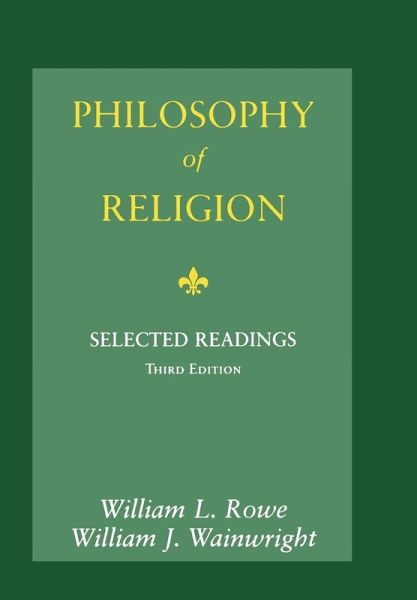
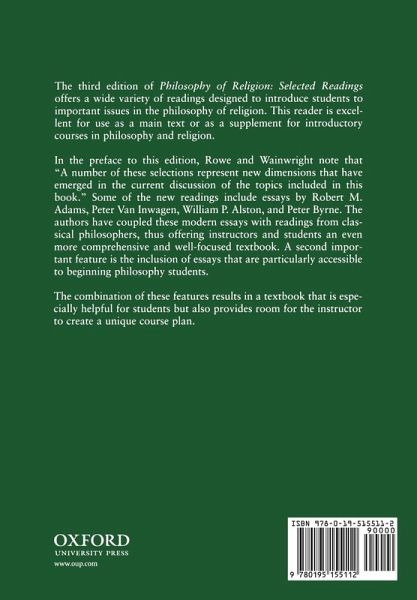
This third edition of Philosophy of Religion offers a wide variety of readings designed to introduce students to important issues in the philosophy of religion. The authors have coupled new readings--including essays by Robert M. Adams, Peter Van Inwagen, and William P. Alston--with readings from classical philosophers, thus offering instructors and students an even more comprehensive and well-focused textbook. Many of the essays are particularly accessible to beginning philosophy students. New essays cover religious pluralism, teleological and moral arguments for God's existence, and the…mehr
This third edition of Philosophy of Religion offers a wide variety of readings designed to introduce students to important issues in the philosophy of religion. The authors have coupled new readings--including essays by Robert M. Adams, Peter Van Inwagen, and William P. Alston--with readings from classical philosophers, thus offering instructors and students an even more comprehensive and well-focused textbook. Many of the essays are particularly accessible to beginning philosophy students. New essays cover religious pluralism, teleological and moral arguments for God's existence, and the problem of evil. Philosophy of Religion, 3/e is an excellent choice for use as a main text or as a supplement for introductory courses in philosophy and religion.
* I. The Nature and Attributes of God * Introduction * * The Divine Nature Exists through Itself, from Monologium * God's Nature Cannot Be Separated from His Existence, from Summa Theologica * Divine Necessity * Can God's Existence Be Disproved? * * Divine Foreknowledge and Freedom of the Will, from The Consolation of Philosophy * The Knowledge of God, from Summa Theologica * Divine Omniscience and Voluntary Action * * The Omnipotence of God, from Summa Theologica * Can God Do Evil?, from A Discourse Concerning the Being and Attributes of God * Omnipotence * * God Is Timeless, Immutable, and Impassible, from Proslogium and Monologium * The Simplicity and Immutability of God, from Summa Theologica * The Divine Relativity, from The Divine Relativity * II. Arguments for the Existence of God * Introduction * * The Ontological Argument, from Proslogium * The Perfect Island Objection * Reply to Gaunilo * The Supremely Perfect Being Must Exist, from Meditations on First Philosophy * Of the Impollibility of an Ontological Proof, from The Critique of Pure Reason * A Modal Version of the Ontological Argument, from God, Freedom and Evil * * The Existence of God and the Beginning of the World, from Summa Theologica * Infinite Causal Regression * The Cosmological Argument, from Discourse Concerning the Being and Attributes of God * Some Objections to the Cosmological Argument, from Dialogues Concerning Natural Religion * Two Criticisms of the Cosmological Argument * * The Evidence of Design, from Natural Theology * Design and the Teleological Argument, from Dialogues Concerning Natural Religion * The Wider Teleological Argument, from Metaphysics * * The Moral Argument, from Kant's Critique of Practical Reason and Other Works * Kant on the Moral Argument, from The Miracle of Theism * Religion and the Queerness of Mortality * III. The Problem of Evil * Introduction * The Argument Reduced to Syllogistic Form, from Theodicy * God and the Problem of Evil, from Dialogs Concerning Natural Religion * Rebellion, from The Brothers Karamazov * The Problem of Evil and Some Varieties of Atheism * The "Soul-Making" Theodicy, from Evil and the God of Love * The Free Will Defense, from God, Freedom, and Evil * IV. Objections to Traditional Theism * Introduction * * Religious Belief, from Lectures and Conversations * Philosophy, Theology and the Reality of God * A Critique of Wittgensteinian Fideism, from The Autonomy of Religious Belief * * The Pluralistic Hypotheses, from An Interpretation of Religion * A Religious Theory of Religion * Worldviews, Criteria and Epistemic Circularity * V. Mysticism and Religious Experience * Introduction * * The Nature of Mysticism, from The Teachings of the Mystics * Nature Mysticism, Soul Mysticism and Theistic Mysticism, from Mysticism: Sacred and Profane * Numinous Experience and Mystical Experience, from A Dialog of Religion * * The Appeal to Religious Experience, from Religion, Philosophy and Psychical Research * The Cognitive Status of Mystical Experience, from Mysticism: A Study of its Nature, Cognitive Value, and Moral Implications * Is Religious Belief Rational?" * VI. Faith and Miracles * Introduction * * Reason and Revelation, from On the Truth of the Catholic Faith * The Wager, from Pensees * The Logic of Pascal's Wager * The Ethics of Belief, from Lectures and Essays * The Will to Believe, from The Will to Believe and Other Essays in Popular Philosophy * Is Belief in God Properly Basic? * Toward a Sensible Evidentialism: On the Notion of "Needing Evidence" * * Of Miracles, from An Enquiry Concerning Human Understanding * Miracles * Revelation and Miracle, from Systematic Theology * VII. Death and Immortality * Introduction * The Soul * The Problem of Life After Death * A Future State, from A Discourse Concerning the Unalterable Obligations of Natural Religion, and the Truth and Certainty of the Christian Revelation * Doubts About Immortality, from Two Essays on Suicide and Immortality * The Dependency Argument, from Some Dogmas of Religion
* I. The Nature and Attributes of God * Introduction * * The Divine Nature Exists through Itself, from Monologium * God's Nature Cannot Be Separated from His Existence, from Summa Theologica * Divine Necessity * Can God's Existence Be Disproved? * * Divine Foreknowledge and Freedom of the Will, from The Consolation of Philosophy * The Knowledge of God, from Summa Theologica * Divine Omniscience and Voluntary Action * * The Omnipotence of God, from Summa Theologica * Can God Do Evil?, from A Discourse Concerning the Being and Attributes of God * Omnipotence * * God Is Timeless, Immutable, and Impassible, from Proslogium and Monologium * The Simplicity and Immutability of God, from Summa Theologica * The Divine Relativity, from The Divine Relativity * II. Arguments for the Existence of God * Introduction * * The Ontological Argument, from Proslogium * The Perfect Island Objection * Reply to Gaunilo * The Supremely Perfect Being Must Exist, from Meditations on First Philosophy * Of the Impollibility of an Ontological Proof, from The Critique of Pure Reason * A Modal Version of the Ontological Argument, from God, Freedom and Evil * * The Existence of God and the Beginning of the World, from Summa Theologica * Infinite Causal Regression * The Cosmological Argument, from Discourse Concerning the Being and Attributes of God * Some Objections to the Cosmological Argument, from Dialogues Concerning Natural Religion * Two Criticisms of the Cosmological Argument * * The Evidence of Design, from Natural Theology * Design and the Teleological Argument, from Dialogues Concerning Natural Religion * The Wider Teleological Argument, from Metaphysics * * The Moral Argument, from Kant's Critique of Practical Reason and Other Works * Kant on the Moral Argument, from The Miracle of Theism * Religion and the Queerness of Mortality * III. The Problem of Evil * Introduction * The Argument Reduced to Syllogistic Form, from Theodicy * God and the Problem of Evil, from Dialogs Concerning Natural Religion * Rebellion, from The Brothers Karamazov * The Problem of Evil and Some Varieties of Atheism * The "Soul-Making" Theodicy, from Evil and the God of Love * The Free Will Defense, from God, Freedom, and Evil * IV. Objections to Traditional Theism * Introduction * * Religious Belief, from Lectures and Conversations * Philosophy, Theology and the Reality of God * A Critique of Wittgensteinian Fideism, from The Autonomy of Religious Belief * * The Pluralistic Hypotheses, from An Interpretation of Religion * A Religious Theory of Religion * Worldviews, Criteria and Epistemic Circularity * V. Mysticism and Religious Experience * Introduction * * The Nature of Mysticism, from The Teachings of the Mystics * Nature Mysticism, Soul Mysticism and Theistic Mysticism, from Mysticism: Sacred and Profane * Numinous Experience and Mystical Experience, from A Dialog of Religion * * The Appeal to Religious Experience, from Religion, Philosophy and Psychical Research * The Cognitive Status of Mystical Experience, from Mysticism: A Study of its Nature, Cognitive Value, and Moral Implications * Is Religious Belief Rational?" * VI. Faith and Miracles * Introduction * * Reason and Revelation, from On the Truth of the Catholic Faith * The Wager, from Pensees * The Logic of Pascal's Wager * The Ethics of Belief, from Lectures and Essays * The Will to Believe, from The Will to Believe and Other Essays in Popular Philosophy * Is Belief in God Properly Basic? * Toward a Sensible Evidentialism: On the Notion of "Needing Evidence" * * Of Miracles, from An Enquiry Concerning Human Understanding * Miracles * Revelation and Miracle, from Systematic Theology * VII. Death and Immortality * Introduction * The Soul * The Problem of Life After Death * A Future State, from A Discourse Concerning the Unalterable Obligations of Natural Religion, and the Truth and Certainty of the Christian Revelation * Doubts About Immortality, from Two Essays on Suicide and Immortality * The Dependency Argument, from Some Dogmas of Religion
Es gelten unsere Allgemeinen Geschäftsbedingungen: www.buecher.de/agb
Impressum
www.buecher.de ist ein Internetauftritt der buecher.de internetstores GmbH
Geschäftsführung: Monica Sawhney | Roland Kölbl | Günter Hilger
Sitz der Gesellschaft: Batheyer Straße 115 - 117, 58099 Hagen
Postanschrift: Bürgermeister-Wegele-Str. 12, 86167 Augsburg
Amtsgericht Hagen HRB 13257
Steuernummer: 321/5800/1497
USt-IdNr: DE450055826

![Language and Religion [microform]](https://bilder.buecher.de/produkte/65/65503/65503269m.jpg "Language and Religion [microform]")
![The Ancient Scandinavians [microform]: Their Maritime Expeditions, Their Discoveries, and Their Religion](https://bilder.buecher.de/produkte/65/65551/65551498m.jpg "The Ancient Scandinavians [microform]: Their Maritime Expeditions, Their Discoveries, and Their Religion")