Andere Kunden interessierten sich auch für
") Pierre (Or, the Ambiguities)16,99 €
Pierre (Or, the Ambiguities)16,99 €") Pierre (Esprios Classics)27,99 €
Pierre (Esprios Classics)27,99 € Grendel9,49 €
 We13,99 €
 The Moon And Sixpence14,99 €
 The Girl with the Golden Eyes14,99 €
 Count Belisarius15,99 €




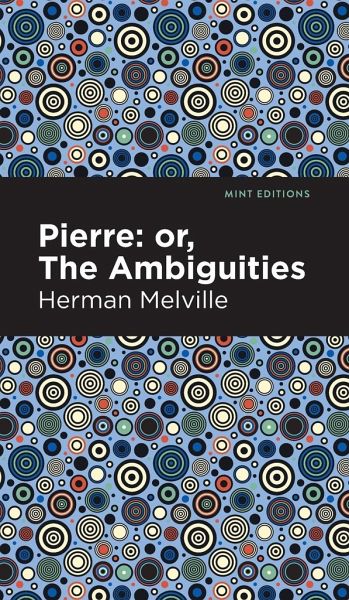
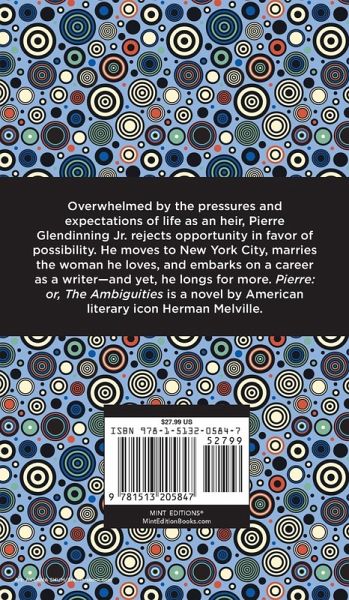
Pierre: or, The Ambiguities (1852) is a novel by American writer Herman Melville. Published the year after Moby-Dick-a critical and commercial failure-Pierre: or, The Ambiguities is a psychological novel in the tradition of Gothic fiction. Melville struggled to find a publisher who would pay him in advance for the book, and its appearance prompted widespread ridicule and condemnation in the press, with some critics claiming that Melville himself had gone mad. The novel plunged Melville deeper into financial ruin, and all but ensured that his next novels, Israel Potter and The Confidence-Man, would be his last. Pierre Glendinning Jr. is a nineteen-year-old heir who lives with his widowed mother at their family manor in upstate New York. Engaged to the beautiful and respectable Lucy Tartan, Pierre stands to inherit-with his mother's approval-a life of comfort and wealth. When he meets a young woman named Isabel Banford, his father's illegitimate daughter, Pierre devises a plan he believes will solve everyone's problems: he will marry Isabel, who will inherit her share of their father's wealth, thereby preserving his father's honor and sparing his mother the embarrassment of her husband's infidelity. Pierre marries Isabel in secret, and when he tells his mother is thrown out of the house and cut off from his family for good. He moves with Isabel to New York City, where he hopes to make a life for himself as a writer, but the sins of the past refuse to let him rest as he wrestles with his choices and discovers the true nature of his seemingly good intentions. This edition of Herman Melville's Pierre: or, The Ambiguities is a classic of American literature reimagined for modern readers. Since our inception in 2020, Mint Editions has kept sustainability and innovation at the forefront of our mission. Each and every Mint Edition title gets a fresh, professionally typeset manuscript and a dazzling new cover, all while maintaining the integrity of the original book. With thousands of titles in our collection, we aim to spotlight diverse public domain works to help them find modern audiences. Mint Editions celebrates a breadth of literary works, curated from both canonical and overlooked classics from writers around the globe.
Herman Melville was an American Renaissance novelist, poet, and short story writer who lived from August 1, 1819, to September 28, 1891. His most well-known pieces are Typee (1846), a romanticized narrative of his experiences in Polynesia; Moby-Dick (1851); and Billy Budd, Sailor, a novella that was released after his death. Although Melville was no longer well-known to the general public at the time of his death, a Melville renaissance began in 1919, the year of his birth. In the end, Moby-Dick was regarded as one of the best American novels. The third child of a wealthy merchant who died in 1832, leaving the family in terrible financial shape, Melville was born in New York City. He sailed as a common sailor in 1839, first as a whaler Acushnet and subsequently as a merchant ship. However, he abandoned ship in the Marquesas Islands. His first work, Typee, and its follow-up, Omoo (1847), were travelogues inspired by his interactions with the island peoples. He was able to marry Elizabeth Shaw, the daughter of Boston lawyer Lemuel Shaw, because to their prosperity. His debut novel not drawn from personal experience, Mardi (1849), was not well received.