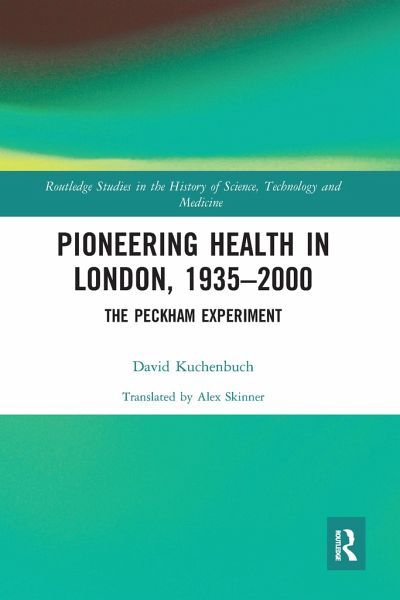

The Peckham Experiment, conducted between 1935 and 1950 in the London Pioneer Health Centre, was one of the most talked-about social experiments of the 20th century. Families from the South London neighbourhood of Peckham were invited to use the facilities of a radiantly modern building. They were encouraged to freely choose and organize their leisure activities, taking advantage of a swimming pool, a gymnasium, and a self-service cafeteria. In doing so, both their health status and interaction with other members of the nascent centre-community were closely observed by a team of physicians.…mehr
The Peckham Experiment, conducted between 1935 and 1950 in the London Pioneer Health Centre, was one of the most talked-about social experiments of the 20th century. Families from the South London neighbourhood of Peckham were invited to use the facilities of a radiantly modern building. They were encouraged to freely choose and organize their leisure activities, taking advantage of a swimming pool, a gymnasium, and a self-service cafeteria. In doing so, both their health status and interaction with other members of the nascent centre-community were closely observed by a team of physicians. The first research monograph on the history of the experiment building on archival sources, this book combines a micro-historical perspective with methods from the history of science. It shows how bio-medical holism and evolutionary theories typical of the interwar years informed research on social life in the centre. But it also reveals that the "guinea pigs", too, were trying to make sense of the research they were taking part in. The outcome was an ambiguous social laboratory that generated new insights into the power of social groups to self-organize, which were soon discussed all over the world - and continue to haunt British political debates today.
David Kuchenbuch is Assistant Professor in the Department of History at Justus-Liebig-University Giessen, Germany.
Inhaltsangabe
Contents List of figures Acknowledgments List of abbreviations 1. Introduction A laboratory of the present? "Peckham" as a social generator of knowledge Structure of the book 2. From C3 to A1 - reforming the working class family (1925-1931) On Queen's Road Pioneers? Helping with self-help Biographical aspects Plans for expansion Responsibility as a biological function: the first book Internal supremacy 3. St Mary's Road, S. E. 15 - new premises, initial routines? (1931-1935) Observation platforms and niches for congregation Success stories 4. "Living Structure of Society" - the magnum opus and its scientific context The social environment as growth medium The ideal life Culture and cultivation Interwar holisms Eugenics, evolution and community 5. Looking through the bioscope - research and social interaction in the prewar centre (1935-1939) Data collection Chaos and order Mary Langman's recollections Revisions: "socialized science" Genius and autocrat The biologist as the summit of creation 6. Interim findings 7. The centre in photographs - visual stimulation and participant observation Holistic perspectives and visual contagions Moving images: The Centre A winter evening 8. Guinea pigs? The members between participation and social control Members' memoirs "Bouquets & Brickbats" An experiment in education 9. Missed opportunities - the centre and the welfare state (1939-1949) War, agriculture and family "Physician, heal thyself" Reviews and an enforced reopening Visitors and lecture tours "Peckham" in the world's press 10. "The Passing of Peckham" (1949-1959) Criticisms from within and without The directors' fall from power The money trail From guinea pigs to citizens' group Proof of the pudding 11."Peckham" after the Pioneer Health Centre and the changing discourse of health (1959) (Post-)modernization From social engineer to social entrepreneur 12. Preliminary conclusion: the Pioneer Health Centre as liberal missing link? 13. The promise of Peckham. Hidden legacies Anarchist appropriations The Peckham experiment as seen by city planners and architects Brave new worlds A "strange laboratory"? Northfield, Hawkspur & Hawthorne Experiments in self-organization Therapeutic experiments The experimental animal 14. Epilogue References Archives
Es gelten unsere Allgemeinen Geschäftsbedingungen: www.buecher.de/agb
Impressum
www.buecher.de ist ein Internetauftritt der buecher.de internetstores GmbH
Geschäftsführung: Monica Sawhney | Roland Kölbl | Günter Hilger
Sitz der Gesellschaft: Batheyer Straße 115 - 117, 58099 Hagen
Postanschrift: Bürgermeister-Wegele-Str. 12, 86167 Augsburg
Amtsgericht Hagen HRB 13257
Steuernummer: 321/5800/1497
USt-IdNr: DE450055826