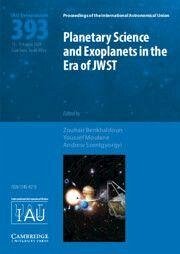
The proceedings of IAU Symposium 393 bring together leading voices in planetary science, exoplanet research, and astrobiology, with a special focus on discoveries enabled by the James Webb Space Telescope (JWST). Topics covered include atmospheric characterization of exoplanets, detection of biosignatures, the dynamics of protoplanetary disks, and studies of Solar System bodies such as comets and Kuiper Belt objects. This volume also highlights international initiatives in public engagement and education, demonstrating how planetary science is expanding globally and becoming more inclusive.…mehr
The proceedings of IAU Symposium 393 bring together leading voices in planetary science, exoplanet research, and astrobiology, with a special focus on discoveries enabled by the James Webb Space Telescope (JWST). Topics covered include atmospheric characterization of exoplanets, detection of biosignatures, the dynamics of protoplanetary disks, and studies of Solar System bodies such as comets and Kuiper Belt objects. This volume also highlights international initiatives in public engagement and education, demonstrating how planetary science is expanding globally and becoming more inclusive. Featuring insights from researchers and educators across multiple continents, this collection captures the multidisciplinary essence of planetary exploration and the search for life beyond Earth. It is a valuable resource for astronomers, planetary scientists, astrobiologists, and educators who wish to understand the scientific breakthroughs and collaborative spirit driving a new era of discovery.
1. Magnetism of Saturn in the origin of the visible dense rings and in their peculiarities recorded by the Cassini probe Vladimir Tchernyi; 2. Migration of bodies ejected from the Earth and the Moon Sergei Ipatov; 3. Unveiling new parent bodies in meteor showers: a robust methodological approach Meryem Guennoun; 4. Host stars and their effects on exoplanet atmospheres: reconstructing the missing extreme-ultraviolet and Lyman-alpha radiation that exoplanets see Jeffrey Linsky; 5. Migration of bodies in the Proxima Centauri and Trappist 1 planetary systems Sergei Ipatov; 6. The magnetic field and space environment of known exoplanet hosts: GJ 436 and HD 63433 Stefano Bellotti; 7. Observing exoplanet biosignatures outside the conservative habitable zone Amri Wandel; 8. Impact of surface pressure on nitrogen-dominated USP super-Earths' atmospheres Jamila Chouqar; 9. Water at the earliest stages of star and planet formation Itziar de Gregorio-Monsalvo; 10. Probing the gas that builds planets: results from the JWST MINDS program Ewine van Dishoeck; 11. Implementing an AstroLab project in Africa Youssef Moulane; 12. Exoplanets in the Classroom: a bilingual K12 educational suite for exploring exoplanet science Marie-Eve Naud; 13. Bringing the sky to the living room: reflections on more than three years of live streaming astronomical events Claudia Mignone; 14. Approach of the NGC1977 star cluster to the TOI-2796 host star Sergei Vereshchagin; 15. Stellar variability monitoring and vistas of its support of JWST programs Alisher Hojaev; 16. Instability of in-plane equilibrium points of the restricted three-body problem with P-R drag and variable masses Tajudeen Amuda; 17. Solar hydrologic cycle determines Earth and Venus atmospheres' mass and composition Xuguang Leng; 18. Numerical geodynamic simulations of the thermal evolution within the outer ice shell of Ganymede Katherine Villavicencio Valero; 19. Observational and chemical modelling of protoplanetary disks after FU Ori outbursts Lis Zwicky; 20. Exploring the collinear Lagrangian points of exoplanet systems with P-R drag and oblateness Priya Shah; 21. Search for new members and age estimation of the young Emilkowalski asteroid family Eduard Kuznetsov; 22. Advances in coronagraphy for future space missions: interferometric apodization through homothety (IAH) and its application in APLC coronagraphs Jamal Chafi; 23. Spectral characterization of a complete equatorial sample of 615 K dwarfs Hodari-Sadiki Hubbard-James; 24. Detecting and characterising exoplanets with HARPS-N Ken Rice; 25. Anticipating additional exoplanets in multi-planetary systems Mahdiyar Mousavi-Sadr; 26. Refining the exoplanet mass-radius relation using machine learning Mahdiyar Mousavi-Sadr; 27. Dynamic evolution of the compact planetary system K2-72 Eduard Kuznetsov; 28. Advancing apodization techniques: optimizing interferometric apodization by homothety for exoplanet detection Aziz Qazbour; 29. Interferometric apodization using deformable mirror in a Michelson interferometer Aziz Qazbour; 30. Shock effects on volatile contents in apatite from poikilitic shergottite NWA7397 Amber Bonsall-Pisano; 31. Discovery of three sub-Neptune exoplanets orbiting M dwarfs with TESS Abderahmane Soubkiou; 32. VLT imaging survey of giant planets around nearby young white dwarfs Wolfgang Brandner; 33. Numerical geodynamic simulations of the thermal evolution within the outer ice shell of Ganymede Katherine Villavicencio Valero.
1. Magnetism of Saturn in the origin of the visible dense rings and in their peculiarities recorded by the Cassini probe Vladimir Tchernyi; 2. Migration of bodies ejected from the Earth and the Moon Sergei Ipatov; 3. Unveiling new parent bodies in meteor showers: a robust methodological approach Meryem Guennoun; 4. Host stars and their effects on exoplanet atmospheres: reconstructing the missing extreme-ultraviolet and Lyman-alpha radiation that exoplanets see Jeffrey Linsky; 5. Migration of bodies in the Proxima Centauri and Trappist 1 planetary systems Sergei Ipatov; 6. The magnetic field and space environment of known exoplanet hosts: GJ 436 and HD 63433 Stefano Bellotti; 7. Observing exoplanet biosignatures outside the conservative habitable zone Amri Wandel; 8. Impact of surface pressure on nitrogen-dominated USP super-Earths' atmospheres Jamila Chouqar; 9. Water at the earliest stages of star and planet formation Itziar de Gregorio-Monsalvo; 10. Probing the gas that builds planets: results from the JWST MINDS program Ewine van Dishoeck; 11. Implementing an AstroLab project in Africa Youssef Moulane; 12. Exoplanets in the Classroom: a bilingual K12 educational suite for exploring exoplanet science Marie-Eve Naud; 13. Bringing the sky to the living room: reflections on more than three years of live streaming astronomical events Claudia Mignone; 14. Approach of the NGC1977 star cluster to the TOI-2796 host star Sergei Vereshchagin; 15. Stellar variability monitoring and vistas of its support of JWST programs Alisher Hojaev; 16. Instability of in-plane equilibrium points of the restricted three-body problem with P-R drag and variable masses Tajudeen Amuda; 17. Solar hydrologic cycle determines Earth and Venus atmospheres' mass and composition Xuguang Leng; 18. Numerical geodynamic simulations of the thermal evolution within the outer ice shell of Ganymede Katherine Villavicencio Valero; 19. Observational and chemical modelling of protoplanetary disks after FU Ori outbursts Lis Zwicky; 20. Exploring the collinear Lagrangian points of exoplanet systems with P-R drag and oblateness Priya Shah; 21. Search for new members and age estimation of the young Emilkowalski asteroid family Eduard Kuznetsov; 22. Advances in coronagraphy for future space missions: interferometric apodization through homothety (IAH) and its application in APLC coronagraphs Jamal Chafi; 23. Spectral characterization of a complete equatorial sample of 615 K dwarfs Hodari-Sadiki Hubbard-James; 24. Detecting and characterising exoplanets with HARPS-N Ken Rice; 25. Anticipating additional exoplanets in multi-planetary systems Mahdiyar Mousavi-Sadr; 26. Refining the exoplanet mass-radius relation using machine learning Mahdiyar Mousavi-Sadr; 27. Dynamic evolution of the compact planetary system K2-72 Eduard Kuznetsov; 28. Advancing apodization techniques: optimizing interferometric apodization by homothety for exoplanet detection Aziz Qazbour; 29. Interferometric apodization using deformable mirror in a Michelson interferometer Aziz Qazbour; 30. Shock effects on volatile contents in apatite from poikilitic shergottite NWA7397 Amber Bonsall-Pisano; 31. Discovery of three sub-Neptune exoplanets orbiting M dwarfs with TESS Abderahmane Soubkiou; 32. VLT imaging survey of giant planets around nearby young white dwarfs Wolfgang Brandner; 33. Numerical geodynamic simulations of the thermal evolution within the outer ice shell of Ganymede Katherine Villavicencio Valero.
Es gelten unsere Allgemeinen Geschäftsbedingungen: www.buecher.de/agb
Impressum
www.buecher.de ist ein Internetauftritt der buecher.de internetstores GmbH
Geschäftsführung: Monica Sawhney | Roland Kölbl | Günter Hilger
Sitz der Gesellschaft: Batheyer Straße 115 - 117, 58099 Hagen
Postanschrift: Bürgermeister-Wegele-Str. 12, 86167 Augsburg
Amtsgericht Hagen HRB 13257
Steuernummer: 321/5800/1497
USt-IdNr: DE450055826