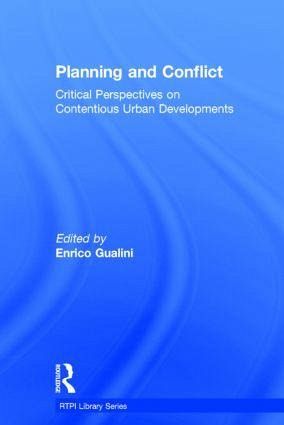
Planning and Conflict discusses the reasons for conflicts around urban developments and analyzes their shape in contemporary cities. It offers an interdisciplinary framework for scholars to engage with the issue of planning conflicts, focusing on both empirical and theoretical inquiry. By reviewing different perspectives for planners to engage with conflicts, and not simply mediate or avoid them, Planning and Conflict provides a theoretically informed look forward to the future of engaged, responsive city development that involves all its stakeholders.
Planning and Conflict discusses the reasons for conflicts around urban developments and analyzes their shape in contemporary cities. It offers an interdisciplinary framework for scholars to engage with the issue of planning conflicts, focusing on both empirical and theoretical inquiry. By reviewing different perspectives for planners to engage with conflicts, and not simply mediate or avoid them, Planning and Conflict provides a theoretically informed look forward to the future of engaged, responsive city development that involves all its stakeholders.
Enrico Gualini is Professor of Planning Theory and Urban-Regional Policy Analysis at the Institute for Urban and Regional Planning of Technische Universität Berlin - Berlin University of Technology, Germany. Among his published books are: Planning and the Intelligence of Institutions (2001), Multilevel Governance and Institutional Change (2004), and Framing Strategic Urban Projects (2007, co-edited with Willem Salet).
Inhaltsangabe
Section 1: Introduction to the volume 1. Conflict in the City: Democratic, Emancipatory - and Transformative? In Search of the Political in Planning Conflicts 2. Space, Politics and Conflicts: A Review of Contemporary Debates in Urban Research and Planning Theory Section 2: Dynamics of Contention and Collective Mobilisation in Planning Conflicts 3. What Makes a Protest (Not) Happen? The Fragmented Landscape of Post-Political Conflict Culture 4. Urban Planning without Conflicts? Observations on the Nature and Conditions for Urban Contestation in the Case of Milan 5. A Muddled Landscape of Conflicts: What we can Learn about Planning/Conflict Relationships from the Story of Tor Marancia, Rome, and its Unexpected Shift Section 3: Knowledge, Power and Hegemony: Exploring the Governmentality of Planning Conflicts 6. Conflict in the Face of Planning? Power, Knowledge, and Hegemony in Planning Practice 7. Planners amidst the Storm: Planning and Politics in the Contested Metropolitan Area of Jerusalem 8. Problem Spaces, Problem Subjects: Contesting Policies in a Shrinking City 9. Mediating Stuttgart 21: The Struggle for Reconstructing Local Democracy between Agonistic and Deliberative Practices Section 4: Interpretive Policy Analysis and Deliberative Approaches to Planning Conflicts 10. Negotiation as an Interpretive Tool of Conflict Transformation in Deliberative Situations: Learning from the French 'Public Debate' on the Extension of the Highway La Francilienne 11. Large Infrastructures and Conflicts: Searching for 'Boundary Objects' - Reflections from an Italian Experience 12. Planning through Emotions: Political Lessons from the Controversy between 'Fat Cats' and 'Stupid Activists' over Re-building Brno Railway Station 13. Develop Stories, Develop Communities: Narrative Practice to Analyse and Engage in Urban Conflict Afterword
Section 1: Introduction to the volume 1. Conflict in the City: Democratic, Emancipatory - and Transformative? In Search of the Political in Planning Conflicts 2. Space, Politics and Conflicts: A Review of Contemporary Debates in Urban Research and Planning Theory Section 2: Dynamics of Contention and Collective Mobilisation in Planning Conflicts 3. What Makes a Protest (Not) Happen? The Fragmented Landscape of Post-Political Conflict Culture 4. Urban Planning without Conflicts? Observations on the Nature and Conditions for Urban Contestation in the Case of Milan 5. A Muddled Landscape of Conflicts: What we can Learn about Planning/Conflict Relationships from the Story of Tor Marancia, Rome, and its Unexpected Shift Section 3: Knowledge, Power and Hegemony: Exploring the Governmentality of Planning Conflicts 6. Conflict in the Face of Planning? Power, Knowledge, and Hegemony in Planning Practice 7. Planners amidst the Storm: Planning and Politics in the Contested Metropolitan Area of Jerusalem 8. Problem Spaces, Problem Subjects: Contesting Policies in a Shrinking City 9. Mediating Stuttgart 21: The Struggle for Reconstructing Local Democracy between Agonistic and Deliberative Practices Section 4: Interpretive Policy Analysis and Deliberative Approaches to Planning Conflicts 10. Negotiation as an Interpretive Tool of Conflict Transformation in Deliberative Situations: Learning from the French 'Public Debate' on the Extension of the Highway La Francilienne 11. Large Infrastructures and Conflicts: Searching for 'Boundary Objects' - Reflections from an Italian Experience 12. Planning through Emotions: Political Lessons from the Controversy between 'Fat Cats' and 'Stupid Activists' over Re-building Brno Railway Station 13. Develop Stories, Develop Communities: Narrative Practice to Analyse and Engage in Urban Conflict Afterword
Es gelten unsere Allgemeinen Geschäftsbedingungen: www.buecher.de/agb
Impressum
www.buecher.de ist ein Internetauftritt der buecher.de internetstores GmbH
Geschäftsführung: Monica Sawhney | Roland Kölbl | Günter Hilger
Sitz der Gesellschaft: Batheyer Straße 115 - 117, 58099 Hagen
Postanschrift: Bürgermeister-Wegele-Str. 12, 86167 Augsburg
Amtsgericht Hagen HRB 13257
Steuernummer: 321/5800/1497
USt-IdNr: DE450055826