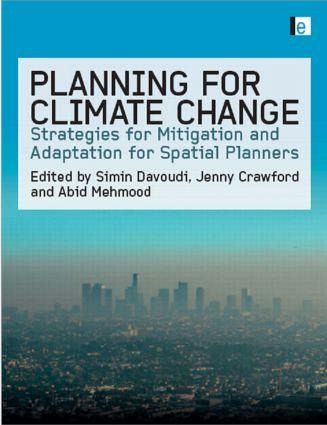
Climate change is changing the context of spatial planning and shaping its priorities. It has strengthened its environmental dimension and has become a new rationale for coordinating actions and integrating different policy priorities. This book sets out the economic, social and environmental challenges that climate change raises for urban and regional planners and explores current and potential responses. These are set within the context of recent research and scholarly works on the role of spatial planning in combating climate change. Addressing both mitigation measures for reducing…mehr
Climate change is changing the context of spatial planning and shaping its priorities. It has strengthened its environmental dimension and has become a new rationale for coordinating actions and integrating different policy priorities. This book sets out the economic, social and environmental challenges that climate change raises for urban and regional planners and explores current and potential responses. These are set within the context of recent research and scholarly works on the role of spatial planning in combating climate change. Addressing both mitigation measures for reducing greenhouse gas emissions and adaptation to the effects of climate change, the book provides an overview of emerging practice, with analysis of the drivers of policy change and practical implementation of measures. It scopes planning issues and opportunities at different spatial scales, drawing on both the UK and international experiences and highlighting the need to link global and local responses to shared risks and opportunities.
Simin Davoudi is Professor of Environmental Policy and Planning and Co-Director Director of the Institute for Research on Environment and Sustainability (IRES) at Newcastle University. Jenny Crawford is an urban and regional planner and Head of Research at the Royal Town Planning Institute. Abid Mehmood is working on environment, sustainability and climate change associate at the Institute for Research on Environment and Sustainability (IRES) and Global Urban Research Unit (GURU), Newcastle University.
Inhaltsangabe
Preface and Acknowledgments Part I Introduction: The Challenge of Climate Change - Adaptation, Mitigation and Vulnerability 1. Climate Change and Spatial Planning Responses 2. Climate Change Mitigation and Adaptation in Developed Nations: A Critical Perspective on the Adaptation Turn in Urban Climate Planning 3. Urban Form and Climate Change: Towards Appropriate Development Patterns to Mitigate and Adapt to Global Warming 4. Patterns of Settlement Compared 5. Transport Policies and Climate Change 6. Transitioning Away from Oil: A Transport Planning Case Study with Emphasis on US and Australian Cities 7. Climate Change Vulnerability: A New Threat to Poverty Alleviation in Developing Countries 8. Climate Change Vulnerability: Planning Challenges for Small Islands Part II Introduction: Strategic Planning Responses 9. The Territorial Agenda of the European Union - Progress for Climate Change Mitigation and Adaptation? 10. California's Climate Change Planning: Policy Innovation and Structural Hurdles 11. Climate Change and Australian Urban Resilience: The Limits of Ecological Modernisation as an Adaptive Strategy 12. Beyond a Technical Response: New Growth-management Experiments in Canada 13. Planning for Offshore Wind Energy in Northern Europe 14. Sustainable Construction and Design in UK Planning 15. Making Space for Water: Spatial Planning and Water Management in the Netherlands 16. Climate Change and Flood Risk Methodologies in the UK Part III Introduction: Implementation, Governance and Engagement 17. Use of Scenarios for Climate Change Adaptation in Spatial Planning 18. Integrated Assessment to Support Regional and Local Decision Making 19. Planning for Green Infrastructure: Adapting to Climate Change 20. Planning and Governance of Climate Change 21. A Climate of Planning: Swedish Municipal Responses to Climate Change 22. Moving Cities Towards a Sustainable Low Carbon Energy Future: Learning from Woking and London 23. Public Engagement in Planning for Renewable Energy
Preface and Acknowledgments Part I Introduction: The Challenge of Climate Change - Adaptation, Mitigation and Vulnerability 1. Climate Change and Spatial Planning Responses 2. Climate Change Mitigation and Adaptation in Developed Nations: A Critical Perspective on the Adaptation Turn in Urban Climate Planning 3. Urban Form and Climate Change: Towards Appropriate Development Patterns to Mitigate and Adapt to Global Warming 4. Patterns of Settlement Compared 5. Transport Policies and Climate Change 6. Transitioning Away from Oil: A Transport Planning Case Study with Emphasis on US and Australian Cities 7. Climate Change Vulnerability: A New Threat to Poverty Alleviation in Developing Countries 8. Climate Change Vulnerability: Planning Challenges for Small Islands Part II Introduction: Strategic Planning Responses 9. The Territorial Agenda of the European Union - Progress for Climate Change Mitigation and Adaptation? 10. California's Climate Change Planning: Policy Innovation and Structural Hurdles 11. Climate Change and Australian Urban Resilience: The Limits of Ecological Modernisation as an Adaptive Strategy 12. Beyond a Technical Response: New Growth-management Experiments in Canada 13. Planning for Offshore Wind Energy in Northern Europe 14. Sustainable Construction and Design in UK Planning 15. Making Space for Water: Spatial Planning and Water Management in the Netherlands 16. Climate Change and Flood Risk Methodologies in the UK Part III Introduction: Implementation, Governance and Engagement 17. Use of Scenarios for Climate Change Adaptation in Spatial Planning 18. Integrated Assessment to Support Regional and Local Decision Making 19. Planning for Green Infrastructure: Adapting to Climate Change 20. Planning and Governance of Climate Change 21. A Climate of Planning: Swedish Municipal Responses to Climate Change 22. Moving Cities Towards a Sustainable Low Carbon Energy Future: Learning from Woking and London 23. Public Engagement in Planning for Renewable Energy
Es gelten unsere Allgemeinen Geschäftsbedingungen: www.buecher.de/agb
Impressum
www.buecher.de ist ein Internetauftritt der buecher.de internetstores GmbH
Geschäftsführung: Monica Sawhney | Roland Kölbl | Günter Hilger
Sitz der Gesellschaft: Batheyer Straße 115 - 117, 58099 Hagen
Postanschrift: Bürgermeister-Wegele-Str. 12, 86167 Augsburg
Amtsgericht Hagen HRB 13257
Steuernummer: 321/5800/1497
USt-IdNr: DE450055826