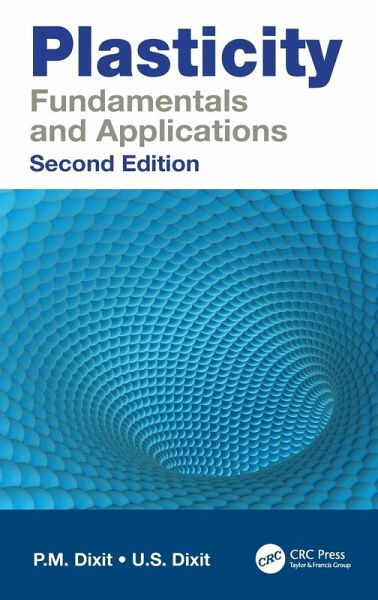
This book covers the fundamentals of the elastic-plastic deformation including stress, strain, constitutive relations, fracture, anisotropy and contact problems along with a discussion of updated Lagrangian and Eulerian formulations. The second edition includes new material on thermal effects in plasticity and an introduction to crystal plasticity with review of all the chapters including more solved examples and a solutions manual. Features: Explores the physics behind the equations and computational aspects of plasticity.Reviews the latest developments in fracture mechanics including…mehr
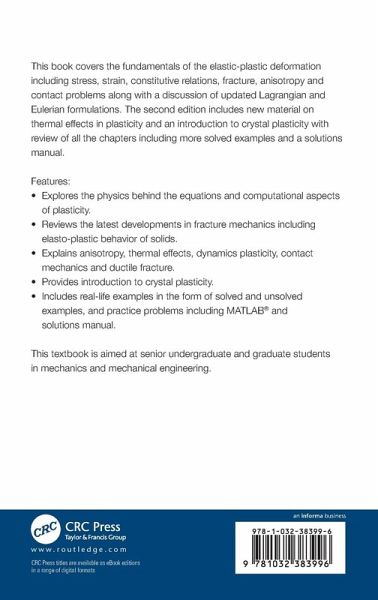
This book covers the fundamentals of the elastic-plastic deformation including stress, strain, constitutive relations, fracture, anisotropy and contact problems along with a discussion of updated Lagrangian and Eulerian formulations. The second edition includes new material on thermal effects in plasticity and an introduction to crystal plasticity with review of all the chapters including more solved examples and a solutions manual.
Features: Explores the physics behind the equations and computational aspects of plasticity.Reviews the latest developments in fracture mechanics including elasto-plastic behavior of solids.Explains anisotropy, thermal effects, dynamics plasticity, contact mechanics and ductile fracture.Provides introduction to crystal plasticity.Includes real-life examples in the form of solved and unsolved examples, and practice problems including MATLAB® and solutions manual. This textbook is aimed at senior undergraduate and graduate students in mechanics and mechanical engineering.
Prakash M. Dixit obtained a bachelor's degree in aeronautical engineering from Indian Institute of Technology (IIT) Kharagpur in 1974 and a PhD in mechanics in 1979 from the University of Minnesota, Minneapolis, USA. After a short teaching career (1980-1984) at the Department of Aeronautical Engineering at IIT Kharagpur, he joined the Department of Mechanical Engineering at IIT Kanpur in 1984, from where he superannuated as a professor in 2016. For 35 years, he worked in the area of computational plasticity with applications to metal-forming processes and ductile fracture in impact problems using the finite element method as a computational tool. He has published about 60 journal papers, 30 conference papers and three books (on modeling of metal-forming processes and plasticity). He has guided ten doctoral and 80 master's students. Uday S. Dixit obtained a bachelor's degree in mechanical engineering from the University of Roorkee (now Indian Institute of Technology Roorkee) in 1987, and MTech in mechanical engineering from Indian Institute of Technology (IIT) Kanpur in 1993, and a PhD in mechanical engineering from IIT Kanpur in 1998. He has worked in two industries-HMT Pinjore and INDOMAG Steel Technology, New Delhi, where his main responsibility was designing various machines. Dr. Dixit joined the Department of Mechanical Engineering, Indian Institute of Technology Guwahati, in 1998, where he is currently a professor. He has been actively engaged in carrying out research in applied plasticity for the last 23 years. Dr. Dixit has published about 150 journal papers, 150 conference papers and eight books related to manufacturing and the finite element method. He has also edited one book on metal forming. He has guest-edited a number of special issues of journals and is currently an associate editor in the Journal of Institution of Engineers (India) Series C and Journal of Micromanufacturing . He has guided 19 doctoral and 56 master's students.
Inhaltsangabe
1. Solid Mechanics and Its Applications 2. Review of Algebra and Calculus of Vectors and Tensors 3. Stress 4. Measures of Deformation and Rate of Deformation 5. Incremental and Rate Type of Elastic-Plastic Constitutive Relations for Isotropic Materials, Objective Incremental Stress and Stress Rate Measures 6. Eulerian and Updated Lagrangian Formulations 7. Calculus of Variations and Extremum Principles 8. Two-Dimensional and Axisymmetric Elasto-Plastic Problems 9. Contact Mechanics 10. Dynamic Elasto-Plastic Problems 11. Continuum Damage Mechanics and Ductile Fracture 12. Plastic Anisotropy 13. Thermal Considerations in Plasticity 14. Introduction to Crystal Plasticity
Solid Mechanics and Its Applications. Review of Algebra and Calculus of Vectors and Tensors. Stress. Measures of Deformation and Rate of Deformation. Incremental and Rate Type of Elastic-Plastic Constitutive Relations for Isotropic Materials, Objective Incremental Stress and Stress Rate Measures. Eulerian and Updated Lagrangian Formulations. Calculus of Variations and Extremum Principles. Two-Dimensional and Axisymmetric Elasto-Plastic Problems. Contact Mechanics. Dynamic Elasto-Plastic Problems. Continuum Damage Mechanics and Ductile Fracture. Plastic Anisotropy. References. Index.
1. Solid Mechanics and Its Applications 2. Review of Algebra and Calculus of Vectors and Tensors 3. Stress 4. Measures of Deformation and Rate of Deformation 5. Incremental and Rate Type of Elastic-Plastic Constitutive Relations for Isotropic Materials, Objective Incremental Stress and Stress Rate Measures 6. Eulerian and Updated Lagrangian Formulations 7. Calculus of Variations and Extremum Principles 8. Two-Dimensional and Axisymmetric Elasto-Plastic Problems 9. Contact Mechanics 10. Dynamic Elasto-Plastic Problems 11. Continuum Damage Mechanics and Ductile Fracture 12. Plastic Anisotropy 13. Thermal Considerations in Plasticity 14. Introduction to Crystal Plasticity
Solid Mechanics and Its Applications. Review of Algebra and Calculus of Vectors and Tensors. Stress. Measures of Deformation and Rate of Deformation. Incremental and Rate Type of Elastic-Plastic Constitutive Relations for Isotropic Materials, Objective Incremental Stress and Stress Rate Measures. Eulerian and Updated Lagrangian Formulations. Calculus of Variations and Extremum Principles. Two-Dimensional and Axisymmetric Elasto-Plastic Problems. Contact Mechanics. Dynamic Elasto-Plastic Problems. Continuum Damage Mechanics and Ductile Fracture. Plastic Anisotropy. References. Index.
Rezensionen
"This book has been written in a way that a plasticity course can be offered to graduate students without previous solid mechanics background. The concept of Cartesian vectors and tensors in index notation is discussed in chapter 2 to prepare students for understanding the topics presented in subsequent chapters. ... This book emphasizes the application of plasticity in solving engineering problems. Eulerian and updated Lagrangian formulations, calculus of variations and extreme principles are discussed in chapters 6 and 7 to prepare students for numerical calculation." -Han-Chin Wu, University of Iowa, Iowa City, USA
"The book is successful in presenting a modern treatment of plasticity theories without sacrificing details both at the conceptual and the applied level. The breadth of applications covered is unique and includes a wide range of disciplines ranging from contact mechanics to fracture. In this the book will find no parallels in the modern literature on plasticity." -Prof. Anurag Gupta, Indian Institute of Technology Kanpur
"Comprehensive coverage from mathematic tools to constitutive formulations, from application examples to computational aspects." -Tongxi Yu, Hong Kong University of Science and Technology (HKUST)
Es gelten unsere Allgemeinen Geschäftsbedingungen: www.buecher.de/agb
Impressum
www.buecher.de ist ein Internetauftritt der buecher.de internetstores GmbH
Geschäftsführung: Monica Sawhney | Roland Kölbl | Günter Hilger
Sitz der Gesellschaft: Batheyer Straße 115 - 117, 58099 Hagen
Postanschrift: Bürgermeister-Wegele-Str. 12, 86167 Augsburg
Amtsgericht Hagen HRB 13257
Steuernummer: 321/5800/1497
USt-IdNr: DE450055826