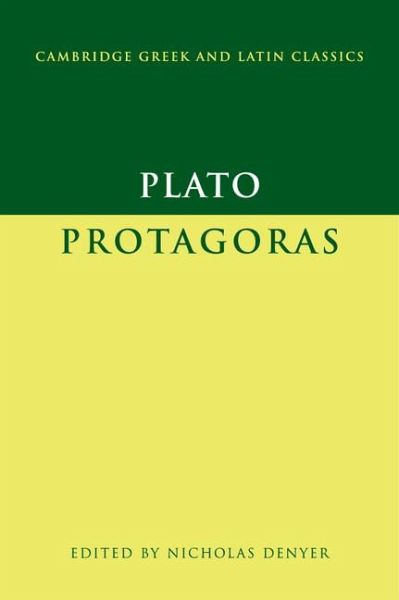
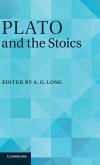
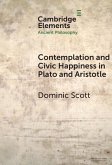
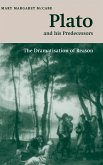
The Protagoras is one of Plato's most entertaining dialogues. It represents Socrates at a gathering of the most celebrated and highest-earning intellectuals of the day, among them the sophist Protagoras. In flamboyant displays of both rhetoric and dialectic, Socrates and Protagoras try to out-argue one another. Their arguments range widely, from political theory to literary criticism, from education to the nature of cowardice; but in view throughout this literary and philosophical masterpiece are the questions of what part knowledge plays in a successful life, and how we may acquire the…mehr
The Protagoras is one of Plato's most entertaining dialogues. It represents Socrates at a gathering of the most celebrated and highest-earning intellectuals of the day, among them the sophist Protagoras. In flamboyant displays of both rhetoric and dialectic, Socrates and Protagoras try to out-argue one another. Their arguments range widely, from political theory to literary criticism, from education to the nature of cowardice; but in view throughout this literary and philosophical masterpiece are the questions of what part knowledge plays in a successful life, and how we may acquire the knowledge that makes for success. This edition contains the first commentary in English on the Greek text for almost a hundred years. The commentary provides the assistance with linguistic, literary and philosophical detail that will enable students and scholars to savour to the full the pleasures of the Protagoras.
Plato (428/427 or 424/423 - 348/347 BC) was an Athenian philosopher during the Classical period in Ancient Greece, founder of the Platonist school of thought, and the Academy, the first institution of higher learning in the Western world. He is widely considered the pivotal figure in the history of Ancient Greek and Western philosophy, along with his teacher, Socrates, and his most famous student, Aristotle.[a] Plato has also often been cited as one of the founders of Western religion and spirituality.[4] The so-called Neoplatonism of philosophers like Plotinus and Porphyry influenced Saint Augustine and thus Christianity. Alfred North Whitehead once noted: "the safest general characterization of the European philosophical tradition is that it consists of a series of footnotes to Plato."[5] Plato was the innovator of the written dialogue and dialectic forms in philosophy. Plato is also considered the founder of Western political philosophy. His most famous contribution is the theory of Forms known by pure reason, in which Plato presents a solution to the problem of universals known as Platonism (also ambiguously called either Platonic realism or Platonic idealism). He is also the namesake of Platonic love and the Platonic solids. His own most decisive philosophical influences are usually thought to have been along with Socrates, the pre-Socratics Pythagoras, Heraclitus and Parmenides, although few of his predecessors' works remain extant and much of what we know about these figures today derives from Plato himself.[b] Unlike the work of nearly all of his contemporaries, Plato's entire body of work is believed to have survived intact for over 2,400 years.[7] Although their popularity has fluctuated over the years, the works of Plato have never been without readers since the time they were written
Es gelten unsere Allgemeinen Geschäftsbedingungen: www.buecher.de/agb
Impressum
www.buecher.de ist ein Internetauftritt der buecher.de internetstores GmbH
Geschäftsführung: Monica Sawhney | Roland Kölbl | Günter Hilger
Sitz der Gesellschaft: Batheyer Straße 115 - 117, 58099 Hagen
Postanschrift: Bürgermeister-Wegele-Str. 12, 86167 Augsburg
Amtsgericht Hagen HRB 13257
Steuernummer: 321/5800/1497
USt-IdNr: DE450055826