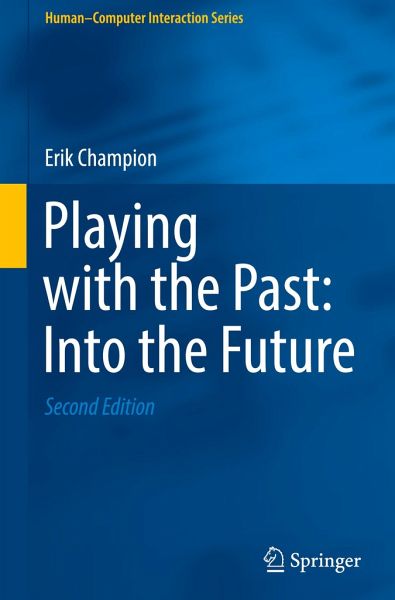
Since the turn of this century (and even earlier), a plethora of projects have arisen to promise us bold new interactive adventures and immersive travel into the past with digital environments (using mixed, virtual or augmented reality, as well as computer games). In Playing with the Past: Into the Future Erik Champion surveys past attempts to communicate history and heritage through virtual environments and suggests new technology and creative ideas for more engaging and educational games and virtual learning environments. This second edition builds on and updates the first edition with…mehr
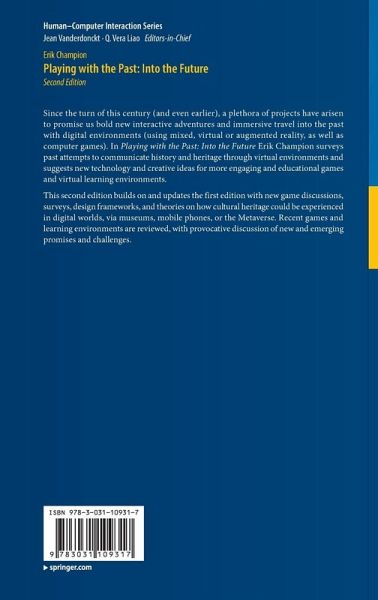
Since the turn of this century (and even earlier), a plethora of projects have arisen to promise us bold new interactive adventures and immersive travel into the past with digital environments (using mixed, virtual or augmented reality, as well as computer games). In Playing with the Past: Into the Future Erik Champion surveys past attempts to communicate history and heritage through virtual environments and suggests new technology and creative ideas for more engaging and educational games and virtual learning environments.
This second edition builds on and updates the first edition with new game discussions, surveys, design frameworks, and theories on how cultural heritage could be experienced in digital worlds, via museums, mobile phones, or the Metaverse. Recent games and learning environments are reviewed, with provocative discussion of new and emerging promises and challenges.
Erik is Associate Professor at Auckland School of Design, Massey University, and a member of IGDA (International Game Developers Association), DiGRA, and ICIP (ICOMOS International Committee on Interpretation and Presentation of Cultural Heritage Sites). He graduated in architecture, philosophy, and engineering (Geomatics). His doctoral thesis 'Evaluating Cultural Learning in Virtual Environments' (sponsored by an Australian Research Council industry grant) involved the design and evaluation of online virtual environments; the industry partner was Lonely Planet. Since his PhD he has supervised or collaborated on various games and virtual environment projects, mostly based on cultural learning, spatial projection, or physical computing. He has taught game design, interaction design, user experience design, architectural design, digital media and CAD. He is now the Associate Professor, Research and Postgraduate Director, School of Design, College of Creative Arts, Massey University, NewZealand. His research areas include: game design, virtual heritage (digital and online interpretations of culture), architectural visualization, serious gaming (using game engines to teach archaeology), innovative peripherals and physical computing (tangible computing, biofeedback, surround displays), interactive narrative, and evaluation techniques for the user experience of interactive spatial media.
Inhaltsangabe
Virtual Travel: Being Not Quite 'There'.- Virtual Environment: Constraints and Possibilities.-Space and Place in Cyberspace.- Culturally Significant Presence.- What Have We Learnt from Game-Style Interaction?.- Playing With The Past: Case Studies.- Mixed Histories, Augmented Pasts.- 8. Evaluating Virtual Heritage in the Future.- An Open Conclusion.- Index.
Virtual Travel: Being Not Quite 'There'.- Virtual Environment: Constraints and Possibilities.-Space and Place in Cyberspace.- Culturally Significant Presence.- What Have We Learnt from Game-Style Interaction?.- Playing With The Past: Case Studies.- Mixed Histories, Augmented Pasts.- 8. Evaluating Virtual Heritage in the Future.- An Open Conclusion.- Index.
Es gelten unsere Allgemeinen Geschäftsbedingungen: www.buecher.de/agb
Impressum
www.buecher.de ist ein Internetauftritt der buecher.de internetstores GmbH
Geschäftsführung: Monica Sawhney | Roland Kölbl | Günter Hilger
Sitz der Gesellschaft: Batheyer Straße 115 - 117, 58099 Hagen
Postanschrift: Bürgermeister-Wegele-Str. 12, 86167 Augsburg
Amtsgericht Hagen HRB 13257
Steuernummer: 321/5800/1497
USt-IdNr: DE450055826