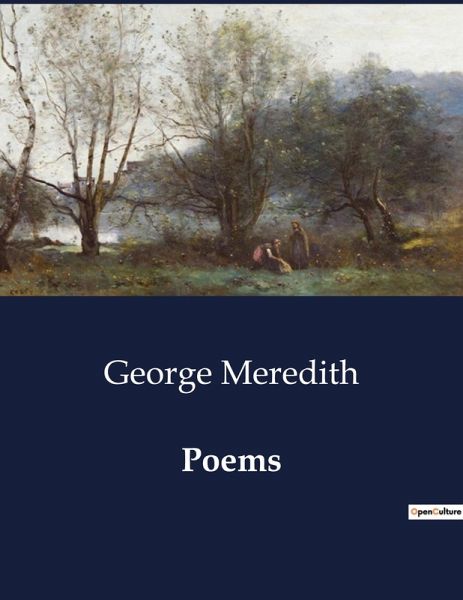
"Poems" by George Meredith is a profound collection that showcases the poet's keen observation, lyrical skill, and philosophical depth. Through his verses, Meredith explores the complexities of human experience, from the depths of emotion to the heights of intellectual inquiry. Each poem is a testament to Meredith's mastery of language and his ability to capture the essence of life's fleeting moments. With themes ranging from love and nature to society and morality, Meredith's poetry offers readers a rich tapestry of thought-provoking reflections and lyrical beauty. "Poems" stands as a…mehr
"Poems" by George Meredith is a profound collection that showcases the poet's keen observation, lyrical skill, and philosophical depth. Through his verses, Meredith explores the complexities of human experience, from the depths of emotion to the heights of intellectual inquiry. Each poem is a testament to Meredith's mastery of language and his ability to capture the essence of life's fleeting moments. With themes ranging from love and nature to society and morality, Meredith's poetry offers readers a rich tapestry of thought-provoking reflections and lyrical beauty. "Poems" stands as a timeless testament to Meredith's enduring legacy as one of the Victorian era's most revered poets, whose words continue to resonate with readers across generations.
Die Herstellerinformationen sind derzeit nicht verfügbar.
Autorenporträt
George Meredith OM (12 February 1828 ¿ 18 May 1909) was an English novelist and poet of the Victorian era. At first his focus was poetry, influenced by John Keats among others, but he gradually established a reputation as a novelist. The Ordeal of Richard Feverel (1859) briefly scandalised Victorian literary circles. Of his later novels, the most enduring is The Egoist (1879), though in his lifetime his greatest success was Diana of the Crossways (1885). His novels were innovative in their attention to characters' psychology, and also took a close interest in social change. His style, in both poetry and prose, was noted for its syntactic complexity; Oscar Wilde likened it to chaos illumined by brilliant flashes of lightning. He was an encourager of other novelists, as well as an influence on them; among those to benefit were Rrt Louis Stevenson and George Gissing. He was nominated for the Nl Prize in Literature seven times.
Es gelten unsere Allgemeinen Geschäftsbedingungen: www.buecher.de/agb
Impressum
www.buecher.de ist ein Internetauftritt der buecher.de internetstores GmbH
Geschäftsführung: Monica Sawhney | Roland Kölbl | Günter Hilger
Sitz der Gesellschaft: Batheyer Straße 115 - 117, 58099 Hagen
Postanschrift: Bürgermeister-Wegele-Str. 12, 86167 Augsburg
Amtsgericht Hagen HRB 13257
Steuernummer: 321/5800/1497
USt-IdNr: DE450055826