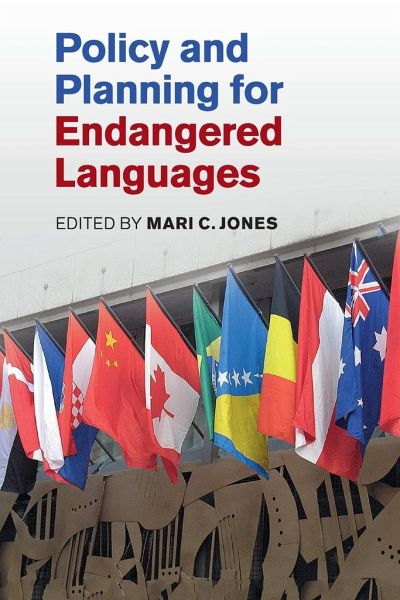
Policy and Planning for Endangered Languages
Herausgeber: Jones, Mari C.
Policy and Planning for Endangered Languages
Herausgeber: Jones, Mari C.
- Broschiertes Buch
- Merkliste
- Auf die Merkliste
- Bewerten Bewerten
- Teilen
- Produkt teilen
- Produkterinnerung
- Produkterinnerung
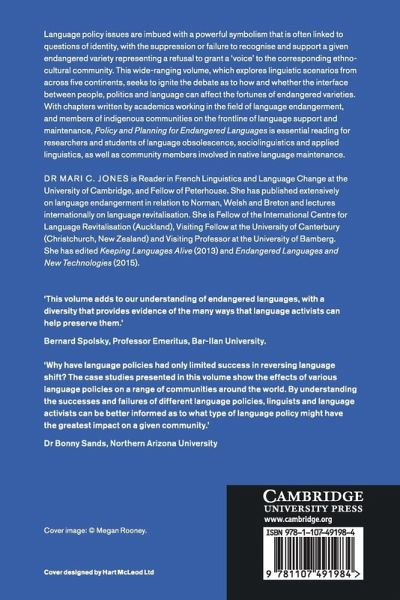
A unique and timely exploration of how the development and implementation of language policy and planning impact on endangered languages.
Andere Kunden interessierten sich auch für
Policy and Planning for Endangered Languages118,99 €
Creating Orthographies for Endangered Languages90,99 €
Creating Orthographies for Endangered Languages43,99 €
A. Grenoble / J. Whaley (eds.)Endangered Languages128,99 €
Revitalizing Endangered Languages119,99 €
A. Grenoble / J. Whaley (eds.)Endangered Languages67,99 €
Language Planning and Policy96,99 €-
-
-
A unique and timely exploration of how the development and implementation of language policy and planning impact on endangered languages.
Produktdetails
- Produktdetails
- Verlag: Cambridge University Press
- Seitenzahl: 280
- Erscheinungstermin: 27. November 2018
- Englisch
- Abmessung: 229mm x 152mm x 15mm
- Gewicht: 410g
- ISBN-13: 9781107491984
- ISBN-10: 1107491983
- Artikelnr.: 55715196
- Herstellerkennzeichnung
- Libri GmbH
- Europaallee 1
- 36244 Bad Hersfeld
- gpsr@libri.de
- Verlag: Cambridge University Press
- Seitenzahl: 280
- Erscheinungstermin: 27. November 2018
- Englisch
- Abmessung: 229mm x 152mm x 15mm
- Gewicht: 410g
- ISBN-13: 9781107491984
- ISBN-10: 1107491983
- Artikelnr.: 55715196
- Herstellerkennzeichnung
- Libri GmbH
- Europaallee 1
- 36244 Bad Hersfeld
- gpsr@libri.de
Preface Mari C. Jones; 1. Leveraging language policy to effect change in
the Arctic Lenore A. Grenoble; 2. Maintaining and revitalising the
indigenous endangered languages of Borneo: comparing 'top-down' and
community-based policy initiatives and strategies James McLellan and Gary
Jones; 3. Language ideologies, practices and policies in Kanaky/New
Caledonia Julia Sallabank; 4. Immersion education and the revitalisation of
Breton and Gaelic as community languages Fabienne Goalalbré; 5. Asset,
affiliation, anxiety? Exploring student perspectives on Welsh-medium study
at post-16 Further Education Colleges Andrew James Davies and Prysor Mason
Davies; 6. From policies to practice: the complex role of social mediators
in Náayeri public education (Nayarit, Mexico) Margarita Valdovinos; 7.
Transitional turtle soup: reconceptualising Mikasuki language acquisition
planning Arieh Sherris and Jill Robbins; 8. Value, status, language policy
and the language plan Rawinia Higgins and Poia Rewi; 9. Assessing the
effect of official recognition on the vitality of endangered languages: a
case study from Italy Claudia Soria; 10. Young Kashubs and language policy:
between officialisation and community Nicole Döowy-Rybi¿ska; 11.
Confrontation and language policy: non-militant perspectives on conflicting
revitalisation strategies in Béarn, France Damien Mooney; 12. Occitan: a
language that cannot stop dying Aurélie Joubert; 13. 'To be a good
westerner, you need to know where you come from': challenges facing
language revitalisation in central Africa Rebecca Mitchell; 14.
Rediscovering history and the Cornish revival: changing attitudes to obtain
language policies Michael Tressider.
the Arctic Lenore A. Grenoble; 2. Maintaining and revitalising the
indigenous endangered languages of Borneo: comparing 'top-down' and
community-based policy initiatives and strategies James McLellan and Gary
Jones; 3. Language ideologies, practices and policies in Kanaky/New
Caledonia Julia Sallabank; 4. Immersion education and the revitalisation of
Breton and Gaelic as community languages Fabienne Goalalbré; 5. Asset,
affiliation, anxiety? Exploring student perspectives on Welsh-medium study
at post-16 Further Education Colleges Andrew James Davies and Prysor Mason
Davies; 6. From policies to practice: the complex role of social mediators
in Náayeri public education (Nayarit, Mexico) Margarita Valdovinos; 7.
Transitional turtle soup: reconceptualising Mikasuki language acquisition
planning Arieh Sherris and Jill Robbins; 8. Value, status, language policy
and the language plan Rawinia Higgins and Poia Rewi; 9. Assessing the
effect of official recognition on the vitality of endangered languages: a
case study from Italy Claudia Soria; 10. Young Kashubs and language policy:
between officialisation and community Nicole Döowy-Rybi¿ska; 11.
Confrontation and language policy: non-militant perspectives on conflicting
revitalisation strategies in Béarn, France Damien Mooney; 12. Occitan: a
language that cannot stop dying Aurélie Joubert; 13. 'To be a good
westerner, you need to know where you come from': challenges facing
language revitalisation in central Africa Rebecca Mitchell; 14.
Rediscovering history and the Cornish revival: changing attitudes to obtain
language policies Michael Tressider.
Preface Mari C. Jones; 1. Leveraging language policy to effect change in
the Arctic Lenore A. Grenoble; 2. Maintaining and revitalising the
indigenous endangered languages of Borneo: comparing 'top-down' and
community-based policy initiatives and strategies James McLellan and Gary
Jones; 3. Language ideologies, practices and policies in Kanaky/New
Caledonia Julia Sallabank; 4. Immersion education and the revitalisation of
Breton and Gaelic as community languages Fabienne Goalalbré; 5. Asset,
affiliation, anxiety? Exploring student perspectives on Welsh-medium study
at post-16 Further Education Colleges Andrew James Davies and Prysor Mason
Davies; 6. From policies to practice: the complex role of social mediators
in Náayeri public education (Nayarit, Mexico) Margarita Valdovinos; 7.
Transitional turtle soup: reconceptualising Mikasuki language acquisition
planning Arieh Sherris and Jill Robbins; 8. Value, status, language policy
and the language plan Rawinia Higgins and Poia Rewi; 9. Assessing the
effect of official recognition on the vitality of endangered languages: a
case study from Italy Claudia Soria; 10. Young Kashubs and language policy:
between officialisation and community Nicole Döowy-Rybi¿ska; 11.
Confrontation and language policy: non-militant perspectives on conflicting
revitalisation strategies in Béarn, France Damien Mooney; 12. Occitan: a
language that cannot stop dying Aurélie Joubert; 13. 'To be a good
westerner, you need to know where you come from': challenges facing
language revitalisation in central Africa Rebecca Mitchell; 14.
Rediscovering history and the Cornish revival: changing attitudes to obtain
language policies Michael Tressider.
the Arctic Lenore A. Grenoble; 2. Maintaining and revitalising the
indigenous endangered languages of Borneo: comparing 'top-down' and
community-based policy initiatives and strategies James McLellan and Gary
Jones; 3. Language ideologies, practices and policies in Kanaky/New
Caledonia Julia Sallabank; 4. Immersion education and the revitalisation of
Breton and Gaelic as community languages Fabienne Goalalbré; 5. Asset,
affiliation, anxiety? Exploring student perspectives on Welsh-medium study
at post-16 Further Education Colleges Andrew James Davies and Prysor Mason
Davies; 6. From policies to practice: the complex role of social mediators
in Náayeri public education (Nayarit, Mexico) Margarita Valdovinos; 7.
Transitional turtle soup: reconceptualising Mikasuki language acquisition
planning Arieh Sherris and Jill Robbins; 8. Value, status, language policy
and the language plan Rawinia Higgins and Poia Rewi; 9. Assessing the
effect of official recognition on the vitality of endangered languages: a
case study from Italy Claudia Soria; 10. Young Kashubs and language policy:
between officialisation and community Nicole Döowy-Rybi¿ska; 11.
Confrontation and language policy: non-militant perspectives on conflicting
revitalisation strategies in Béarn, France Damien Mooney; 12. Occitan: a
language that cannot stop dying Aurélie Joubert; 13. 'To be a good
westerner, you need to know where you come from': challenges facing
language revitalisation in central Africa Rebecca Mitchell; 14.
Rediscovering history and the Cornish revival: changing attitudes to obtain
language policies Michael Tressider.