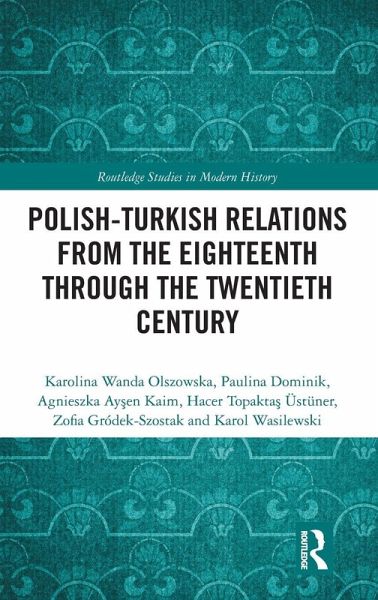
This interdisciplinary volume examines the longstanding and complex relations between Poland and Turkey from the 18th century to the present, exploring their cultural, diplomatic, political and economic dimensions. Drawing on extensive archival research across Europe and the Middle East, it presents a polyphonic narrative that highlights both shared interests and moments of divergence between the two states. The book analyses key themes such as public and cultural diplomacy, transcultural identities, stateless diplomacy, economic cooperation and contemporary foreign policy. It traces how these…mehr
This interdisciplinary volume examines the longstanding and complex relations between Poland and Turkey from the 18th century to the present, exploring their cultural, diplomatic, political and economic dimensions. Drawing on extensive archival research across Europe and the Middle East, it presents a polyphonic narrative that highlights both shared interests and moments of divergence between the two states. The book analyses key themes such as public and cultural diplomacy, transcultural identities, stateless diplomacy, economic cooperation and contemporary foreign policy. It traces how these relations evolved despite periods of geopolitical instability and asymmetries of power, offering new insights into Eastern European and Middle Eastern entanglements. By reassessing Polish-Turkish ties through a longue durée lens, the book contributes to current debates on EU-Turkey relations and the relevance of historical models of cooperation in shaping contemporary international engagements. Rich in empirical material and combining historical, political and cultural analysis, the volume is essential reading for scholars and postgraduate students in international relations, Ottoman and East European history, political science and cultural diplomacy. Its fresh approach and innovative framework make it equally accessible to a broader audience, including policymakers, librarians and non-specialist readers interested in global history and regional connectivity.
Karolina Wanda Olszowska is Assistant Professor at the Faculty of International and Political Studies at Jagiellonian University. Paulina Dominik is Dan David Postdoctoral Fellow at the Faculty of Humanities at Tel Aviv University and former Max Weber Postdoctoral Fellow at the European University Institute. Agnieszka Ay¿en Kaim is Associate Professor at the Institute of Slavic Studies at the Polish Academy of Sciences. Hacer Topaktä Üstüner is Professor of Slavic Languages and Literatures at the Faculty of Letters at Istanbul University. Zofia Gródek-Szostak is Assistant Professor in the Department of Economics and Organization of Enterprises at the Kraków University of Economics. Karol Wasilewski is Head of the Turkey, Caucasus and Central Asia Department at the Centre for Eastern Studies (OSW).
Inhaltsangabe
List of Tables vii About the Authors viii Acknowledgements x Introduction 1 1 Public Diplomacy in 18th-Century Polish-Ottoman Relations 6 1.1 Public Diplomacy as an Instrument of International Cooperation 7 1.2 Cultural Diplomacy in Polish-Ottoman Relations from the Perspective of Extraordinary Envoys 15 1.3 Polyphonies of Public Diplomacy and Their Implications for Polish-Ottoman Relations 23 1.4 Conclusion 25 2 Polish-Ottoman Geopolitical Entanglements from the Late 18th to the Early 20th Century 37 2.1 A Forgotten Alliance: Poland-Lithuania, the Ottoman Empire and the Defence of Europe 38 2.2 Polish-Ottoman Cooperation in the 19th Century: Imperial Contexts, Independence Projects and Polish Activism 41 2.2.1 Stateless Diplomacy: Hôtel Lambert and the Eastern Mission 45 2.2.2 Adampol (Polonezköy): A Strategic Settlement and Symbolic Outpost 49 2.2.3 War as Opportunity: Polish Geopolitical Ambitions amid Russo-Ottoman Conflagrations 50 2.2.4 The Young Poles and the Young Ottomans 52 2.2.5 The End of the Polish Era 53 2.3 Turkey in the Promethean Plans of the Second Republic of Poland: Between Shared Interests and Pragmatic Distance 54 2.3.1 Turkey as a Geopolitical Partner and Laboratory 58 2.4 Conclusion 59 3 The Identity and Transculturality of Ottoman Go-Betweens of Polish Origin and Their Role as Intermediaries in the Modernisation of the Ottoman/Turkish State 70 3.1 Multilayered Identity and Transculturalism of Ottoman/Polish Subjects 70 3.1.1 Heritage of "Imagined Polishness and Poland" 71 3.1.2 Conversion 72 3.1.3 Inter-Religious Identities 74 3.2 Varieties of Ottoman/Turkish Patriotism in the Case of Go-Betweens of Polish Origin 74 3.3 Transmission of European Cultural Models to the New State in the Context of Modernisation 76 3.4 Contact Zone and Polish Istanbul 81 3.5 Conclusion 84 4 From Ambivalence to Sustainable Economic Cooperation 91 4.1 In Two Blocs of Influence-The Relationship in the Period after the Second World War and during the Cold War 92 4.2 Systemic Frameworks for Economic Cooperation 106 4.3 Directions for Sustainable Economic Cooperation 130 4.4 Conclusion 132 5 Poland and Turkey after the Cold War-A Stable Relationship in an Increasingly Unstable International Order 139 5.1 A Payback Time-Turkey's Road to the European Union and Poland's Stance 139 5.2 "New Turkey" and Its Complex Relationship with the EU-A View from Warsaw 145 5.3 New Ideas to Anchor Turkey in Europe after the Fiasco of the Accession Negotiations 148 Index 153
Es gelten unsere Allgemeinen Geschäftsbedingungen: www.buecher.de/agb
Impressum
www.buecher.de ist ein Internetauftritt der buecher.de internetstores GmbH
Geschäftsführung: Monica Sawhney | Roland Kölbl | Günter Hilger
Sitz der Gesellschaft: Batheyer Straße 115 - 117, 58099 Hagen
Postanschrift: Bürgermeister-Wegele-Str. 12, 86167 Augsburg
Amtsgericht Hagen HRB 13257
Steuernummer: 321/5800/1497
USt-IdNr: DE450055826