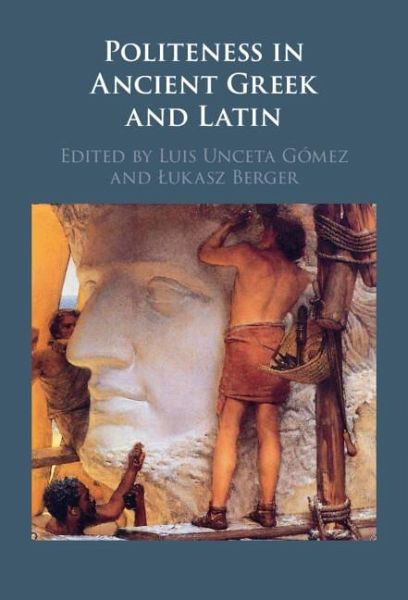
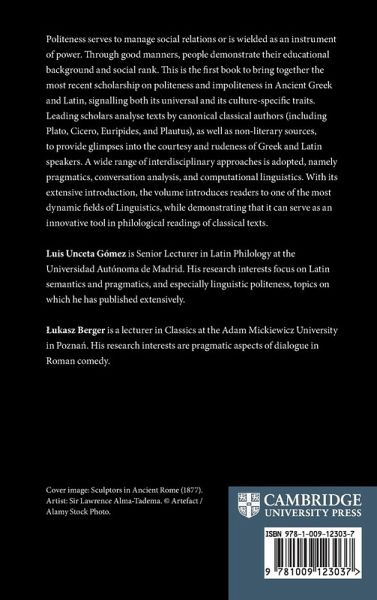
The first major study of politeness in Ancient Greece and Rome, introducing the linguistic framework and showcasing a range of methods, topics, and genres. The individual chapters focus on canonical authors as well as on under-studied texts by ancient scholars and court proceedings.
The first major study of politeness in Ancient Greece and Rome, introducing the linguistic framework and showcasing a range of methods, topics, and genres. The individual chapters focus on canonical authors as well as on under-studied texts by ancient scholars and court proceedings.
Part I. Introduction: 1. Im/Politeness Research in Ancient Greek and Latin: Concepts, Methods, Data Luis Unceta Gómez and ukasz Berger; Part II. The Expression of Im/Politeness: 2. Towards a Comparison of Greek and Roman Politeness Systems Peter Barrios-Lech; 3. How to Be Polite without Saying 'Please' in Classical Greek? The Role of in Polite Requests Camille Denizot; 4. Text as Interaction: ut mihi (quidem) uidetur as a Hedging Device in Latin Literary Texts Francesca Mencacci; 5. Politeness Formulae in Roman Non-Literary Sources: The Case of Juridical Texts Rolando Ferri; Part III. Im/Politeness in Use: 6. Friendship Terms in Plato Michael Lloyd; 7. Conversational Openings and Politeness in Menander. An Integrated Pragmatic Approach to Menandrean Dialogue Giada Sorrentino; 8. Im/politeness of Interruptions in Roman Comedy ukasz Berger; 9. Im/Politeness and Conversation Analysis in Greek Tragedy: The Case of Theseus and the Herald in Euripides' Supplices Evert Van Emde Boas; 10. Qui honoris causa nominatur. Form and Function of Third-Party Politeness in Cicero Lidewij Van Gils and Rodie Risselada; 11. Banter, Teasing and Politeness in Varro's De re rustica Jon Hall; Part IV. Ancient Perceptions on Im/Politeness: 12. Being Polite the Roman Way. Comments about Im/Politeness in the Comedies of Plautus and Terence Luis Unceta Gómez; 13. Impoliteness outside Literature: The Colloquium Harleianum Federica Iurescia; 14. Politeness in Ancient Scholarship Anna Zago.
Part I. Introduction: 1. Im/Politeness Research in Ancient Greek and Latin: Concepts, Methods, Data Luis Unceta Gómez and ukasz Berger; Part II. The Expression of Im/Politeness: 2. Towards a Comparison of Greek and Roman Politeness Systems Peter Barrios-Lech; 3. How to Be Polite without Saying 'Please' in Classical Greek? The Role of in Polite Requests Camille Denizot; 4. Text as Interaction: ut mihi (quidem) uidetur as a Hedging Device in Latin Literary Texts Francesca Mencacci; 5. Politeness Formulae in Roman Non-Literary Sources: The Case of Juridical Texts Rolando Ferri; Part III. Im/Politeness in Use: 6. Friendship Terms in Plato Michael Lloyd; 7. Conversational Openings and Politeness in Menander. An Integrated Pragmatic Approach to Menandrean Dialogue Giada Sorrentino; 8. Im/politeness of Interruptions in Roman Comedy ukasz Berger; 9. Im/Politeness and Conversation Analysis in Greek Tragedy: The Case of Theseus and the Herald in Euripides' Supplices Evert Van Emde Boas; 10. Qui honoris causa nominatur. Form and Function of Third-Party Politeness in Cicero Lidewij Van Gils and Rodie Risselada; 11. Banter, Teasing and Politeness in Varro's De re rustica Jon Hall; Part IV. Ancient Perceptions on Im/Politeness: 12. Being Polite the Roman Way. Comments about Im/Politeness in the Comedies of Plautus and Terence Luis Unceta Gómez; 13. Impoliteness outside Literature: The Colloquium Harleianum Federica Iurescia; 14. Politeness in Ancient Scholarship Anna Zago.
Es gelten unsere Allgemeinen Geschäftsbedingungen: www.buecher.de/agb
Impressum
www.buecher.de ist ein Internetauftritt der buecher.de internetstores GmbH
Geschäftsführung: Monica Sawhney | Roland Kölbl | Günter Hilger
Sitz der Gesellschaft: Batheyer Straße 115 - 117, 58099 Hagen
Postanschrift: Bürgermeister-Wegele-Str. 12, 86167 Augsburg
Amtsgericht Hagen HRB 13257
Steuernummer: 321/5800/1497
USt-IdNr: DE450055826