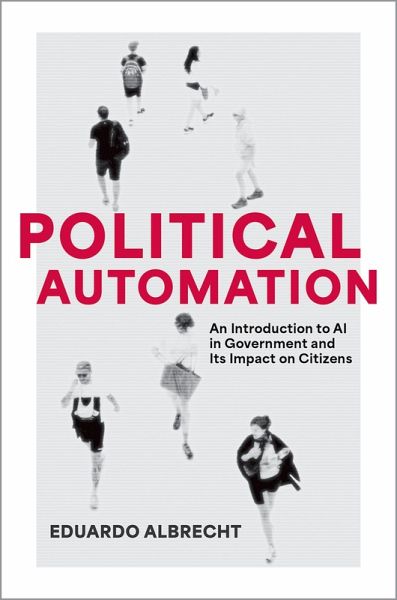
In Political Automation, Eduardo Albrecht explores this question in various domains, including policing, national security, and international peacekeeping. Drawing upon interviews with rights activists, Albrecht examines popular attempts to interact with this novel form of algorithmic governance so far. He then proposes the idea of a Third House, a virtual chamber that legislates exclusively on AI in government decision-making and is based on principles of direct democracy, unlike existing upper and lower houses that are representative. An in-depth look at how political automation impacts the…mehr
In Political Automation, Eduardo Albrecht explores this question in various domains, including policing, national security, and international peacekeeping. Drawing upon interviews with rights activists, Albrecht examines popular attempts to interact with this novel form of algorithmic governance so far. He then proposes the idea of a Third House, a virtual chamber that legislates exclusively on AI in government decision-making and is based on principles of direct democracy, unlike existing upper and lower houses that are representative. An in-depth look at how political automation impacts the lives of citizens, this book addresses the challenges at the heart of automation in public policy decision-making and offers a way forward.
Eduardo Albrecht is Associate Dean at Mercy University, Senior Fellow with the United Nations University's Centre for Policy Research (UNU-CPR), and Adjunct Associate Professor at both City University of New York's (CUNY) Colin Powell School for Civic and Global Leadership and Columbia University's School of International and Public Affairs (SIPA). His research focuses on uses of AI in public decision-making processes. Previously, he served as fellow at the European Institute for Asian Studies (EIAS) and the International Peace Institute (IPI) and worked on projects funded by the World Bank and the British government, leading research teams and gaining direct experience designing innovative AI-based governance tools. His research has been presented at such venues as the Organization for Economic Cooperation and Development (OECD) and the Defense Advanced Research Projects Agency (DARPA), as well as dozens of academic conferences organized by leading political and social science associations.
Inhaltsangabe
Foreword Chapter 1: Political Machines Chapter 2: California Chapter 3: The Informatized Body Chapter 4: Europe Chapter 5: Mechanics of Expression Chapter 6: Africa Chapter 7: Digitized Biographies Chapter 8: India Chapter 9: The Eye of Nations Chapter 10: Kenya Chapter 11: A Third House Appendix I: Further Reading by Scholars Appendix II: Further Reading by Organizations Notes Index
Es gelten unsere Allgemeinen Geschäftsbedingungen: www.buecher.de/agb
Impressum
www.buecher.de ist ein Internetauftritt der buecher.de internetstores GmbH
Geschäftsführung: Monica Sawhney | Roland Kölbl | Günter Hilger
Sitz der Gesellschaft: Batheyer Straße 115 - 117, 58099 Hagen
Postanschrift: Bürgermeister-Wegele-Str. 12, 86167 Augsburg
Amtsgericht Hagen HRB 13257
Steuernummer: 321/5800/1497
USt-IdNr: DE450055826