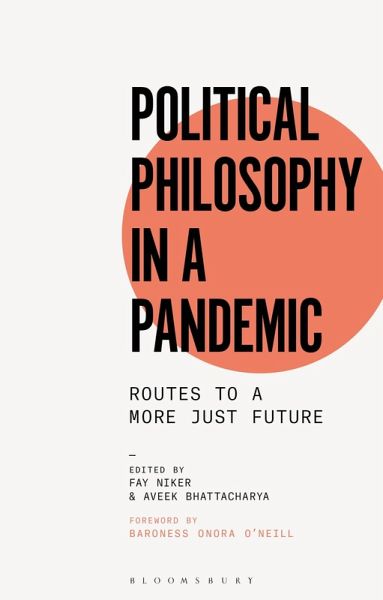
Government lockdowns, school closures, mass unemployment, health and wealth inequality. Political Philosophy in a Pandemic asks us, where do we go from here? What are the ethics of our response to a radically changed, even more unequal society, and how do we seize the moment for enduring change? Addressing the moral and political implications of pandemic response from states and societies worldwide, the 20 essays collected here cover the most pressing debates relating to the biggest public health crisis in the last century. Discussing the pandemic in five key parts covering social welfare,…mehr
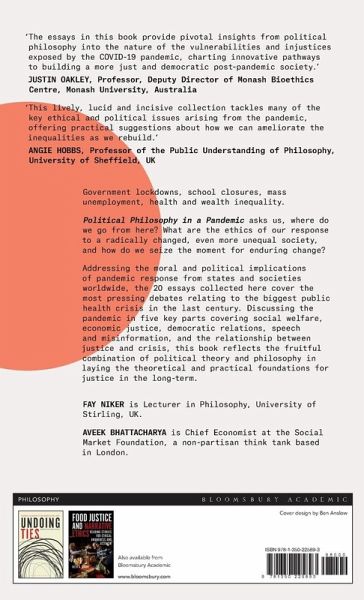
Government lockdowns, school closures, mass unemployment, health and wealth inequality. Political Philosophy in a Pandemic asks us, where do we go from here? What are the ethics of our response to a radically changed, even more unequal society, and how do we seize the moment for enduring change? Addressing the moral and political implications of pandemic response from states and societies worldwide, the 20 essays collected here cover the most pressing debates relating to the biggest public health crisis in the last century. Discussing the pandemic in five key parts covering social welfare, economic justice, democratic relations, speech and misinformation, and the relationship between justice and crisis, this book reflects the fruitful combination of political theory and philosophy in laying the theoretical and practical foundations for justice in the long-term.
Fay Niker is Lecturer in Philosophy, University of Stirling, UK. Aveek Bhattacharya is Chief Economist at the Social Market Foundation, a non-partisan think tank based in London.
Inhaltsangabe
List of contributors Foreword by Onora O'Neill Baroness O'Neill of Bengrave 1. Introduction Aveek Battacharya (Social Market Foundation UK) Fay Niker (University of Stirling UK) Part I Social welfare and vulnerability 2. Risk disadvantage and the COVID-19 crisis Jonathan Wolff (University of Oxford UK) Avner de-Shalit (Hebrew University of Jerusalem Israel) 3. How should we distribute scarce medical resources in a pandemic? Sara Van Goozen (University of York UK) 4. Assessing the impact of school closures on children through a vulnerability lens Nicolás Brando (Queen's University Belfast UK) Katarina Pitasse Fragoso (São Paulo University Brazil) 5. Adequate housing in a pandemic David Jenkins (University of Otago Canada) Katy Wells (University of Warwick UK) Kimberley Brownlee (University of British Columbia Canada) Part II Economic justice 6. Should the older generation pay more of the COVID-19 debt? David Yarrow (University of Edinburgh UK) 7. Rebuilding social insurance to end economic precarity Lisa Herzog (University of Groningen Netherlands) 8. Pandemic solidarity and universal basic income Diana Popescu (King's College London UK) Part III Democratic relations 9. Legitimating pandemic-responsive policy: Whose voices count when? Rowan Cruft (University of Stirling UK) 10. Living alone under lockdown Felix Pinkert (University of Vienna Austria) 11. Should we hold elections during a pandemic? Alexandru Volacu (University of Bucharest Romania) 12. The pandemic and our democratic way of life Marc Stears (University of Sydney Australia) Part IV Speech and (mis)information 13.Coronavirus misinformation social media and freedom of speech Jeffrey Howard (University College London UK) 14. What is the democratic state's obligation of transparency in times of crisis? Rebecca Lowe (King's College London UK) 15. Deferring to expertise in public health emergencies Viktor Ivankovic (Institute of Philosophy Croatia) Lovro Savic (University of Oxford UK) 16. Should we shame those who ignore social distancing guidelines? Paul Billingham (University of Oxford UK) Tom Parr (University of Warwick UK) Part V Crisis and justice 17. Harnessing the epistemic value of crises for just ends Matthew Adams (Indiana University Bloomington USA) Fay Niker (University of Stirling UK) 18. Living through the pandemic: an experiment in egalitarian living for the middle classes? Anca Gheaus (Central European University Austria) 19. Coronavirus and climate change: What can the former teach us about the latter? Julia Hermann (Eindhoven University of Technology Netherlands) Katharina Bauer (Erasmus University Rotterdam Netherlands) Christian Baatz (University of Kiel Germany) 20. Pandemic as political theory Adam Swift (University College London UK) Index
List of contributors Foreword by Onora O'Neill Baroness O'Neill of Bengrave 1. Introduction Aveek Battacharya (Social Market Foundation UK) Fay Niker (University of Stirling UK) Part I Social welfare and vulnerability 2. Risk disadvantage and the COVID-19 crisis Jonathan Wolff (University of Oxford UK) Avner de-Shalit (Hebrew University of Jerusalem Israel) 3. How should we distribute scarce medical resources in a pandemic? Sara Van Goozen (University of York UK) 4. Assessing the impact of school closures on children through a vulnerability lens Nicolás Brando (Queen's University Belfast UK) Katarina Pitasse Fragoso (São Paulo University Brazil) 5. Adequate housing in a pandemic David Jenkins (University of Otago Canada) Katy Wells (University of Warwick UK) Kimberley Brownlee (University of British Columbia Canada) Part II Economic justice 6. Should the older generation pay more of the COVID-19 debt? David Yarrow (University of Edinburgh UK) 7. Rebuilding social insurance to end economic precarity Lisa Herzog (University of Groningen Netherlands) 8. Pandemic solidarity and universal basic income Diana Popescu (King's College London UK) Part III Democratic relations 9. Legitimating pandemic-responsive policy: Whose voices count when? Rowan Cruft (University of Stirling UK) 10. Living alone under lockdown Felix Pinkert (University of Vienna Austria) 11. Should we hold elections during a pandemic? Alexandru Volacu (University of Bucharest Romania) 12. The pandemic and our democratic way of life Marc Stears (University of Sydney Australia) Part IV Speech and (mis)information 13.Coronavirus misinformation social media and freedom of speech Jeffrey Howard (University College London UK) 14. What is the democratic state's obligation of transparency in times of crisis? Rebecca Lowe (King's College London UK) 15. Deferring to expertise in public health emergencies Viktor Ivankovic (Institute of Philosophy Croatia) Lovro Savic (University of Oxford UK) 16. Should we shame those who ignore social distancing guidelines? Paul Billingham (University of Oxford UK) Tom Parr (University of Warwick UK) Part V Crisis and justice 17. Harnessing the epistemic value of crises for just ends Matthew Adams (Indiana University Bloomington USA) Fay Niker (University of Stirling UK) 18. Living through the pandemic: an experiment in egalitarian living for the middle classes? Anca Gheaus (Central European University Austria) 19. Coronavirus and climate change: What can the former teach us about the latter? Julia Hermann (Eindhoven University of Technology Netherlands) Katharina Bauer (Erasmus University Rotterdam Netherlands) Christian Baatz (University of Kiel Germany) 20. Pandemic as political theory Adam Swift (University College London UK) Index
Es gelten unsere Allgemeinen Geschäftsbedingungen: www.buecher.de/agb
Impressum
www.buecher.de ist ein Internetauftritt der buecher.de internetstores GmbH
Geschäftsführung: Monica Sawhney | Roland Kölbl | Günter Hilger
Sitz der Gesellschaft: Batheyer Straße 115 - 117, 58099 Hagen
Postanschrift: Bürgermeister-Wegele-Str. 12, 86167 Augsburg
Amtsgericht Hagen HRB 13257
Steuernummer: 321/5800/1497
USt-IdNr: DE450055826