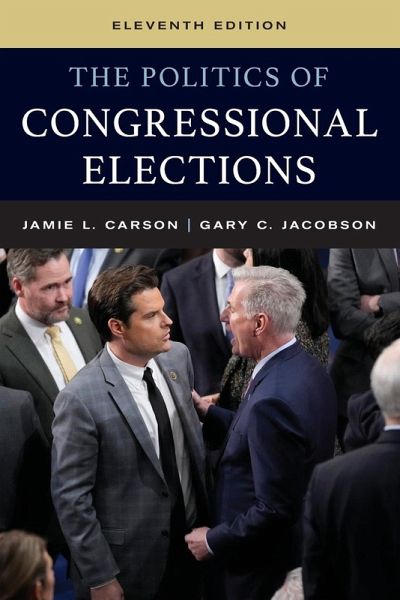
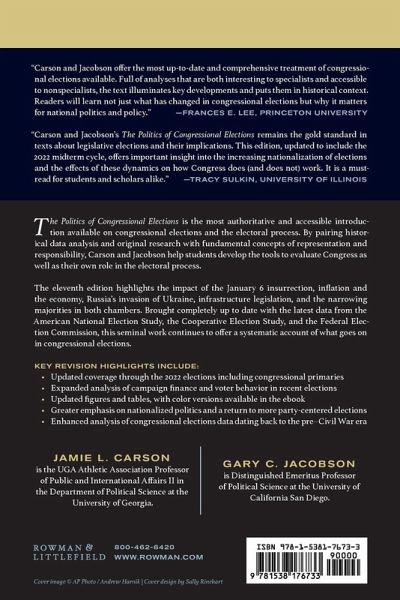
The Politics of Congressional Elections is the most authoritative and accessible introduction available on the topic. By pairing original research with fundamental concepts of representation and responsibility, Carson and Jacobson help students develop the tools to evaluate representative government and their own role in the electoral process.
The Politics of Congressional Elections is the most authoritative and accessible introduction available on the topic. By pairing original research with fundamental concepts of representation and responsibility, Carson and Jacobson help students develop the tools to evaluate representative government and their own role in the electoral process.
Jamie L. Carson is the UGA Athletic Association Professor of Public and International Affairs II in the Department of Political Science at the University of Georgia. He received his PhD from Michigan State University in 2003, where he was a fellow in the Political Institutions and Public Choice Program. Carson's research interests include American politics with a specific emphasis on the U.S. Congress, congressional elections, separation of powers, and American political development. His most recent books include Nationalized Politics: Evaluating Electoral Politics Across Time (with Joel Sievert and Ryan Williamson) and Change and Continuity in the 2020 and 2022 Elections (with John Aldrich, Brad Gomez, and Jennifer Merolla). Gary C. Jacobson is Distinguished Emeritus Professor of Political Science at the University of California, San Diego. He received his PhD from Yale University in 1972 and has served on the Council of the American Political Science Association and on the Board of Overseers of National Election Studies. Jacobson's field of interest is American national politics, with a subfield focus on Congress and congressional elections, and his current research is on the electoral basis of partisan polarization in Congress. Among books he has authored or coauthored are Money in Congressional Elections, The Electoral Origins of Divided Government, and The Logic of American Politics.
Inhaltsangabe
List of Figures List of Tables Preface 1. Introduction 2. The Context The Constitutional Framework Congressional Districts Partisan Gerrymandering Redistricting between Censuses Racial Gerrymandering Bipartisan Gerrymanders The Republican Advantage in House Districts States as Electoral Units Election Laws Political Parties Social and Political Contexts Conclusion 3. Congressional Candidates The Incumbency Factor Measuring the Value of Incumbency The Vanishing Marginals Sources of the Incumbency Advantage The Institutional Characteristics of Congress Changes in Voting Behavior Constituency Service The Variability of the Incumbency Advantage Discouraging the Opposition Money in Congressional Elections The Connection between Money and Success Why Campaign Money Is More Important to Challengers Than to Incumbents The Career in the District Motivating Challengers 4. Congressional Campaigns Campaign Money Contributions to Candidates PACs PACs and the Pivotal 1994 Election Party Money Contributions from Other Members of Congress Self-Financing by Candidates Fund-Raising Tactics and Donors Independent, Voter-Education, and Issue-Advocacy Campaigns Campaign Organizations Campaign Strategies Campaign Media Personal Campaigning Campaign Messages Challengers' Campaigns Going Negative Incumbents' Campaigns Candidates for Open Seats Senate Campaigns Manipulating Turnout Conclusion 5. Congressional Voters Turnout in Congressional Elections Who Votes? Partisanship in Congressional Elections Alternative Interpretations of Party Identification Partisanship and Voting Partisanship and Incumbency Information and Voting Recall and Recognition of Candidates Contacting Voters Changing Evaluations of Incumbents 6. National Politics and Congressional Elections Political Interpretations of Congressional Elections Models of Aggregate Congressional Election Results Presidential Coattails National Conditions and Strategic Politics Campaign Themes House Elections, 1992-2022 1992-2000 2002-2010 2012-2020 The 2022 Midterm Election Senate Elections, 1992-2022 1992-2000 2002-2010 2012-2020 The 2022 Senate Elections Conclusion 7. Elections, Representation, and the Politics of Congress Representation Policy Congruence Constituents, Interests, and Causes Representation by Referendum Descriptive Representation Policy Consequences Particularism Serving the Organized Responsiveness without Responsibility The Congressional Parties: Decline and Revival The Revival of Party Cohesion, 1980-2022 Ideological Polarization in Congress and the Electorate Polarization in Presidential Support Party Polarization: The Electoral Connection Diverging Electoral Constituencies Chicken or Egg? The Downside of Strong Party Government The Public's Evaluations of Congress Reforming Congress Term Limits 2024 and Beyond: Geography, Demography, and Nationalized Politics Bibliography Index About the Authors
List of Figures List of Tables Preface 1. Introduction 2. The Context The Constitutional Framework Congressional Districts Partisan Gerrymandering Redistricting between Censuses Racial Gerrymandering Bipartisan Gerrymanders The Republican Advantage in House Districts States as Electoral Units Election Laws Political Parties Social and Political Contexts Conclusion 3. Congressional Candidates The Incumbency Factor Measuring the Value of Incumbency The Vanishing Marginals Sources of the Incumbency Advantage The Institutional Characteristics of Congress Changes in Voting Behavior Constituency Service The Variability of the Incumbency Advantage Discouraging the Opposition Money in Congressional Elections The Connection between Money and Success Why Campaign Money Is More Important to Challengers Than to Incumbents The Career in the District Motivating Challengers 4. Congressional Campaigns Campaign Money Contributions to Candidates PACs PACs and the Pivotal 1994 Election Party Money Contributions from Other Members of Congress Self-Financing by Candidates Fund-Raising Tactics and Donors Independent, Voter-Education, and Issue-Advocacy Campaigns Campaign Organizations Campaign Strategies Campaign Media Personal Campaigning Campaign Messages Challengers' Campaigns Going Negative Incumbents' Campaigns Candidates for Open Seats Senate Campaigns Manipulating Turnout Conclusion 5. Congressional Voters Turnout in Congressional Elections Who Votes? Partisanship in Congressional Elections Alternative Interpretations of Party Identification Partisanship and Voting Partisanship and Incumbency Information and Voting Recall and Recognition of Candidates Contacting Voters Changing Evaluations of Incumbents 6. National Politics and Congressional Elections Political Interpretations of Congressional Elections Models of Aggregate Congressional Election Results Presidential Coattails National Conditions and Strategic Politics Campaign Themes House Elections, 1992-2022 1992-2000 2002-2010 2012-2020 The 2022 Midterm Election Senate Elections, 1992-2022 1992-2000 2002-2010 2012-2020 The 2022 Senate Elections Conclusion 7. Elections, Representation, and the Politics of Congress Representation Policy Congruence Constituents, Interests, and Causes Representation by Referendum Descriptive Representation Policy Consequences Particularism Serving the Organized Responsiveness without Responsibility The Congressional Parties: Decline and Revival The Revival of Party Cohesion, 1980-2022 Ideological Polarization in Congress and the Electorate Polarization in Presidential Support Party Polarization: The Electoral Connection Diverging Electoral Constituencies Chicken or Egg? The Downside of Strong Party Government The Public's Evaluations of Congress Reforming Congress Term Limits 2024 and Beyond: Geography, Demography, and Nationalized Politics Bibliography Index About the Authors
Es gelten unsere Allgemeinen Geschäftsbedingungen: www.buecher.de/agb
Impressum
www.buecher.de ist ein Internetauftritt der buecher.de internetstores GmbH
Geschäftsführung: Monica Sawhney | Roland Kölbl | Günter Hilger
Sitz der Gesellschaft: Batheyer Straße 115 - 117, 58099 Hagen
Postanschrift: Bürgermeister-Wegele-Str. 12, 86167 Augsburg
Amtsgericht Hagen HRB 13257
Steuernummer: 321/5800/1497
USt-IdNr: DE450055826