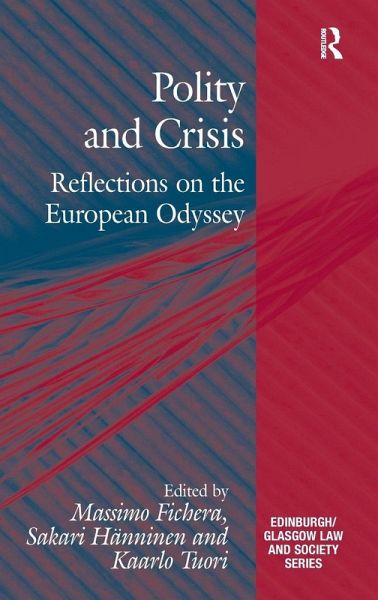
This book addresses the present EU foundational dilemma by looking at the problematic relationship between the ideal model of integration and the reality of the 21st century. It discusses the current role of the EU and whether it aspires to be a democratic polity or a functional organization based on inter-governmental bargaining and explores the ways and extent to which the present European crisis could create a politico-legal space for new possibilities and opportunities for action.
This book addresses the present EU foundational dilemma by looking at the problematic relationship between the ideal model of integration and the reality of the 21st century. It discusses the current role of the EU and whether it aspires to be a democratic polity or a functional organization based on inter-governmental bargaining and explores the ways and extent to which the present European crisis could create a politico-legal space for new possibilities and opportunities for action.
Massimo Fichera is a Post-Doctoral Fellow at the University of Helsinki, Faculty of Law. He has been a member of the Centre of Excellence in Foundations of European Law and Polity Research, Faculty of Law, University of Helsinki and previously completed his PhD at the University of Edinburgh. His research interests lie in constitutional theory and the intersection between EU and international law. He has co-edited Law and Security in Europe: Reconsidering the Security Constitution (with Jens Kremer, Intersentia 2013). Sakari Hÿnninen is Research Professor at the National Institute for Health and Welfare (THL), Finland. Prior to that he has collaborated with the Centre of Excellence in Foundations of European law and Polity Research, Faculty of Law, University of Helsinki and was Professor of Political Science at the University of Jyvÿskylÿ. He has written and edited more than twenty books in political theory, power analytics, welfare politics, regimes of governance and social exclusion studies, as well as articles in scientific journals. Kaarlo Tuori is Academy Professor at the University of Helsinki, Faculty of Law. He has published extensively in the area of legal and constitutional theory, including the monographs Critical Legal Positivism (Ashgate 2002) and Ratio and Voluntas (Ashgate 2010). He has also co-edited The Many Constitutions of Europe (with Suvi Sankari, Ashgate 2010) and co-authored The Eurozone Crisis: A Constitutional Analysis (with Klaus Tuori, Cambridge University Press 2014). He has directed the Centre of Excellence in Foundations of European Law and Polity Research (University of Helsinki) and is a member and former Vice-president of the Venice Commission.
Inhaltsangabe
Editors' Preface; Part I Constitutional Challenges of the Eurozone Crisis; Chapter 1 The Eurozone Crisis as a Constitutional Crisis, Kaarlo Tuori; Chapter 2 The European Crisis - Paradoxes of Constitutionalizing Democratic Capitalism, Hauke Brunkhorst; Chapter 3 The Economics of Constitutional Renewal, Emilios Christodoulidis; Chapter 4 Finding our Way Back to Europe?, Michelle Everson; Part II Can European Democracy Be Saved For Democracy?; Chapter 5 Thomas Hobbes Reading the EU as a Polity, Sakari Hänninen; Chapter 6 Reinventing European Democracy Democratization and the Existential Crisis of the EU, Ari Hirvonen; Chapter 7 Which Democracy for Which Demos?, RBJ Walker; Chapter 8 Law, Community and ultima ratio in Transnational Law, Massimo Fichera; Part III Europe as a Post-National Polity?; Chapter 9 Nordic Democracy Facing the EU: Traditions, Myths and Challenges, Pia Letto-Vanamo; Chapter 10 Governance Networks as a Means to Enhance European Democracy, Eva Sørensen, Tore Vincents Olsen; Chapter 11 Patterns of Post-National Europe: The Future of Integration after the Crisis of Monetary Union, Giandomenico Majone; Chapter 12 Sovereignty, Organized Hypocrisy, the Paradox of Post-9/11 International Relations, Patricia Springborg;
Editors' Preface; Part I Constitutional Challenges of the Eurozone Crisis; Chapter 1 The Eurozone Crisis as a Constitutional Crisis, Kaarlo Tuori; Chapter 2 The European Crisis - Paradoxes of Constitutionalizing Democratic Capitalism, Hauke Brunkhorst; Chapter 3 The Economics of Constitutional Renewal, Emilios Christodoulidis; Chapter 4 Finding our Way Back to Europe?, Michelle Everson; Part II Can European Democracy Be Saved For Democracy?; Chapter 5 Thomas Hobbes Reading the EU as a Polity, Sakari Hänninen; Chapter 6 Reinventing European Democracy Democratization and the Existential Crisis of the EU, Ari Hirvonen; Chapter 7 Which Democracy for Which Demos?, RBJ Walker; Chapter 8 Law, Community and ultima ratio in Transnational Law, Massimo Fichera; Part III Europe as a Post-National Polity?; Chapter 9 Nordic Democracy Facing the EU: Traditions, Myths and Challenges, Pia Letto-Vanamo; Chapter 10 Governance Networks as a Means to Enhance European Democracy, Eva Sørensen, Tore Vincents Olsen; Chapter 11 Patterns of Post-National Europe: The Future of Integration after the Crisis of Monetary Union, Giandomenico Majone; Chapter 12 Sovereignty, Organized Hypocrisy, the Paradox of Post-9/11 International Relations, Patricia Springborg;
Es gelten unsere Allgemeinen Geschäftsbedingungen: www.buecher.de/agb
Impressum
www.buecher.de ist ein Internetauftritt der buecher.de internetstores GmbH
Geschäftsführung: Monica Sawhney | Roland Kölbl | Günter Hilger
Sitz der Gesellschaft: Batheyer Straße 115 - 117, 58099 Hagen
Postanschrift: Bürgermeister-Wegele-Str. 12, 86167 Augsburg
Amtsgericht Hagen HRB 13257
Steuernummer: 321/5800/1497
USt-IdNr: DE450055826