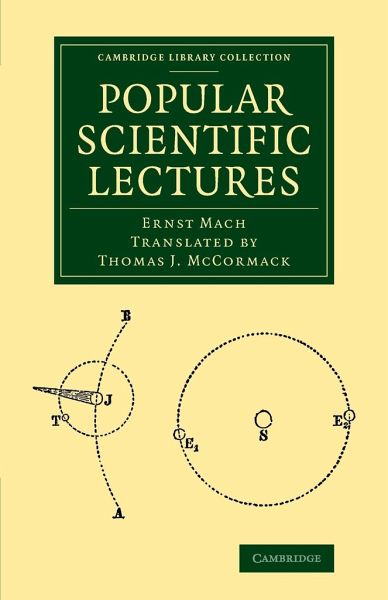
The Austrian scientist Ernst Mach (1838-1916) carried out work of importance in many fields of enquiry, including physics, physiology, psychology and philosophy. Many significant thinkers, such as Ludwig Wittgenstein and Bertrand Russell, benefited from engaging with his ideas. Mach delivered the twelve lectures collected here between 1864 and 1894. This English translation by Thomas J. McCormack (1865-1932) appeared in 1895. Mach tackles a range of topics in an engaging style, demonstrating his abilities as both a researcher and a communicator. In the realm of the physical sciences, he…mehr
The Austrian scientist Ernst Mach (1838-1916) carried out work of importance in many fields of enquiry, including physics, physiology, psychology and philosophy. Many significant thinkers, such as Ludwig Wittgenstein and Bertrand Russell, benefited from engaging with his ideas. Mach delivered the twelve lectures collected here between 1864 and 1894. This English translation by Thomas J. McCormack (1865-1932) appeared in 1895. Mach tackles a range of topics in an engaging style, demonstrating his abilities as both a researcher and a communicator. In the realm of the physical sciences, he discusses electrostatics, the conservation of energy, and the speed of light. He also addresses physiological matters, seeking to explain aspects of the hearing system and why humans have two eyes. In the final four lectures, he deals with the nature of scientific study. The Science of Mechanics (1893), Mach's historical and philosophical account, is also reissued in this series.
Ernst Mach (1838-1916) was a renowned physicist and philosopher, known for his contributions to the fields of mechanics, optics, and wave dynamics. He was influential in shaping the philosophy of science with his empirical and skeptical approach, emphasizing the importance of sensory experience and the rejection of metaphysics. His insights were foundational to the development of logical positivism and had a significant impact on thinkers such as Albert Einstein. Mach's work on the Doppler effect and the study of shock waves was groundbreaking and is immortalized in the term 'Mach number,' the ratio of an object's speed to the speed of sound. A cornerstone of Mach's scholarship was his ability to make complex scientific ideas accessible to the broader public through his writings, exemplified in his collection of essays 'Popular Scientific Lectures' (1895). In these lectures, Mach tackled subjects such as the conservation of energy, the principle of comparison in physics, and the concept of inertia in a manner that resonated with readers across varying levels of technical expertise. His literary style is characterized by clarity, brevity, and a precise use of language to elucidate scientific principles without oversimplification. Mach's enduring legacy is the impetus for continued discourse at the intersection of scientific inquiry and philosophical thought.
Inhaltsangabe
Preface Translator's note 1. The forms of liquids 2. The fibres of corti 3. On the causes of harmony 4. The velocity of light 5. Why has man two eyes? 6. On symmetry 7. On the fundamental concepts of electrostatics 8. On the principle of the conservation of energy 9. On the economical nature of physical inquiry 10. On transformation and adaptation in scientific thought 11. On the principle of comparison in physics 12. In instruction in the classics and the mathematico-physical sciences Index.
Preface Translator's note 1. The forms of liquids 2. The fibres of corti 3. On the causes of harmony 4. The velocity of light 5. Why has man two eyes? 6. On symmetry 7. On the fundamental concepts of electrostatics 8. On the principle of the conservation of energy 9. On the economical nature of physical inquiry 10. On transformation and adaptation in scientific thought 11. On the principle of comparison in physics 12. In instruction in the classics and the mathematico-physical sciences Index.
Es gelten unsere Allgemeinen Geschäftsbedingungen: www.buecher.de/agb
Impressum
www.buecher.de ist ein Internetauftritt der buecher.de internetstores GmbH
Geschäftsführung: Monica Sawhney | Roland Kölbl | Günter Hilger
Sitz der Gesellschaft: Batheyer Straße 115 - 117, 58099 Hagen
Postanschrift: Bürgermeister-Wegele-Str. 12, 86167 Augsburg
Amtsgericht Hagen HRB 13257
Steuernummer: 321/5800/1497
USt-IdNr: DE450055826