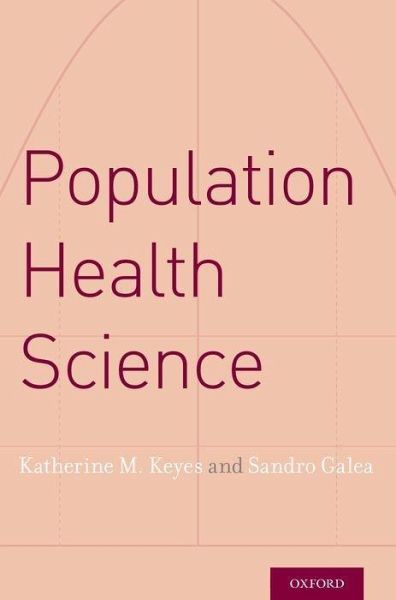
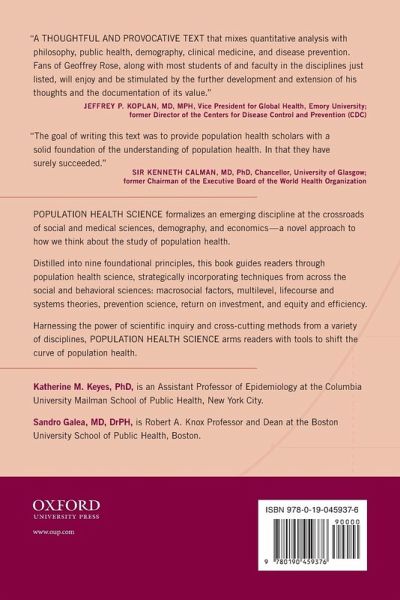
Population Health Science formalizes an emerging discipline at the crossroads of social and medical sciences, demography, and economicsan emerging approach to population studies that represents a seismic shift in how traditional health sciences measure and observe health events.
Population Health Science formalizes an emerging discipline at the crossroads of social and medical sciences, demography, and economicsan emerging approach to population studies that represents a seismic shift in how traditional health sciences measure and observe health events.
Katherine M. Keyes, PhD, is an Assistant Professor of Epidemiology at Columbia University. Her research focuses on life course epidemiology with particular attention to psychiatric disorders, including cross-generational cohort effects on substance use, mental health, and chronic disease. She has particular expertise in the development and application of novel epidemiological methods, and in the development of epidemiological theory to measure and elucidate the drivers of population health. Sandro Galea, MD, DrPH, is the Robert A. Knox Professor and Dean at the School of Public Health at Boston University. A physician and epidemiologist interested in the social production of health of urban populations, his work explores innovative cells-to-society approaches to population health questions, with an overall aim of advancing a consequentialist approach to population health scholarship. He is a past president of the Society for Epidemiologic Research and an elected member of the National Academy of Medicine. Together Keyes and Galea have taught introductory epidemiology across various institutions for more than 15 years.
Inhaltsangabe
* 1. An introduction to population health science * 2. Conceptualizing and evaluating causes for population health science * 3. The causes of cases versus causes of incidence * 4. Population health across levels, systems, and the lifecourse * 5. Ubiquity and the macrosocial determinants of population health * 6. Causal architecture to understand what matters most: theory * 7. Causal architecture and what matters most: quantitative examples * 8. Valuing population health interventions, measuring return on investment * 9. Equity and efficiency in population health science * 10. Prediction in population health science * 11. Case study: Can we reduce obesity by encouraging people to eat better? * 12. Case study: Simulating the impact of high-risk and population intervention strategies for the prevention of disease * 13. Tensions in population health science
* 1. An introduction to population health science * 2. Conceptualizing and evaluating causes for population health science * 3. The causes of cases versus causes of incidence * 4. Population health across levels, systems, and the lifecourse * 5. Ubiquity and the macrosocial determinants of population health * 6. Causal architecture to understand what matters most: theory * 7. Causal architecture and what matters most: quantitative examples * 8. Valuing population health interventions, measuring return on investment * 9. Equity and efficiency in population health science * 10. Prediction in population health science * 11. Case study: Can we reduce obesity by encouraging people to eat better? * 12. Case study: Simulating the impact of high-risk and population intervention strategies for the prevention of disease * 13. Tensions in population health science
Es gelten unsere Allgemeinen Geschäftsbedingungen: www.buecher.de/agb
Impressum
www.buecher.de ist ein Internetauftritt der buecher.de internetstores GmbH
Geschäftsführung: Monica Sawhney | Roland Kölbl | Günter Hilger
Sitz der Gesellschaft: Batheyer Straße 115 - 117, 58099 Hagen
Postanschrift: Bürgermeister-Wegele-Str. 12, 86167 Augsburg
Amtsgericht Hagen HRB 13257
Steuernummer: 321/5800/1497
USt-IdNr: DE450055826