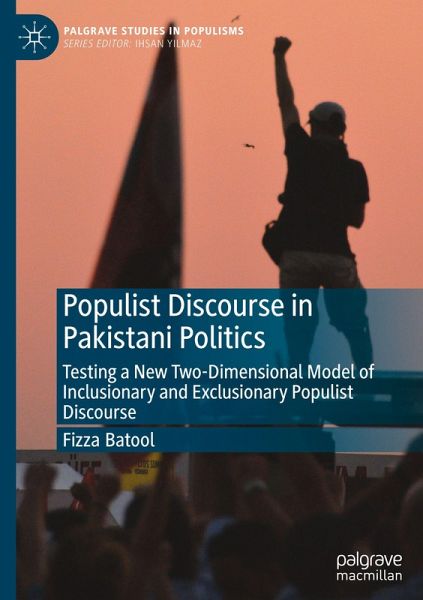
This book presents a new theoretical model for mapping how populist leaders construct the people , using simultaneous processes of inclusion and exclusion. Applying this model to Pakistan's distinctive political landscape, the work analyzes the populist discourse of Zulfikar Ali Bhutto and Imran Khan, highlighting the key similarities and differences in their construct. The comparative analysis underlines how Pakistan s political history, including the role of religion, the military, and dynastic politics, shapes populist politics in the country. By centering a non-Western case, this book…mehr
This book presents a new theoretical model for mapping how populist leaders construct the people , using simultaneous processes of inclusion and exclusion. Applying this model to Pakistan's distinctive political landscape, the work analyzes the populist discourse of Zulfikar Ali Bhutto and Imran Khan, highlighting the key similarities and differences in their construct. The comparative analysis underlines how Pakistan s political history, including the role of religion, the military, and dynastic politics, shapes populist politics in the country.
By centering a non-Western case, this book challenges dominant frameworks and offers an accessible, comparative lens on populist discourse. It will be of interest to scholars and students of populism, Pakistani politics, and discourse analysis, as well as to those interested in the broader dynamics of democratization in hybrid political systems.
Ihsan Yilmaz is research chair and professor of political science and international relations at Deakin University's ADI (Alfred Deakin Institute for Citizenship and Globalisation). Previously, he worked at the Universities of Oxford and London. He researches on nation-building, citizenship, minorities, securitisation, intergroup emotions, populism, transnationalism, digital authoritarianism, and legal pluralism. Presently, he leads two Australian Research Council (ARC) Discovery projects: "Religious Populism, Emotions, and Political Mobilisation: Civilisationism in Turkey, Indonesia, and Pakistan" and "Civilisationist Mobilisation, Digital Technologies, and Social Cohesion: The Case of Turkish & Indian Diasporas in Australia." Additionally, he co-leads a 3-year Gerda Henkel Foundation project: "Smart Digital Technologies and the Future of Democracy in the Muslim World: The Pakistani, Iranian, Egyptian and Turkish Cases." Fizza Batool is an Assistant Professor at SZABIST University, where she teaches courses on Democratisation and South Asian Politics. She is concurrently a Postdoctoral Fellow at the Central European University Democracy Institute. Prior to her academic career, Fizza held senior research positions at prominent Pakistani policy research institutions. In 2020, she was a distinguished South Asian Visiting Fellow at the Stimson Center in Washington, D.C.
Inhaltsangabe
Chapter 1: The Puzzle of Pakistani Populism.- Chapter 2: A New Model for Analyzing Populism.- Chapter 3: Populism and Pakistan: A Brief History.- Chapter 4: Between Socialism and Islam: Mapping Inclusion and Exclusion in Bhutto's Populism.- Chapter 5: Between Tradition and Change: Mapping Inclusion and Exclusion in Imran Khan s Populism.- Chapter 6: Conclusion.
Chapter 1: The Puzzle of Pakistani Populism.- Chapter 2: A New Model for Analyzing Populism.- Chapter 3: Populism and Pakistan: A Brief History.- Chapter 4: Between Socialism and Islam: Mapping Inclusion and Exclusion in Bhutto's Populism.- Chapter 5: Between Tradition and Change: Mapping Inclusion and Exclusion in Imran Khan s Populism.- Chapter 6: Conclusion.
Es gelten unsere Allgemeinen Geschäftsbedingungen: www.buecher.de/agb
Impressum
www.buecher.de ist ein Internetauftritt der buecher.de internetstores GmbH
Geschäftsführung: Monica Sawhney | Roland Kölbl | Günter Hilger
Sitz der Gesellschaft: Batheyer Straße 115 - 117, 58099 Hagen
Postanschrift: Bürgermeister-Wegele-Str. 12, 86167 Augsburg
Amtsgericht Hagen HRB 13257
Steuernummer: 321/5800/1497
USt-IdNr: DE450055826