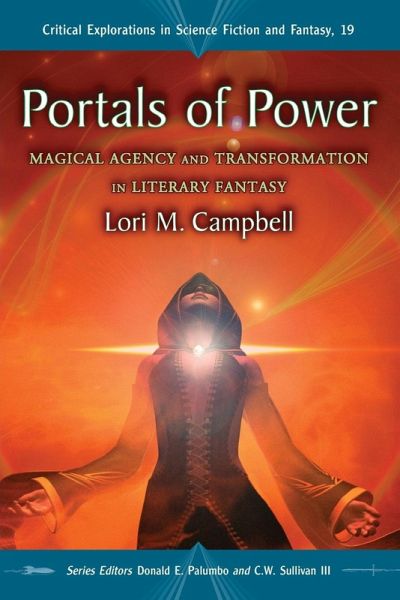
Fantasy writing, like literature in general, provides a powerful vehicle for challenging the status quo. Via symbolism, imagery and supernaturalism, fantasy constructs secondary-world narratives that both mirror and critique the political paradigms of our own world. This critical work explores the role of the portal in fantasy, investigating the ways in which magical nexus points and movement between worlds are used to illustrate real-world power dynamics, especially those impacting women and children. Through an examination of high and low fantasy, fairy tales, children's literature, the…mehr
Fantasy writing, like literature in general, provides a powerful vehicle for challenging the status quo. Via symbolism, imagery and supernaturalism, fantasy constructs secondary-world narratives that both mirror and critique the political paradigms of our own world. This critical work explores the role of the portal in fantasy, investigating the ways in which magical nexus points and movement between worlds are used to illustrate real-world power dynamics, especially those impacting women and children. Through an examination of high and low fantasy, fairy tales, children's literature, the Gothic, and science fiction, the portal is identified as a living being, place or magical object of profound metaphorical and cultural significance.
Lori M. Campbell is a lecturer in the Department of English at the University of Pittsburgh, where she teaches courses on nineteenth- and twentieth-century literature.
Inhaltsangabe
Table of Contents Acknowledgments Preface Introduction PART Women and Other Magical Creatures: Portals in Romance and Fairy Tale 1. Who "Wears the Pants" in Faërie? The Woman Question in William Morris's The Wood Beyond the World 2. "For I am but a girl": The Problem of Female Power in Ford Madox Ford's The Brown Owl PART Charms, Places, and Little Girls: Portals in Children's Literature 3. E. Nesbit and the Magic Word: Empowering Child and Woman in Real-World Fantasy 4. Lost Boys to Men: Romanticism and the Magic of the Female Imagination in J.M. Barrie's Peter Pan and Frances Hodgson Burnett's The Secret Garden
PART Haunted Houses and the Hidden Self: Portals in the Gothic, Low Fantasy, and Science Fiction 5. Confronting Chaos at the In-Between: William Hope Hodgson's The House on the Borderland 6. The Society Insider/Outsider and the Sympathetic Supernatural in Fantastic Tales by Edith Wharton and Oscar Wilde PART Haunting History: The Portal in Modern/Postmodern Fantasy 7. One World to Rule Them All: The Un-Making and Re-Making of the Symbolic Portal in J.R.R. Tolkien's The Lord of the Rings 8. Harry Potter and the Ultimate In-Between: J.K. Rowling's Portals of Power 9. Portals Between Then and Now: Susan Cooper, Alan Garner, Diana Wynne Jones, Neil Gaiman, and Jonathan Stroud Chaper Notes Bibliography Index
Table of Contents Acknowledgments Preface Introduction PART Women and Other Magical Creatures: Portals in Romance and Fairy Tale 1. Who "Wears the Pants" in Faërie? The Woman Question in William Morris's The Wood Beyond the World 2. "For I am but a girl": The Problem of Female Power in Ford Madox Ford's The Brown Owl PART Charms, Places, and Little Girls: Portals in Children's Literature 3. E. Nesbit and the Magic Word: Empowering Child and Woman in Real-World Fantasy 4. Lost Boys to Men: Romanticism and the Magic of the Female Imagination in J.M. Barrie's Peter Pan and Frances Hodgson Burnett's The Secret Garden
PART Haunted Houses and the Hidden Self: Portals in the Gothic, Low Fantasy, and Science Fiction 5. Confronting Chaos at the In-Between: William Hope Hodgson's The House on the Borderland 6. The Society Insider/Outsider and the Sympathetic Supernatural in Fantastic Tales by Edith Wharton and Oscar Wilde PART Haunting History: The Portal in Modern/Postmodern Fantasy 7. One World to Rule Them All: The Un-Making and Re-Making of the Symbolic Portal in J.R.R. Tolkien's The Lord of the Rings 8. Harry Potter and the Ultimate In-Between: J.K. Rowling's Portals of Power 9. Portals Between Then and Now: Susan Cooper, Alan Garner, Diana Wynne Jones, Neil Gaiman, and Jonathan Stroud Chaper Notes Bibliography Index
Es gelten unsere Allgemeinen Geschäftsbedingungen: www.buecher.de/agb
Impressum
www.buecher.de ist ein Internetauftritt der buecher.de internetstores GmbH
Geschäftsführung: Monica Sawhney | Roland Kölbl | Günter Hilger
Sitz der Gesellschaft: Batheyer Straße 115 - 117, 58099 Hagen
Postanschrift: Bürgermeister-Wegele-Str. 12, 86167 Augsburg
Amtsgericht Hagen HRB 13257
Steuernummer: 321/5800/1497
USt-IdNr: DE450055826