In our daily life, almost every family owns a portfolio of assets. This portfolio could contain real assets such as a car, or a house, as well as financial assets such as stocks, bonds or futures. Portfolio theory deals with how to form a satisfied portfolio among an enormous number of assets. Originally proposed by H. Markowtiz in 1952, the mean-variance methodology for portfolio optimization has been central to the research activities in this area and has served as a basis for the development of modem financial theory during the past four decades. Follow-on work with this approach has born…mehr
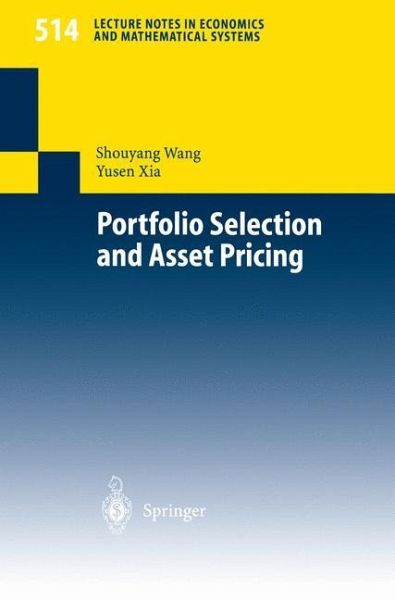
In our daily life, almost every family owns a portfolio of assets. This portfolio could contain real assets such as a car, or a house, as well as financial assets such as stocks, bonds or futures. Portfolio theory deals with how to form a satisfied portfolio among an enormous number of assets. Originally proposed by H. Markowtiz in 1952, the mean-variance methodology for portfolio optimization has been central to the research activities in this area and has served as a basis for the development of modem financial theory during the past four decades. Follow-on work with this approach has born much fruit for this field of study. Among all those research fruits, the most important is the capital asset pricing model (CAPM) proposed by Sharpe in 1964. This model greatly simplifies the input for portfolio selection and makes the mean-variance methodology into a practical application. Consequently, lots of models were proposed to price the capital assets. In this book, some of the most important progresses in portfolio theory are surveyed and a few new models for portfolio selection are presented. Models for asset pricing are illustrated and the empirical tests of CAPM for China's stock markets are made. The first chapter surveys ideas and principles of modeling the investment decision process of economic agents. It starts with the Markowitz criteria of formulating return and risk as mean and variance and then looks into other related criteria which are based on probability assumptions on future prices of securities.
Produktdetails
Produktdetails
Lecture Notes in Economics and Mathematical Systems 514
Yingxue Zhao received his Ph.D. degree in Management Sciences and En- gineering from Institute of Systems Science, Academy of Mathematics and Systems Science, Chinese Academy of Sciences (CAS), in 2010. He is currently associate professor of Supply Chain Management at School of International Trade and Economics of University of International Business and Economics. He has received some academic awards including the "Outstanding Paper Award" awarded by IEEE Systems, Man and Cybernetics (SMC) and the "Excellent Research Award for Scientific Research of Universities (Humanities and Social Sciences)" awarded by Ministry of Education of China. His research interests mainly focus on Supply Chain Management, particularly on Supply Chain Contract. His research papers have been published in journals including Production and Operations Management, European Journal of Operational Research, Annals of Operations Research, International Journal of Production Research, Journal of the Operational Research Society, Journal of Optimization Theory and Applications, and International Journal of Production Economics. Xiaoge Meng received her Master degree in Mathematics from College of Science, Shantou University, in 2006. During the Master period, her research interests mainly focused on Complex Analysis and Harmonic Analysis. Research papers of the relevant fields have been published in journals including Abstract and Applied Analysis, Applied Mathematics and Computation, and Journal of Systems Science and Complexity. Currently, as a Ph.D. student of School of Economics and Management at Beijing University of Aeronautics & Astronautics, her research interests have transferred to the area of Supply Chain Management. Over the years, she has received some academic awards including the "Excellent Paper Award" awarded by the 10th Annual Meeting of the Chinese Logistics Society (CLS). Shouyang Wang received his Ph.D. degree in Operations Research from Institute of Systems Science of Chinese Academy of Sciences (CAS) in 1986. He is currently a Bairen distinguished professor of Management Science at Academy of Mathematics and Systems Science of CAS and the Lotus distinguished professor of Management Science of Hunan University at Changsha. He is also an adjunct professor of over 30 universities in the world. He is/was the editor- in-chief, an area editor or a co-editor of 15 journals including Information and Management and Energy Economics. He was/is a guest editor for a special issue/volume of over 20 journals including European Journal of Operational Research, Annals of Operations Research, IIE Transactions, and Decision Support Systems. He has published 30 monographs and over 250 papers in leading journals. His current research interests include Supply Chain Management, Financial Engineering, Economic Forecasting, and Decision Analysis. T. C. Edwin Cheng is Dean of the Faculty of Business, Fung Yiu King Wing Hang Bank Endowed Professor in Business Administration, and Chair Professor of Management at The Hong Kong Polytechnic University. He obtained a B.Sc.[Eng](First Class Honours) from the University of Hong Kong, an M.Sc. from the University of Birmingham, U.K., and a Ph.D. and an Sc.D. from the University of Cambridge, U.K. He has previously taught in Canada, England, and Singapore. Prof. Cheng's research interests are in Operations Management and Operations Research. He has published over 600 papers in such journals as California Management Review, IEEE Transactions on Automatic Control, Journal of Management Information Systems, Journal of Operations Management, Management Science, MIS Quarterly, Operations Research, Organization Science, Production and Operations Management, and SIAM Journal on Optimization. He has co-authored 11 books published by Chapman and Hall, McGraw-Hill, and Springer. He received the Outstanding Young Engineer of the Year Award from the Institute of Industrial Engineers, U.S.A., in 1992 and the Crouch
Inhaltsangabe
Criteria, Models and Strategies in Portfolio Selection.- A Model for Portfolio Selection with Order of Expected Returns.- A Compromise Solution to Mutual Funds Portfolio Selection with Transaction Costs.- Optimal Portfolio Selection of Assets with Transaction Costs and No Short Sales.- Portfolio Frontier with Different Interest Rates for Borrowing and Lending.- Multi-period Investment.- Mean-Variance-Skewness Model for Portfolio Selection with Transaction Costs.- Capital Asset Pricing: Theory and Methodologies.- Empirical Tests of CAPM for China's Stock Markets.
Criteria, Models and Strategies in Portfolio Selection.- A Model for Portfolio Selection with Order of Expected Returns.- A Compromise Solution to Mutual Funds Portfolio Selection with Transaction Costs.- Optimal Portfolio Selection of Assets with Transaction Costs and No Short Sales.- Portfolio Frontier with Different Interest Rates for Borrowing and Lending.- Multi-period Investment.- Mean-Variance-Skewness Model for Portfolio Selection with Transaction Costs.- Capital Asset Pricing: Theory and Methodologies.- Empirical Tests of CAPM for China's Stock Markets.
Es gelten unsere Allgemeinen Geschäftsbedingungen: www.buecher.de/agb
Impressum
www.buecher.de ist ein Internetauftritt der buecher.de internetstores GmbH
Geschäftsführung: Monica Sawhney | Roland Kölbl | Günter Hilger
Sitz der Gesellschaft: Batheyer Straße 115 - 117, 58099 Hagen
Postanschrift: Bürgermeister-Wegele-Str. 12, 86167 Augsburg
Amtsgericht Hagen HRB 13257
Steuernummer: 321/5800/1497
USt-IdNr: DE450055826