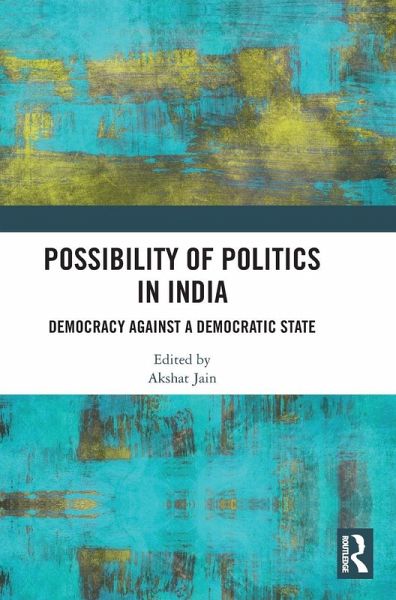
This book is an attempt to find new ways of inter-disciplinary theorisation about this moment when both the unitary idea of the Indian nation and the bureaucratic dream of a centralised Indian state are falling apart. At this juncture, the Indian state has two choices.
This book is an attempt to find new ways of inter-disciplinary theorisation about this moment when both the unitary idea of the Indian nation and the bureaucratic dream of a centralised Indian state are falling apart. At this juncture, the Indian state has two choices.
Akshat Jain is an editor, translator and writer. He edits publications about the environment and climate change, and also translates literature from around the world into Hindi.
Inhaltsangabe
Introduction-Possibility of politics in India: Democracy against a democratic state 1. Indian federalism at the crossroads: Limits of the territorial management of ethnic conflict 2. Nation-building and the political impasse in India's north-eastern region 3. Kashmir and Palestine: Itineraries of (anti) colonial solidarity 4. Counter-maps of the ordinary: Occupation, subjectivity, and walking under curfew in Kashmir 5. Rethinking Sikh nationalism in the twenty-first century 6. Hindu nation and its queers: Caste, Islamophobia, and de/coloniality in India 7. Cultural identity and beef festivals: Toward a 'multiculturalism against caste' 8. The revolution will wear burqas: Feminist body politics and online activism in India 9. The rule of law and citizenship in central India: Post-colonial dilemmas 10. To be or not to be a refugee? Reflections on refugeehood and citizenship among Sri Lankan Tamils in India 11. The prerogative of the brave: Hijras and sexual citizenship after orientalism 12. Internal migration and citizenship in India 13. Uncovering a politics of livelihoods: Analysing displacement and contention in contemporary India 14. Re-politicising water governance: Exploring water re-allocations in terms of justice 15. The land question: Special economic zones and the political economy of dispossession in India 16. The farm laws struggle 2020-2021: Class-caste alliances and bypassed agrarian transition in neoliberal India 17. Janathana Sarkar (people's government): Rebel governance and agency of the poor in India's Maoist guerrilla zones
Introduction-Possibility of politics in India: Democracy against a democratic state 1. Indian federalism at the crossroads: Limits of the territorial management of ethnic conflict 2. Nation-building and the political impasse in India's north-eastern region 3. Kashmir and Palestine: Itineraries of (anti) colonial solidarity 4. Counter-maps of the ordinary: Occupation, subjectivity, and walking under curfew in Kashmir 5. Rethinking Sikh nationalism in the twenty-first century 6. Hindu nation and its queers: Caste, Islamophobia, and de/coloniality in India 7. Cultural identity and beef festivals: Toward a 'multiculturalism against caste' 8. The revolution will wear burqas: Feminist body politics and online activism in India 9. The rule of law and citizenship in central India: Post-colonial dilemmas 10. To be or not to be a refugee? Reflections on refugeehood and citizenship among Sri Lankan Tamils in India 11. The prerogative of the brave: Hijras and sexual citizenship after orientalism 12. Internal migration and citizenship in India 13. Uncovering a politics of livelihoods: Analysing displacement and contention in contemporary India 14. Re-politicising water governance: Exploring water re-allocations in terms of justice 15. The land question: Special economic zones and the political economy of dispossession in India 16. The farm laws struggle 2020-2021: Class-caste alliances and bypassed agrarian transition in neoliberal India 17. Janathana Sarkar (people's government): Rebel governance and agency of the poor in India's Maoist guerrilla zones
Es gelten unsere Allgemeinen Geschäftsbedingungen: www.buecher.de/agb
Impressum
www.buecher.de ist ein Internetauftritt der buecher.de internetstores GmbH
Geschäftsführung: Monica Sawhney | Roland Kölbl | Günter Hilger
Sitz der Gesellschaft: Batheyer Straße 115 - 117, 58099 Hagen
Postanschrift: Bürgermeister-Wegele-Str. 12, 86167 Augsburg
Amtsgericht Hagen HRB 13257
Steuernummer: 321/5800/1497
USt-IdNr: DE450055826