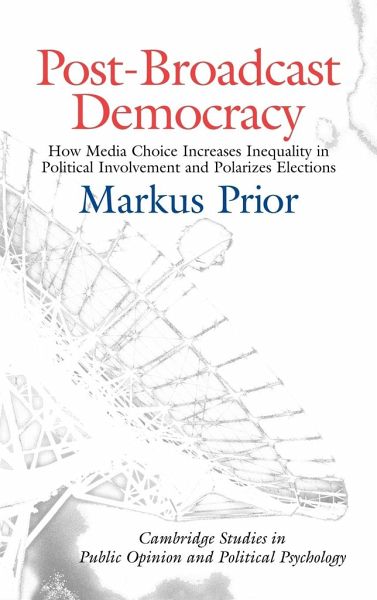
The media environment is changing. Today in the United States, the average viewer can choose from hundreds of channels, including several twenty-four hour news channels. News is on cell phones, on iPods, and online; it has become a ubiquitous and unavoidable reality in modern society. The purpose of this 2007 book is to examine systematically, how these differences in access and form of media affect political behaviour. Using experiments and survey data, it shows how changes in the media environment reverberate through the political system, affecting news exposure, political learning, turnout, and voting behaviour.…mehr
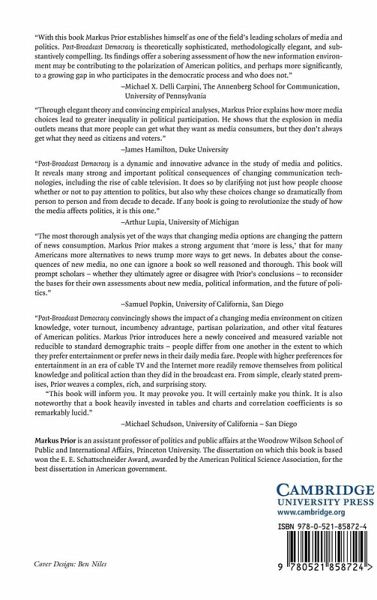
The media environment is changing. Today in the United States, the average viewer can choose from hundreds of channels, including several twenty-four hour news channels. News is on cell phones, on iPods, and online; it has become a ubiquitous and unavoidable reality in modern society. The purpose of this 2007 book is to examine systematically, how these differences in access and form of media affect political behaviour. Using experiments and survey data, it shows how changes in the media environment reverberate through the political system, affecting news exposure, political learning, turnout, and voting behaviour.
Markus Prior is Assistant Professor of Politics and Public Affairs in the Woodrow Wilson School and the Department of Politics at Princeton University. He received his Ph.D. from Stanford's Department of Communication in 2004. He is the author of Post-Broadcast Democracy (Cambridge University Press, 2007), an early version of which won the E. E. Schattschneider Award for the best dissertation in American politics, awarded by the American Political Science Association. The book examines how broadcast television, cable television and the internet have changed politics in the United States over the last half-century. His work has also appeared in the American Political Science Review, the American Journal of Political Science, the Journal of Politics, and Political Communication.
Inhaltsangabe
1. Introduction; 2. Conditional political learning; Part I. The Participatory Effects of Media Choice: 3. Broadcast television, political knowledge, and turnout; 4. From low choice to high choice: the impact of cable tv and internet on news exposure, political knowledge, and turnout; 5. From low choice to high choice: does greater media choice affect total news consumption and average turnout?; Part II. The Political Effects of Media Choice: 6. Broadcast television, partisanship, and the incumbency advantage; 7. Partisan polarization in the high-choice media environment; 8. Divided by choice: audience fragmentation and political inequality in the post-broadcast media environment.
1. Introduction; 2. Conditional political learning; Part I. The Participatory Effects of Media Choice: 3. Broadcast television, political knowledge, and turnout; 4. From low choice to high choice: the impact of cable tv and internet on news exposure, political knowledge, and turnout; 5. From low choice to high choice: does greater media choice affect total news consumption and average turnout?; Part II. The Political Effects of Media Choice: 6. Broadcast television, partisanship, and the incumbency advantage; 7. Partisan polarization in the high-choice media environment; 8. Divided by choice: audience fragmentation and political inequality in the post-broadcast media environment.
Es gelten unsere Allgemeinen Geschäftsbedingungen: www.buecher.de/agb
Impressum
www.buecher.de ist ein Internetauftritt der buecher.de internetstores GmbH
Geschäftsführung: Monica Sawhney | Roland Kölbl | Günter Hilger
Sitz der Gesellschaft: Batheyer Straße 115 - 117, 58099 Hagen
Postanschrift: Bürgermeister-Wegele-Str. 12, 86167 Augsburg
Amtsgericht Hagen HRB 13257
Steuernummer: 321/5800/1497
USt-IdNr: DE450055826