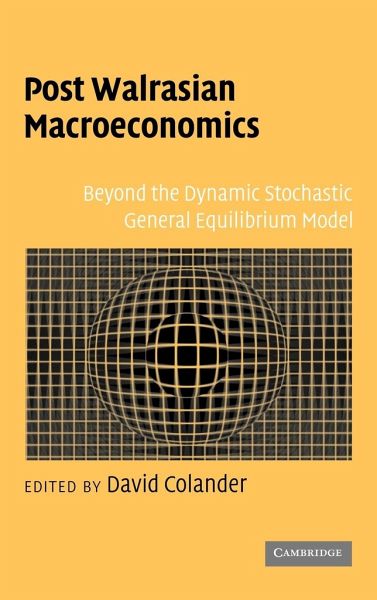
Macroeconomics is evolving in an almost dialectic fashion. The latest evolution is the development of a new synthesis that combines insights of new classical, new Keynesian and real business cycle traditions into a dynamic, stochastic general equilibrium (DSGE) model that serves as a foundation for thinking about macro policy. That new synthesis has opened up the door to a new antithesis, which is being driven by advances in computing power and analytic techniques. This new synthesis is coalescing around developments in complexity theory, automated general to specific econometric modeling,…mehr
Macroeconomics is evolving in an almost dialectic fashion. The latest evolution is the development of a new synthesis that combines insights of new classical, new Keynesian and real business cycle traditions into a dynamic, stochastic general equilibrium (DSGE) model that serves as a foundation for thinking about macro policy. That new synthesis has opened up the door to a new antithesis, which is being driven by advances in computing power and analytic techniques. This new synthesis is coalescing around developments in complexity theory, automated general to specific econometric modeling, agent-based models, and non-linear and statistical dynamical models. This book thus provides the reader with an introduction to what might be called a Post Walrasian research program that is developing as the antithesis of the Walrasian DSGE synthesis.
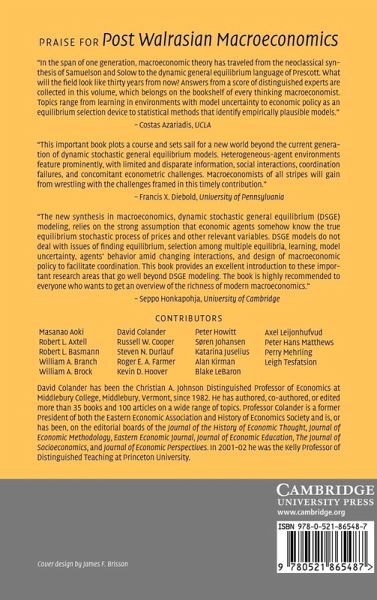
David Colander has been the Christian A. Johnson Distinguished Professor of Economics at Middlebury College, Middlebury, Vermont since 1982. He previously taught at Columbia University, Vassar College, and the University of Miami. Professor Colander has authored, co-authored, or edited more than 35 books and 100 articles on a wide range of topics. His books have been, or are being, translated into a number of different languages, including Chinese, Bulgarian, Polish, Italian, and Spanish. He is a former President of both the Eastern Economic Association and History of Economics Society and is, or has been, on the editorial boards of the Journal of the History of Economic Thought, Journal of Economic Methodology, Eastern Economic Journal, Journal of Economic Education, The Journal of Socioeconomics, and Journal of Economic Perspectives. He has also been a consultant to Time-Life Films, the U.S. Congress, a Brookings Policy Fellow, and a Visiting Scholar at Nuffield College, Oxford. In 2001-2002 he was the Kelly Professor of Distinguished Teaching at Princeton University.
Inhaltsangabe
Part I. Where We Are in Macro and How We Got There: 1. Stories from the haunted vault: notes on a century of macroeconomics 2. Post Walrasian macroeconomics: some historic links 3. The DSGE model and the post Walrasian alternative in historical perspective 4. Who is post Walrasian man? Part II. Edging Away from the DSGE Model: 5. Social interactions and macroeconomics 6. Macroeconomics and model uncertainty 7. Restricted perceptions equilibria and learning in macroeconomics 8. Not more so: some concepts outside the DSGE framework Part III. Leaping Away from the DSGE Model: 9. Agent-based computational modeling and macroeconomics 10. Multi-agent systems macro: a prospectus 11. Agent-based financial markets: matching stylized facts with style Part IV. Doing More Good than Harm: Roles of Business and Government in Critical Infrastructure Protection: 12. Characteristics of resilient systems and organizations 13. Networks and interdependencies 14. Public - private risk-sharing: the case of terrorism risk coverage 15. Learning from experience: drawing correct analogies? Letting the data guide theory 16. The past as the future: the Marshallian approach to post Walrasian macro 17. Old world econometrics and New World theory 18. Four entrenched notions post Walrasians should avoid 19. Confronting the economic model with the data 20. Extracting information from the data: a European view on empirical macro Part V. Policy Implications: 21. Economic policy in the presence of coordination problems 22. Monetary policy and the limitations of economic knowledge.
Part I. Where We Are in Macro and How We Got There: 1. Stories from the haunted vault: notes on a century of macroeconomics 2. Post Walrasian macroeconomics: some historic links 3. The DSGE model and the post Walrasian alternative in historical perspective 4. Who is post Walrasian man? Part II. Edging Away from the DSGE Model: 5. Social interactions and macroeconomics 6. Macroeconomics and model uncertainty 7. Restricted perceptions equilibria and learning in macroeconomics 8. Not more so: some concepts outside the DSGE framework Part III. Leaping Away from the DSGE Model: 9. Agent-based computational modeling and macroeconomics 10. Multi-agent systems macro: a prospectus 11. Agent-based financial markets: matching stylized facts with style Part IV. Doing More Good than Harm: Roles of Business and Government in Critical Infrastructure Protection: 12. Characteristics of resilient systems and organizations 13. Networks and interdependencies 14. Public - private risk-sharing: the case of terrorism risk coverage 15. Learning from experience: drawing correct analogies? Letting the data guide theory 16. The past as the future: the Marshallian approach to post Walrasian macro 17. Old world econometrics and New World theory 18. Four entrenched notions post Walrasians should avoid 19. Confronting the economic model with the data 20. Extracting information from the data: a European view on empirical macro Part V. Policy Implications: 21. Economic policy in the presence of coordination problems 22. Monetary policy and the limitations of economic knowledge.
Es gelten unsere Allgemeinen Geschäftsbedingungen: www.buecher.de/agb
Impressum
www.buecher.de ist ein Internetauftritt der buecher.de internetstores GmbH
Geschäftsführung: Monica Sawhney | Roland Kölbl | Günter Hilger
Sitz der Gesellschaft: Batheyer Straße 115 - 117, 58099 Hagen
Postanschrift: Bürgermeister-Wegele-Str. 12, 86167 Augsburg
Amtsgericht Hagen HRB 13257
Steuernummer: 321/5800/1497
USt-IdNr: DE450055826