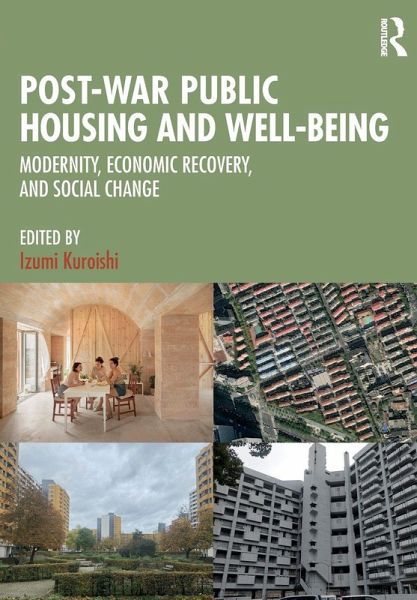
This collection illustrates the evolving role of housing as a symbol of modernity, a tool for economic recovery, and a response to societal transitions. It draws on case studies that focus on the intersection of public housing, well-being, and social change in the aftermath of the Second World War.
This collection illustrates the evolving role of housing as a symbol of modernity, a tool for economic recovery, and a response to societal transitions. It draws on case studies that focus on the intersection of public housing, well-being, and social change in the aftermath of the Second World War.
Izumi Kuroishi is Professor at Fukushima Gakuin University and is the chair of Japan Lifeology Academy.
Inhaltsangabe
Introduction Section 1: Well Being and Social Ethos 1. How Do People Want to Live?': Catherine Bauer and Social Questions in Modern American Housing 2. Ideas of Health and Well Being as Understood and Applied in the Design and Planning of Post War British Public Housing 3. The Idea of Life (Seikatsu) and Well Being in Japanese Pre and Post War Housing Section 2: Well Being, Urban Space and Accessibility 4. Designing for Well Being in Large Housing Estates in East and West Berlin: Märkisches Viertel and Marzahn 5. The Impact of Housing Access Policies on Wellbeing in Spain 6. Nishiyama Uzo: Writing for Housing and Planning for Well Being in Post War Japan Section 3: Well Being, Ideological and Personal Affluence 7. The Impact of Well Being on Housing Policies and the Consumption of Durable Goods in Postwar West Germany 8. Post War Housing and the Concept of Wellbeing: A Comparison of the United States and China 9. Housing Security and Policy over the Long Run, Japan 1600 2000 Section 4: Well Being in the 21st Century 10. Well Rounded Well Being: The Low Carbon Bioclimatic Architecture of the Balearic Housing Institute 11. Living Together with Dementia: Domestic Rearrangements
Introduction Section 1: Well Being and Social Ethos 1. How Do People Want to Live?': Catherine Bauer and Social Questions in Modern American Housing 2. Ideas of Health and Well Being as Understood and Applied in the Design and Planning of Post War British Public Housing 3. The Idea of Life (Seikatsu) and Well Being in Japanese Pre and Post War Housing Section 2: Well Being, Urban Space and Accessibility 4. Designing for Well Being in Large Housing Estates in East and West Berlin: Märkisches Viertel and Marzahn 5. The Impact of Housing Access Policies on Wellbeing in Spain 6. Nishiyama Uzo: Writing for Housing and Planning for Well Being in Post War Japan Section 3: Well Being, Ideological and Personal Affluence 7. The Impact of Well Being on Housing Policies and the Consumption of Durable Goods in Postwar West Germany 8. Post War Housing and the Concept of Wellbeing: A Comparison of the United States and China 9. Housing Security and Policy over the Long Run, Japan 1600 2000 Section 4: Well Being in the 21st Century 10. Well Rounded Well Being: The Low Carbon Bioclimatic Architecture of the Balearic Housing Institute 11. Living Together with Dementia: Domestic Rearrangements
Es gelten unsere Allgemeinen Geschäftsbedingungen: www.buecher.de/agb
Impressum
www.buecher.de ist ein Internetauftritt der buecher.de internetstores GmbH
Geschäftsführung: Monica Sawhney | Roland Kölbl | Günter Hilger
Sitz der Gesellschaft: Batheyer Straße 115 - 117, 58099 Hagen
Postanschrift: Bürgermeister-Wegele-Str. 12, 86167 Augsburg
Amtsgericht Hagen HRB 13257
Steuernummer: 321/5800/1497
USt-IdNr: DE450055826