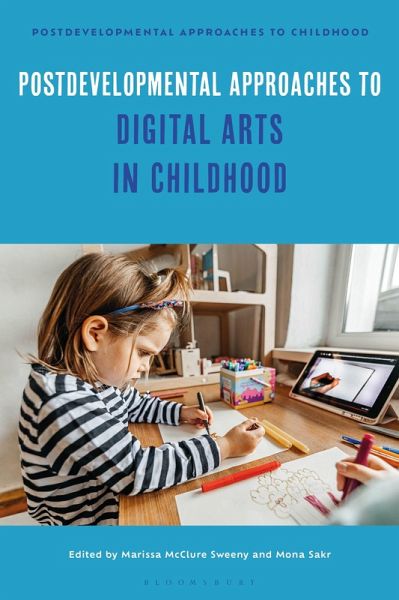
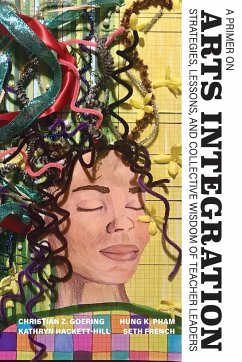
This book deconstructs traditional developmentalist logic around children's engagement with digital media where the focus is on what the digital 'does to' children's bodies and brains. Rather than seeing children as vulnerable and passive recipients, the authors position children as co-creators and digital artists, embracing the richness of children's digital play. The chapters cover a wide range of topics including indigenous digital art, digital drawing, learning to code, social media and artificial intelligence. The authors use a diverse range of theoretical perspectives, including…mehr
This book deconstructs traditional developmentalist logic around children's engagement with digital media where the focus is on what the digital 'does to' children's bodies and brains. Rather than seeing children as vulnerable and passive recipients, the authors position children as co-creators and digital artists, embracing the richness of children's digital play. The chapters cover a wide range of topics including indigenous digital art, digital drawing, learning to code, social media and artificial intelligence. The authors use a diverse range of theoretical perspectives, including posthumanism, feminist new materialism, social semiotics, socialcultural and multimodal approaches to childhood to generate new ways of seeing the relationship between children and the digital. The book includes chapters from academics and practitioners based in Australia, Canada, Sweden, the UK and the USA and a companion website showcasing innovative and interactive material, including visual essays and soundscapes.
Marisssa McClure Sweeny is Professor and Program Director of Early Childhood Education at Carlow University, USA. Mona Sakr is Senior Lecturer in Education and Early Childhood at Middlesex University, UK.
Inhaltsangabe
Introduction Marissa McClure Sweeny (Indiana University of Pennsylvania USA) and Mona Sakr (Middlesex University UK) Part I: Exploring Materials in Childhood Digital Arts 1. Connecting Analogue and Digital Genres? On Uses and Semiotic Potentials of Digital Pencils in a Swedish Middle School Anders Björkvall (Örebro University Sweden) and Fredrik Lindstrand (Konstfack Sweden) 2. Digital Piggybacking: Materialised Figuration Across Roblox With Children Hampered by Adults Victoria de Rijke (Middlesex University UK) and Dylan Yamada-Rice (RCA UK) 3. New Materialist Prosthetic Convergences of Children Clay and Video Heather Kaplan (University of Texas El Paso USA) 4. Youtubing Without an Internet Connection: Young Children Documenting Their Lives Through Public/Private Video. Mona Sakr (Middlesex University UK) 5. Drawing Digital: From Lines of Flight and Legos to Loose-Logics and Lightsabers Christopher Schulte (University of Arkansas USA) Part II: Supporting Environments for Childhood Digital Arts 6. Reframing Learning to Code Tomi Slotte Dufva (Aalto University Finland) 7. Children's Experimental Forays Into Coding With the You/Me/Us: AI Participatory Artwork Linda Knight (RMIT University Australia) 8. Visual and Visualising Aspects of Digital Technology in the Atelier of Preschool Lena O Magnusson (University of Gothenburg Sweden) 9. Intra-active Real-time Collaboration in the Digital Art Classroom Hayon Park (George Mason University USA) Part III: Following Children's Trajectories Through Digital Arts 10. Digital Artmaking in the Time of Tweenhood: Mapping Flows of Affect in Ingrid's Art Laura Trafí-Prats (Manchester Metropolitan University UK) 11. Friday Night Funkin' and Saturday Morning Dunkin' in a Postdigital Playscape Marissa McClure Sweeny (Indiana University of Pennsylvania USA) and Robert W. Sweeny (Indiana University of Pennsylvania USA) 12. Zap Out: Performance Connection and Expertise Thrive in Children's Digital Media Creations Shana Cinquemani (Rhode Island School of Design USA) Part IV: Reconceptualising Childhood Digital Arts 13. Ethnocomputation and Afrofuturism in Theory and Practice Nettrice Gaskins (Lesley Unviersity USA) 14. Indigital Arts: Indigenizing the Digital Space Georgina Badoni (New Mexico State University USA) 15. The Queer Songbook Orchestra Hannah Dyer (Brock University Canada) and Casey Mecija (York University Canada) References Index
Introduction Marissa McClure Sweeny (Indiana University of Pennsylvania USA) and Mona Sakr (Middlesex University UK) Part I: Exploring Materials in Childhood Digital Arts 1. Connecting Analogue and Digital Genres? On Uses and Semiotic Potentials of Digital Pencils in a Swedish Middle School Anders Björkvall (Örebro University Sweden) and Fredrik Lindstrand (Konstfack Sweden) 2. Digital Piggybacking: Materialised Figuration Across Roblox With Children Hampered by Adults Victoria de Rijke (Middlesex University UK) and Dylan Yamada-Rice (RCA UK) 3. New Materialist Prosthetic Convergences of Children Clay and Video Heather Kaplan (University of Texas El Paso USA) 4. Youtubing Without an Internet Connection: Young Children Documenting Their Lives Through Public/Private Video. Mona Sakr (Middlesex University UK) 5. Drawing Digital: From Lines of Flight and Legos to Loose-Logics and Lightsabers Christopher Schulte (University of Arkansas USA) Part II: Supporting Environments for Childhood Digital Arts 6. Reframing Learning to Code Tomi Slotte Dufva (Aalto University Finland) 7. Children's Experimental Forays Into Coding With the You/Me/Us: AI Participatory Artwork Linda Knight (RMIT University Australia) 8. Visual and Visualising Aspects of Digital Technology in the Atelier of Preschool Lena O Magnusson (University of Gothenburg Sweden) 9. Intra-active Real-time Collaboration in the Digital Art Classroom Hayon Park (George Mason University USA) Part III: Following Children's Trajectories Through Digital Arts 10. Digital Artmaking in the Time of Tweenhood: Mapping Flows of Affect in Ingrid's Art Laura Trafí-Prats (Manchester Metropolitan University UK) 11. Friday Night Funkin' and Saturday Morning Dunkin' in a Postdigital Playscape Marissa McClure Sweeny (Indiana University of Pennsylvania USA) and Robert W. Sweeny (Indiana University of Pennsylvania USA) 12. Zap Out: Performance Connection and Expertise Thrive in Children's Digital Media Creations Shana Cinquemani (Rhode Island School of Design USA) Part IV: Reconceptualising Childhood Digital Arts 13. Ethnocomputation and Afrofuturism in Theory and Practice Nettrice Gaskins (Lesley Unviersity USA) 14. Indigital Arts: Indigenizing the Digital Space Georgina Badoni (New Mexico State University USA) 15. The Queer Songbook Orchestra Hannah Dyer (Brock University Canada) and Casey Mecija (York University Canada) References Index
Es gelten unsere Allgemeinen Geschäftsbedingungen: www.buecher.de/agb
Impressum
www.buecher.de ist ein Internetauftritt der buecher.de internetstores GmbH
Geschäftsführung: Monica Sawhney | Roland Kölbl | Günter Hilger
Sitz der Gesellschaft: Batheyer Straße 115 - 117, 58099 Hagen
Postanschrift: Bürgermeister-Wegele-Str. 12, 86167 Augsburg
Amtsgericht Hagen HRB 13257
Steuernummer: 321/5800/1497
USt-IdNr: DE450055826